|
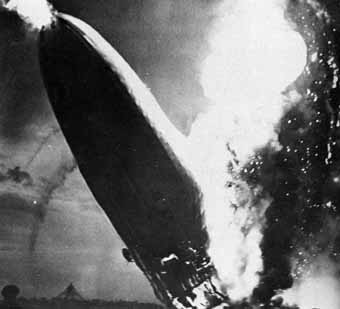
This
print shows the Hindenburg in flames above Lakehurst
Naval Air Station on May 6th, 1937. (The
National Archives)
|
The
Mystery of the Hindenburg Disaster
It was the largest airship ever built; over eight-hundred
feet long from its nose to its massive tail fins. It was the
height of luxury travel and in the course of two seasons carried
over 2,656 people across the Atlantic between Germany to New
York and Rio de Janeiro. It was called the Hindenburg and the
space of 37 seconds this mighty zeppelin was destroyed in a
fire that killed a third of its crew and passengers and left
spectators crying in horror.
What caused this catastrophe? Was it negligence,
sabotage, or as Hitler called it, "An act of God"?
The
Dirigible
The first successful dirigible (a balloon that
has engines to control its horizontal movement) was built in
France in 1852. Although other countries built these types of
airships, the Germans quickly became the most advanced builders
of this form of lighter-than-air technology. Count Ferdinand
von Zeppelin, a German businessman, built a fleet of experimental
dirigibles. The type of airships Zeppelin built were spindle-shaped
with a rigid internal steel structure (unlike the flexible bodied
blimps common today). Inside the craft were large bags filled
with gas that gave the ship its lift, as well as catwalks to
allow the crew to move back and forth inside the hull to service
the airship. Beneath the craft was a gondola which carried the
crew and passengers. By 1911 Zeppelin's airship LZ-10 (also
known as the Schwaben) was in passenger service and would go
onto make 218 flights carrying 1,553 passengers. Zeppelin became
so well-known for this type of dirigible that his name soon
became synonymous with that type of airship.
Starting in 1914, the beginning of WWI, the Count's
zeppelins were used to drop bombs on cities in a number of European
countries. They made over fifty raids on London alone, dropping
nearly 200 tons of explosives. As the war progressed, however,
most of the German's zeppelin fleet was destroyed by British
guns or aircraft. The gas that gave them their lift, hydrogen,
was very flammable, and even a small bomb hitting a zeppelin
could reduce it to ashes in just a few minutes.
|

The
LZ7, one of Count Zeppelin's early ships (also known as
the Deutschland), can be considered the first true
passenger aircraft. It first flew on October 19th, 1910.
|
After the war Germany again began building large
airships. As part of war reparations the Germans built the ZR-3
Los Angeles for the U.S. Navy. In 1928 the Zeppelin Company
built what was the most successful passenger dirigible of all
time, the Graf Zeppelin.
The Graf Zeppelin was a hundred feet longer than
any other airship ever built and stretched 776 feet from nose
to tail fins. It was designed as a passenger liner to compete
with the ocean liners crossing the Atlantic. With a maximum
speed of 80 miles per hour, it cut the time it took to make
the trip by more than two-thirds. The passenger cabin was outfitted
with drapes and thick carpeting. Dinner was made by professional
chefs and was served using silverware, crystal and fine china.
Time magazine declared, "Certainly for trans-oceanic trips,
the airship is the thing."
Constructing
The Hindenburg
The Graf Zeppelin was so successful that the Zeppelin
Company planned a new airship. One that would be bigger, faster
and carry more passengers with more luxurious amenities. It
would be named after a national hero who had been elected Germany's
president in 1925. It would be called the Hindenburg.
The Hindenburg was not only longer than the Graf
Zeppelin, it was an extra 35 feet wide. This meant it had nearly
twice the volume for lifting gas (7,062,000 cubic feet) than
the Graf Zeppelin. There was a reason for this. The Hindenburg's
designers had decided to fill the new dirigible with helium
gas, not hydrogen. Helium, unlike hydrogen, does not burn, making
it safer. However, it doesn't produce as much lift as hydrogen,
so the extra volume the Hindenburg had for gas was an important
feature.
The Hindenburg never got its helium, though. At
that time helium was difficult to produce and the United States
had a monopoly on the manufacture of it. When the Americans
saw that Hitler was in power in Germany, they feared he would
use the gas for military purposes and therefore would not sell
the Germans the helium necessary to fill the Hindenburg. The
Zeppelin Company was forced to redesign the ship for hydrogen
and make changes to minimize the possibility of fire.
|
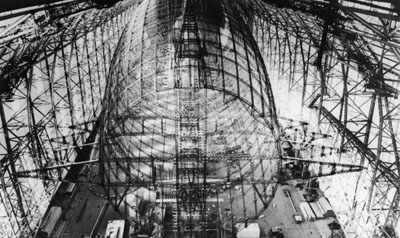
The
frame of the Hindenburg under construction. (Credit:
Bundesarchiv, Bild 146-1986-127-05 / CC-BY-SA)
|
Though it might seem strange to us today, back
then the airship seemed to be the wave of the future in travel.
At that time crossing the Atlantic in an airplane was risky
business. Planes could travel only short distances carrying
a minimum of weight and required constant refueling. To many
the zeppelins was the natural successor to the ocean liner.
The Zeppelin Company planned that the Hindenburg would be the
first of a fleet of airships plying the skies of the world.
Even today the Hindenburg remains the largest
aircraft ever flown. Some of the smaller, modern advertising
blimps have a total length only slightly larger than the girth
of the Hindenburg. If the Hindenburg stood on end it would dwarf
the Washington Monument. It could lift 112 tons beyond its own
weight, an incredible amount for that time. Passengers enjoyed
staterooms with private showers. The dining room served the
finest food on blue and gold porcelain place settings. The ship
provided the passengers a spectacular view along its windowed
200-foot-long promenade deck. One restriction the ship had though
was smoking. Because of the hydrogen, smoking was permitted
only in a special fireproof room.
Final
Flight
A one-way trip across the Atlantic cost $400 and
took only two days. Flights began in 1936 with the airship making
a total of six trips to Rio de Janeiro and ten trips to New
York City carrying a total of 2,656 passengers. In 1937 it made
a trip to Rio then returned to Germany. On May 3rd, 1937, the
Zeppelin departed Frankfurt for North America carrying 97 people.
It would be the first trip to New York City that season.
The trip went smoothly and by 11:40 A.M. on May
6th the airship was passing over Boston. Landing at the Naval
Air Station in Lakehurst was delayed due to bad weather, so
the ship's captain, Commander Max Pruss, decided to linger over
New York City, giving his passengers spectacular views of the
Empire State Building, the Bronx, Harlem, Central Park, the
Battery, Times Square, the Statue of Liberty and Ebbets Field
(where a game was being played between the Dodgers and the Pittsburgh
Pirates).
At 4 P.M. the Hindenburg arrived over Lakehurst,
but the weather was still worrisome. Commander Pruss decided
to take the ship southeast until he hit shore, then north to
Asbury Park, then finally inland back to Lakehurst. At 6:12
Charles E. Rosendahl, Commanding Officer of the Lakehurst N.A.S.,
sent a message to the Hindenburg: "Conditions now considered
suitable for landing." Eleven minutes later a stronger message
followed: "Recommend landing now."
|
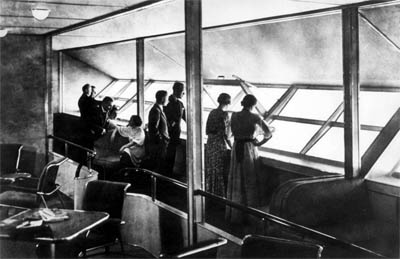
The
lounge of the Hindenburg allowed the passengers to watch
the view below.
|
The
Landing
It was almost a half hour later, at 7:00 P.M.,
that the Hindenburg started its landing. It circled the base,
dropping its altitude from 600 to 300 feet and aligned itself
so it was headed into the wind. As it approached the mooring
mast, Captain Pruss realized he was going a little too fast.
Also the wind was changing direction. Given that he was already
late, he decided not to do a complete go around, but slow the
ship and change his approach by making a sharp "S" turn, first
left, then right.
To further complicate things for the captain,
the airship was losing trim. The tail section was dropping.
This was not particularly odd as it had been raining the water
tended to cling more to the rear of the ship than the front,
making it heavier. Puss ordered some ballast dropped and six
crewmen were sent scurrying to the bow of the dirigible to balance
it. The turn worked and the zeppelin's nose finally faced the
mooring mast where it would be secured. As the Hindenburg got
within 700 feet of the mast, the engines were reversed, bringing
the ship to a stop. Ropes were dropped to allow the ground crew
to tow the ship into position. At this point the Zeppelin was
hanging about 275 off the ground. It was 7:25 P.M..
On the ground a radio reporter named Herbert Morrison
was covering the airship's arrival and his comments were recorded
for prosperity:
...It's practically standing still now. They've
dropped ropes out of the nose of the ship, and it's been taken
a hold of down on the field by a number of men. It's starting
to rain again; the rain had slacked up a little bit. The back
motors of the ship are just holding it, just enough to keep
it from --"
"It burst into flames! ... It's fire and it's
crashing! It's crashing terrible! Oh, my! Get out of the way,
please! It's burning, bursting into flames and is falling on
the mooring mast, and all the folks agree that this is terrible.
This is the worst of the worst catastrophes in the world! ...There's
smoke, and there's flames, now, and the frame is crashing to
the ground, not quite to the mooring mast...Oh, the humanity,
and all the passengers screaming around here!
The flames were first visible towards the tail
of the ship, then within seconds the hydrogen in the gas bags
caught on and the whole aft of the craft was engulfed in a mass
of flame and smoke that towered hundreds of feet into the sky.
As the hydrogen in the rear of the ship burned, the rear of
the Hindenburg lost its lift and fell to the ground and its
nose pointed upwards at a forty-five degree angle. Then as the
flames raced through to the bow, it also fell. In just 37 seconds
since the first flames were spotted the ship lay on the ground,
the skeleton of its framework the only thing visible through
the fire. Passengers jumped from windows and ran for safety.
One cabin boy had his life saved when a water tank burst above
his head. Of the 97 people on board, miraculously 62 managed
to escape with their lives, including the ship's captain.
An investigation into the cause of the disaster
was made both by the United States and the German governments.
They concluded a hydrogen leak was ignited by a spark of static
electricity. Both governments wanted to close the book on the
disaster. The Americans were anxious to avoid an international
incident and the Germans were embarrassed that the cause might
have been a design flaw in the ship or the result of foul play.
The
Gas Leak Theory
Some theories suggest that Commander Pruss's final
turns to land were too sharp and they caused a support wire
to snap inside the ship tearing open one of the hydrogen gas
cells. The leaking gas then might have been set off by a rare,
natural electrical phenomenon known was St. Elmo's fire. St.
Elmo's fire is usually seen as a static electric charge around
high objects (like church steeples) during stormy weather. Given
the weather on that day, it is very likely that the ship was
carrying a static electric charge. Just before the fire broke
out, witnesses saw a fluttering movement of the ship's skin
near the rear of the vessel. Some people argue this was caused
by escaping gas. Other witnesses noticed a blue glow around
the rear of the vessel that might have been St. Elmo's fire.
If the gas escaped out a ventilation shaft and met the static
electric discharge, it might well have triggered the fire.
The
Lightning Theory
Instead of st. Elmo's Fire, lightning is sometimes
blamed as the cause of the fire. However, the Hindenburg had
been struck several times before by lightning with no damage.
If lightning was the cause of the disaster, it seems it must
have been coupled with a gas leak, as with the above theory.
However, no witnesses saw lightning strike the ship and there
were no known thunderstorms in the immediate area.
Diesel
Theory
This theory suggests that the diesel fuel used
to power the engines may have started the fire. A leak from
a malfunctioning fuel pump might have ignited if the fuel reached
a hot surface like the engine block. The pods where the engines
were housed, however, were not by all accounts the location
where the fire started.
Initially engineers suspected that sparks from
a backfiring engine might have ignited hydrogen from a leak,
but tests showed that these type of sparks were not actually
hot enough to have set the gas on fire.
The
Flammable Skin Theory
A theory suggested by Addison Bain, former manager
of NASA's hydrogen program, was that the initial fire was not
caused by burning hydrogen. Hydrogen burns without much of a
visible flame, but witnesses described the fire as extremely
colorful. Bain thinks the doping solution used to stretch and
waterproof the hull was responsible. The compound, a layer of
iron oxide covered with coats of cellulose butyrate acetate
mixed with powdered aluminum, is very similar to a mixture used
to power solid fuel rockets. "The Hindenburg was literally painted
with rocket fuel," says Bain.
Bain suspects that the Germans figured out the
real cause, though they didn't want to admit they'd made such
a dangerous mistake. The doping solution used on the Graf Zeppelin
II, completed after the Hindenburg disaster, was changed to
include a fireproofing agent and the aluminum was replaced with
bronze which is less combustible.
Bain thinks the fire was started by a build-up
of static charge from the storm on the craft's surface and frame.
When the mooring ropes (wet from the storm) were dropped to
the ground, the frame discharged, creating an electrical differential
between the frame and covering which started the fire.
|

The
remains of the Hindenburg on the ground just minutes after
the first flames appeared.
|
Tests have been run with remains of the covering,
however, that show that although it is flammable , it doesn't
burn with the speed needed to explain the rapid expansion of
the fire through the whole ship. If the fire did start with
the skin, it seems it must have ignited the hydrogen cells almost
immediately.
The
Sabotage Theory
Some of the crew that survived, including Commander
Pruss, suspected the fire was sabotage. The Hindenburg was more
than just a German airship. It was a symbol of German power
and technical prowess. Hitler's government, which had helped
pay for the Hindenburg's construction, had employed it for such
jobs as making propaganda appearances over the 1936 Olympic
Games in Berlin. Each of the huge tail fins of the Hindenburg
wore the swastika emblem, the symbol of Hitler's Nazi party.
Officials had been concerned even before the ship reached New
York that someone opposing Hitler might make a terrorist attack
upon the craft.
If a saboteur was at work, it must have been one
of the crew or passengers. If so, that person may have placed
a time bomb along one of the ship's internal catwalks. Most
likely it detonated prematurely, or the saboteur did not count
on the craft being so late at arriving and could not return
to the bomb to reset the timing mechanism. Either way the saboteur
may have died in the resulting explosion. A bomb placed near
the rear of the craft might have explained the initial flare
forward of the tail fin as reported by witnesses as flames from
the explosion shot up the gas ventilation shaft to burst out
the top of its hood. The initial explosion would have ruptured
the hydrogen gas cells, causing a more powerful second explosion
that destroyed the craft.
Suspicion for the sabotage initially fell upon
Joseph Spah, a passenger who survived. On several occasions
Spah, a New Jersey resident, had gone unescorted into the cargo
area of the ship to visit his dog that he was bringing home
to his children. This might have given him the opportunity to
place a bomb. Later, others suspected that Erich Spehl, an introverted
crewman who perished in the fire, might have been the saboteur.
Spehl was thought to have had anti-Nazi leanings.
|

The
Hindenburg was nearly the size of the Titanic.
|
There is no proof against either of these gentlemen
and in a search of the wreckage no parts of a bomb were found.
Any time bomb would require a timer mechanism which probably
would have survived the explosion.
End
of An Era
Today, the official results of the investigation
that static electricity set off leaking hydrogen still stand,
despite the various theories. One thing is for sure, though,
the destruction of the Hindenburg signaled the end of the great
zeppelin passenger liners. No zeppelin ever carried another
passenger after the Hindenburg disaster. The Graf Zeppelin II
which was to be the Hindenburg's sister ship, never entered
passenger service. At the start of W.W.II, it was brought into
military service for a short time, then dismantled and the parts
used for the war effort.
By the end of the war the jet engine had been
invented and transatlantic passenger service soon was carried
out with a reliability and speed that could not be matched by
lighter-than-aircraft. Memories of the horror of the Hindenburg
disaster lingered on, killing any future for the large, rigid,
passenger airships. The zeppelin, once thought to be the wave
of the future, was suddenly a thing of the past.

Copyright 2001-2013Lee
Krystek. All Rights Reserved.