In the News:
 Watchdog Says that Ministry withheld UFO Report - Ann Abraham, a British
government parliamentary watchdog, ruled that the British Ministry of
Defense "withheld three documents relating to reported sightings of unexplained
aerial phenomena in 1980 -- the Rendlesham Forest UFO incident." A ministry
spokesperson countered saying that the files were not deliberately withheld
and were available to anyone who asked.
Watchdog Says that Ministry withheld UFO Report - Ann Abraham, a British
government parliamentary watchdog, ruled that the British Ministry of
Defense "withheld three documents relating to reported sightings of unexplained
aerial phenomena in 1980 -- the Rendlesham Forest UFO incident." A ministry
spokesperson countered saying that the files were not deliberately withheld
and were available to anyone who asked.
The incident occurred in late December 1980 when U.S. military officers investigating what they thought might be a crashed plane saw a triangular "strange glowing object" in the woods near their base. According to recently released reports about the incident "the object was described as being metallic in appearance and triangular in shape, approximately two to three meters (seven to 10 feet) across the base and approximately two meters (seven feet) high." Skeptics think the witnesses were actually seeing the light from a nearby lighthouse, but the report adds that the next day three depressions seven feet in diameter were found in the grass and that readings of beta and gamma radiation at the location were 10 times higher than normal.
African
Stonehenge? - A South African scientist thinks he has found an ancient
observatory in Zimbabwe which was similar in function to England's Stonehenge.
The Great Enclosure at the archaeological site of Great Zimbabwe was thought
to be a palace when it was in use 800 years ago, but Richard Wade of the
Nkwe Ridge Observatory thinks the ring of crumbling stone was used to
track the moon, sun, planets and stars. Several of the stone monoliths,
according to Wade, line up with certain bright stars in the constellation
Orion as they rise on the morning of the winter solstice. Wade also suggests
that a mysterious tower at the site was probably built to observe a supernova
that occurred around 1300 AD. Wade has written his ideas into a paper
which has been submitted to the journals Science and Scientific
American.
"Ski
Trails" Found on Mars - Scientists are wondering what created
250 mile long "ski" trails that are visible near the South Pole
of Mars. The images derived by the Mars Orbiting Laser Altimeter on the
Mars Global Surveyor spacecraft show broad, sweeping lines cutting through
a region of the southern ice cap of the fourth planet. "There shouldn't
be anything but meteorites up there," said Zane Crawford, a graduate student
at the University of Colorado who presented the observations to a meeting
of the American Geophysical Union in San Francisco. The tracks are not
on steep terrain which makes it unlikely they could have been caused by
Martians on a ski trip. Scientists have speculated that the trails may
be somehow related to the prevailing winds, but the exact cause of the
features may not be known until an astronaut/geologist takes field trip
to the region and digs a trench to study the underlying sediments.
Bigfoot
Hoaxer Dead - Ray L. Wallace, whose family claims he was responsible
for hoaxes that started the legend of "Bigfoot," died at age
84 last month. According to friends and family Wallace used 16-inch feet-shaped
wood carvings to create tracks near a Humboldt County, California, construction
site in 1958. A bulldozer operator found them and The Humboldt Times
coined the term "Bigfoot" for the creature that made them in a front-page
story about the incident. Wallace was also involved in perhaps what is
considered that best proof that "Bigfoot" exists: The Patterson
Film. In 1967 Roger Patterson filmed an ape-like creature walking away
from him near Bluff Creek, California. Wallace said he told Patterson
where to try and find the animal and skeptics suspect he may have had
someone in an ape suit waiting there for Patterson to film.
Study
Says Mummy Curse is Bunk - A medicine scholar at Monash University
in Melbourne, Australia, has completed a study which purportedly shows
that the curse of King Tut never really existed. Mark Nelson selected
44 Westerners in Egypt at the time the tomb was discovered for inclusion
in the study. Twenty-five of the group were potentially exposed to the
curse either because they were at the breaking of the sacred seals in
the tomb on February 17, 1923, or at the opening of the sarcophagus on
February 3, 1926, or at the opening of the coffins on October 10, 1926
or the examination of the mummy on November 11, 1926. The study, which
was published in the December issue of the British Medical Journal
showed that exposure had no effect on the length of survival.
Newspapers in the decades following the opening of the tomb speculated that the deaths of some of those connected with the discovery, most importantly Lord Carnarvon who financed the expedition and died shortly after the find, were caused by a mysterious curse put on the tomb to protect the King's mummy.
What's New at the Museum:
What
Happened to the "Lost" Ark? - It's perhaps the most famous
relic in history: The ancient Israelite's Ark of the Covenant. What was
it and where did it go to? - What Happened to
the "Lost" Ark?
Ask the Curator:
World
Biggest Web - What was the worlds biggest single spider web and
how big was the spider?
I couldn't find any records for the largest single example of a spider web, but I can tell you that the golden silk spider, Nephila, which lives in along the Gulf Coast of Alabama and northern Florida commonly builds webs as wide as the doors on a garage. The female of the species, which is larger than the male, can be three inches across if its legs are stretched out.
A cousin of the golden silk spider, the golden orb spider, which lives in tropical areas from Africa to Northern Australia and the South Pacific islands, has been known to build webs that are eighteen feet high and over six feet wide. This spider's silk is pound for pound is stronger than steel. South Sea Islanders have been known to trick the spiders into building them fishing nets by creating a circle of bamboo and leaving it in the forest. By morning a spider will often have build a web across it and then it can be used for catching fish. The females of the Golden Orb can have a leg span of eight inches with a body length of two and a half inches.
You might think that the world's largest spiders would build the biggest webs, but they don't. The largest spiders are the tarantulas of the South American rain forests. Some of these can have a leg span of 10 inches, a body length of 4 inches and weight of over 4 ounces.
Spores
in Tombs - I would like to know more about the microorganisms
that were found in the ancient Egyptian pyramids. Were all the microorganisms
found Pathogenic and how did they survive the harsh conditions inside
the pyramids.
As far as I'm aware the question of microorganisms in ancient Egyptian pyramids has not been widely explored. However, several scientists have looked into the possibility of a biological agent being preserved in the rock tombs like that of King Tut or on objects that have come out of a tomb. One of the first people to look at this was Dr. Ezzeddin Taha, of Cairo University. Dr. Taha studied the health records of museum workers and archaeologists and determined that many had been infected with the fungus Aspergillus niger which can cause fever, fatigue, inflammation and rashes. He speculated that they had picked up the fungus by entering tombs or handling objects that had come out of tombs.
In 1993 Dr. Nicoloa Di Paolo found the toxic fungus Aspergillus ochraceus at some Egyptian archaeological sites. It can damage the kidneys and liver, but it is unknown if it is fatal.
In 1999 the German microbiologist Gotthard Kramer found Aspergillus flavus on some mummies. Infection with this agent can lead to organ failure and death and is particularly dangerous to someone with a weakened immune system.
In all these cases the organism would survive in the tomb as a spore. Spores have a hardened outside shell that allow the organisms to survive for long periods under very harsh conditions (high or low temperature and without water). Scientists even speculate that spores may allow life to be transferred through outer space riding on meteorites.
Underwater
Lights - On an evening in January of 1880 the crew of the steamship
Shahihehan, which was cruising in the Indian Ocean, saw a strange
sight: Illumination in the water that looked like spokes rotating on a
giant wheel. The Captain was so surprised by what he saw he stopped his
ship to observe it.
This phenomenon has been observed many times since, especially in the Indian Ocean. Most observers agree that the glow comes from tiny bioluminescent organisms in the water, but what causes these creatures to release their light in such an organized pattern is unknown.
In the Sky:
Dog
Star - Thursday, January 30, is a good day to spot the star Sirius
which is nicknamed "The Dog Star" because of it's location in
the constellation Canis Major, the Great Dog. Look for it in the
southeast an hour after sunset. Sirius will be the brightest star in the
sky, but don't mix it up with the planet Jupiter which rises at about
the same time, but is a magnitude brighter and located in the east-northeast.
Observed:
It's
Raining Fish - Tiny fish rained down on the village of Korona in northern
Greece last month. Villagers found the fish on the banks of Lake Doirani,
which lies on border with Macedonia. According to a weather expert at
the University of Salonica, in northern Greece, the fish were probably
picked up off the lake by a mini-tornado that appeared in conjunction
with a thunderstorm.
On the Tube:
Currently we are only able to give accurate times and dates for these programs in the United States. Check local listings in other locations.
NOVA:
Ancient Creature of the Deep - Meet the coelacanth, a bizarre fish
and "living fossil" that has changed little in its 400 million years on
Earth.. On PBS: Jan 21 at 8:00 PM; ET.
Sasquatch: Legend Meets Science - The legend of a North American Ape
species known as Sasquatch, Bigfoot and Yeti has been around since recorded
time. Even today, sighting and physical evidence is gathered on a regular
basis. Is this creature fact or fiction? On the Discovery Channel: Jan
09 9:00 PM; Jan 10 12:00 AM; Jan 11 3:00 PM; ET.
Nostradamus: A Skeptical Inquiry - Experts use forensic techniques
to translate and verify what Nostradamus "really" predicted. Fact is separated
from fiction as it relates to the terrorist attacks on September 11, 2001.
On the Discovery Channel: Jan 09 10:00 PM; Jan 10 1:00 AM; Jan 11 4:00
PM; ET.
Building the Impossible: The Seven Wonders of the Ancient World - Learn
the historical background of each of the Seven Wonders of the World using
information from ancient sources, modern investigations of the remains
and computer animation. Uncover the mysteries of the cities and civilizations
to which they belonged. On the Discovery Channel: Jan 27 9:00 PM; Jan
28 12:00 AM; Feb 01 5:00 PM; ET.
Archaeological Mysteries - Take a journey far back in time to explore
some of the world's greatest archaeological mysteries including remnants
of a floating stone city in Micronesia, sandstone dwellings in canyon
cliffs in New Mexico and huge patterned lines in the Nazca desert. On
the TCL: Jan 30 10:00 PM; Jan 31 1:00 AM; ET.
Mysteries
of Stonehenge - Experts believe that Stonehenge took half a millennium
to bring to completion. It required the ingenuity to transport the heavy
stones over land and sea for hundreds of miles without our modern tools
and equipment. Explore how and why it was constructed. On the TCL: Jan
30 9:00 PM; Jan 31 12:00 AM; ET.
Trail
of the Vikings - Journey to English soil and find the date of the
last Viking army to set down foot, and then follow their greatest voyage
to America. Learn about their culture and adventures. On the TCL: Jan
14 10:00 PM; Jan 15 1:00 AM; Jan 16 10:00 PM; Jan 17 1:00 AM; Jan 19 7:00
PM; ET.
Secrets
of the Ancient World: The Enduring Mystery of Stonehenge - For 5,000
years, the sacred site of Stonehenge has stood on the plain of Salisbury,
England, silent witness to a myriad of mysteries. Who built the prehistoric
stone circle? Druids? Merlin the Magician? Was it an altar for human sacrifice,
or landing pad for UFOs? Experts, anthropologists, and astronomers assess
the mystery. On the The History Channel: Jan 09 8:00 PM; Jan 10 12:00
AM; January 12 7:00 PM; ET.
History
Undercover The Nazi Plan to Bomb New York - Aviation historian David
Myhra has been investigating secret German aircraft projects for more
than 20 years, and has uncovered evidence of a diabolical Nazi plan to
deliver a radioactive bomb to New York. In late 1944, the "Amerika Bomber"
project was planned, and three aerospace designers--Wernher von Braun,
Eugen Sanger, and Reimar Horton--each had a different solution. On the
The History Channel: Jan 21 8:00 PM; Jan22 12:00 AM; ET.
LGM:
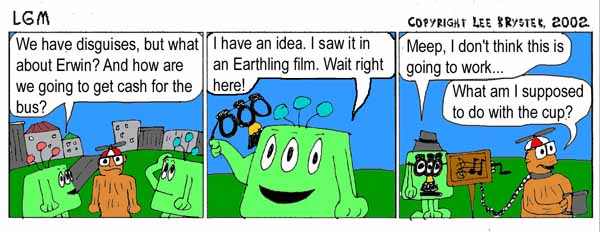
Science over the Edge Archives
LGM Archive 1998, 1999, 2000, 2001, 2002, 2003.

Copyright Lee Krystek 2003. All Rights Reserved.