pop up description layer
HOME
Cryptozoology UFO Mysteries Aviation Space & Time Dinosaurs Geology Archaeology Exploration 7 Wonders Surprising Science Troubled History Library Laboratory Attic Theater Store Index/Site Map Cyclorama
Search the Site:
|



|
See where to send your question at the bottom of the page
Yet Some More Yeti Questions - For some reason we had a horde of questions on the Yeti (also known as the Abominable Snowman of the Himalayas) this month from different people, so I'm just going to go through them one by one: Is there any evidence that the yeti exists? If so, what is it? It depends on what you call evidence. There have been any number of cases were people claimed they saw a Yeti or found foot prints. Were they telling the truth? If they were telling the truth, did they think they saw a Yeti, but really saw some other creature and mistook it for a Yeti? In the case of footprints, were they fake? Or were they footprints of some other animal that had been misshapen by the melting effect of the sun? You see the problems with "evidence." The only really uncontestable evidence would be a dead, or even better, a live Yeti that could be examined by experts. A hair sample might do if it could be used to establish, by checking the DNA, that the creature was not one known to science and a member of the primate family. Hair samples that were supposed to belong to the Yeti have been analyzed for DNA in the past. They are usually were identified as belonging to either wild goats or bears. Are the Yeti and Bigfoot related? Since we can't prove the existence of the either the Bigfoot or the Yeti it is really hard to say if they are related. People who believe in the existence of these creatures seem to think they are primates (the same family of animals as gorillas, chimps and humans). If they are right, then they would be related. If anybody ever finds DNA from these creatures, it could be used to determine if they were not just related, but actually the same species. Have there been any attacks on humans? There is a report of a Sherpa girl who was tending her yaks and said she was surprised by a large ape-like creature with black and brown hair. It started to drag her off, but seemed to be startled by her screams and let her go. It then savagely killed two of her yaks. She escaped with her life and the incident was reported to the police, who found footprints. When was the yeti first seen? Reports of such creatures go back centuries and are part of the legends of the local peoples. The first Westerner to see a Yeti was probably the Greek photographer, N. A. Tombazi. During an expedition in 1925 he was shown a creature moving across the snow in the distance and told it was a Yeti. Do you think a polar bear on its hind legs can be mistaken for a Yeti? As polar bears do not live in the Himalaya Mountains, the supposed range of the Yeti, it seems unlikely. However, a number of people think either the rareTibetan blue bear or the endangered Himalayan Brown Bear may sometimes be misidentified as Yetis. According to mountaineer Reinhold Messner he had an encounter with a Yeti that turned out to be a Himalayan Brown Bear that was upright on his rear legs.
The Mythic Snake - What is a "nãga"? - Jacob There are several meanings to the word, but the one I think you are interested in comes from Asian cultures. There "nãga" refers to a snake, usually a hooded one, like a cobra. Attached to the name is not only living snakes, however, but a large number of stories from the Hindu and Buddhist traditions about mythical snakes. In these traditions the nãga is often pictured as a huge snake with both serpent and human traits. Often the nãga can shape-shift from one form to another and are many times depicted in drawings with a human upper half and a snake lower half (much like the traditional image of a mermaid with a human upper half and a fish tail). Unlike the snakes in many western myths which almost always given evil roles, the n?ga of the east is more often pictured as good or at least neutral. They are associated with water and often seen as guardians of springs, wells and rivers. They can also bring rain (which is extremely important as this grows crops to feed people). Their control over water, however, also has negative aspects and the nãga can bring drought and floods if provoked by human disrespect for the environment. Sometimes they are also the guardians of treasure. The Chinese version of the dragon is in many ways a type of nãga. Both have long sinuous bodies and are associated with water and treasure. In Cambodia along the Mekong River on certain days mysterious red fireballs appear from the river and rise rapidly into the nighttime sky. The number of fireballs varies, sometimes there are only a few dozen and on other occasions a few thousand. According to local tradition these fireballs are caused by the nãga under the river shooting off fireworks to celebrate the end of the rainy period in October. The spectacle has been greatly promoted by the government in recent years and many towns hold festivals. There is no good scientific explanation for this phenomenon as yet, though some people think it might be related to gases rising from the water. A 2002 television program argued that the fireballs were tracers from gunshots on the other side of the river, but this was met with furious protests from local villagers who prefer the Nãga explanation. Nãgas appear in the great Sanskrit epic Mahabharata from India, were they take a more negative role. In the story the sage Kasyapa has two wives, Kadru and Vinata. Kadru's children are the nãga, while Vinata's children are the sun god and the bird, or eagle, god, Garuda. Garuda becomes the sworn enemy of the nãga and devours them for food. Often an amulet of Garuda is worn by people to guard against snake bites. Pictures of nãga are often carved into temples or as a part of other statuary. In addition to the half-human form they are often shown as snakes with multiple heads. Often the heads will form a fan-shape over a person or object as a sign of protection. In modern popular culture the nãga occasionally pop up in some form in books or games. The pet snake of Voldemort, from the Harry Potter series of books, is named Nagini which is the female version of nãga. Also in the World of Warcraft game there is a race of aquatic snake-people called Naga. The Biggest Bomb - Is there anything more powerful than an H-bomb? What would the effects of an H-bomb be on a metropolitan area such as New York? - Jacobn The largest H-Bomb ever detonated in history was the Tsar Bomba tested by the Soviet Union on October 30, 1961. It exploded with a force equivalent to 50 megatons of TNT. In theory the bomb's design could have yielded as much as 100 megatons, but was scaled down to limit the fallout. Even as it was the detonation was so powerful that the pilot of the plane that dropped the bomb received a fatal dose of radiation despite being 28 miles away. Though such power is impressive, a bomb that large is not really a useful military weapon. Because of its size it required a special aircraft to deliver it and it could not be put on top of inter-continental ballistic missile (ICBM). From a military point of view it made more sense to build many smaller nuclear weapons (perhaps 1 megaton or less). If deployed over a large area they could be much more effective than the one big Tsar Bomba.
The flash would be followed by a shock wave traveling outward at the speed of sound. This would level all buildings, including skyscrapers, within a distance of a little more than a mile. This would be an area the width of the island and from Central Park down to about Greenwich Village. Wooden buildings would be demolished over most of the island. Between the flash, blast wave and following firestorm it is estimated that everybody within a mile and a half of the Empire State Building would be killed. On the rest of Manhattan and much of the surrounding area within about 5 miles of ground zero the casualty rate would be around 50 percent. Interestingly enough the fallout from an air detonation would be a much smaller factor that the heat and the blast as much of the radioactive dust would decay before falling to the ground. (Note that a bomb produced by terrorists would not nearly be as powerful, but might have a greater fallout as it would be exploded close to the ground). So is there a weapon more powerful than an H-Bomb? In theory an anti-matter bomb would be enormously more potent. While an H-Bomb converts matter to energy with an efficiency of less than one percent, anti-matter coming in contact with matter would turn into energy with 100 percent efficiency. However, anti-matter isn't easy to obtain. In Dan Brown's bestselling book Angels & Demons he suggests anti-matter is stolen from CERN, the European Nuclear Research Center, to create a bomb. However, if all the anti-matter produced by CERN in the last 30 years was preserved and brought together it would only amount to about to 10 billionths of a gram and would have the power of a kitchen match. There are other agencies with plans to produce anti-matter in larger volumes (like NASA - it would make a great fuel for a spaceship since it is a lot of potential energy in a small package) but the cost of using it to make a bomb would still be far more than building a regular nuclear bomb of the same power. Also for military purposes it is important to have a weapon that can be handled safely and only goes off when you want it too. Since anti-matter will explode whenever it contacts matter, storing it is difficult and should the storage mechanism ever break down a large explosion would result. Even so, the Air Force has expressed some interest in anti-matter, not in order to build an anti-matter bomb itself, but to use anti-matter as a trigger for a regular nuclear bomb.
A Burning Question - Why can aluminum dust burn but a block of aluminum will not? - John It does seem strange that if I put a match to a small pile of aluminum powder I can get an energetic fire, (in fact powdered aluminum is used in rocket fuel and fireworks) but if that same aluminum is in the form of a block I can hold a match to it all day without anything much happening. Why? Then again, perhaps it's not quite as strange as we might think. Anybody who has ever attempted to light a camp fire knows that despite wood being very burnable, it is almost impossible to take a large branch, stick a match to it, and get it to burn. However if you take your knife out and carve tiny pieces off the branch until you have a little pile of shavings, you can put a match to it and it will start burning without any problem. The reason in both the case of aluminum and the wood is that a fire needs three things to burn: Heat, Fuel and Oxygen. Our match provides the heat and the wood or aluminum is the fuel. The missing ingredient is an adequate amount of oxygen. Of course air is about 20% oxygen. The problem is that the oxygen can only participate in the burning if enough of it can get close enough to the fuel to react with it. It needs a large surface area, in comparison to the volume, to make that contact. Let's look at an example. A cube of aluminum one inch square has a volume of 1 cubic inch. (1x1x1). The surface area follows the formula of 6L^2 where L is the length of any one side. So the surface area of the one inch cube is 6 square inches. Suppose we break up our cube into smaller cubes each with the sides a tenth of an inch long. This gives us 10x10x10 = 1000 cubes which still have the same volume of the original cube (1 cubic inch). Each of the smaller cubes would have a surface area of 0.06 inches. If we take this figure a multiple it by the number of small cubes we have we get 60 square inches. So if the aluminum cube is in one piece it has a surface area of just 6 square inches. If we break it up into a 1000 pieces, the surface area jumps to 60 square inches, though the volume has not changed one bit. The more surface area that is available, the better contact the aluminum has with oxygen in the air and the better it will burn. Since the particles in powdered aluminum are much smaller than one tenth of an inch the surface area of one cubic inch of the stuff is enormous compared to the original solid cube and it burns extremely well. And, of course, the same thing is true of wood. Take a one inch square block of wood and it is very difficult to get it to burn with a match. Take that same block and turn it into sawdust and it can be lit with a match quite readily. Take that same saw dust, put it into the air as a cloud, so that all sides of particles have the maximum amount of contact with the oxygen in the air and it will actually explode. Every once in a while you hear about a grain silo exploding. Grain by itself will burn well, but is not explosive. When the grain is poured into a silo, and a cloud of grain dust fills the air then even a small spark can trigger a massive explosion. So the lesson here is that the smaller the size of the particles, the more readily anything, aluminum, wood or even coffee creamer, burns. Check out what happened when Mythbusters took some powered creamer, blew it up into the air to make a cloud, then lit it. Ariel's Family - Please, can you tell me more about mermaids? I've become fascinated with them, especially about sightings of mermaids. Thanks! -Mermaid lover Stories of creatures with a top half that looks like a woman and the bottom half the looks like a fish, go back for thousands of years. Perhaps they first appear around 1000 BC when the Assyrian goddess Atargatis, upset after a love affair gone bad, changes herself into a fish/woman and takes up residence in a local lake. Later stories include the Greek legend of Thessalonike, sister of Alexander the Great, who was turned into a mermaid when she died. Whenever she met a ship she would ask, "Is King Alexander alive?" A sailor with any sense of personal safety knew the right answer was "He lives and reigns and conquers the world" because any other reply would send the mermaid into an rage provoking a storm that would threaten the ship.
Mermaids were often portrayed as extremely beautiful, but troublesome beings. They would often use their female charms, particularly their voices, to lure sailors off a safe course and onto a rocky reef. A mermaid might also try to tempt a sailor to lean over the side of his ship were she could grab him, pull him underwater and drown him. In one tale a Scottish Lord hears a woman in the lake. He runs to her rescue, but is stopped by a servant who warns she is a mermaid. The mermaid then declares to the nobleman that she would have seized him and drowned him if the servant had not intervened. Even when they didn't go out of their way to cause problems, mermaids were still considered worrying and just seeing one was a bad omen. Observing a mermaid might be a warning that a bad storm was on the way. Still, in some mermaid tales the creatures turn out to be good. Probably the most famous mermaid story is Hans Christian Andersen's 1836 work The Little Mermaid which is responsible for much of the modern lure surrounding the creatures. In the story a pretty, young mermaid spies a human prince aboard a ship, rescues him when he nearly drowns and gives up her life in the sea to become human in an attempt to gain his love. This story was interpreted into an extremely successful film by Disney in 1989. The word itself comes from the old English word for sea, mere, and woman, maid. There is an equivalent term for a male creature, merman. The mermen of legend, however, are said to have little interest in humans and are quite ugly. Through the years there have been many reports of the sighting of mermaids. In 1614, English explorer John Smith wrote that he saw a mermaid in the Caribbean. "Her long green hair imparted to her an original character by no means unattractive." He also said he'd "begun to experience the first effects of love," before the creature dove and revealed the fishy parts of her anatomy. Columbus also reported seeing mermaids off the Dominican Republic in 1493. He was less impressed than Smith writing that he saw some "female forms" that "rose high out of the sea, but were not as beautiful as they are represented." In 1610 Capt. Richard Whitbourne also claimed he saw a mermaid in Newfoundland's St. James harbor. What were these sailors seeing? One theory has it that they may have observed some kind of aquatic animal. One possibility in warmer climates would be the manatee (sometimes referred to as a "Sea Cow"). These creatures live along the coast and in rivers in the equatorial regions like Florida, South America and West Africa. They measure up to twelve feet long, weight up to 3,000 pounds and dine on aquatic plants. They are air breathing mammals adapted to the water and move about using flippers and a large tail fin. Most people would think it would take a very lonely sailor to mistake one of these creatures for a beautiful woman, but manatee expert James Powell, a biologist with the Wildlife Trust in St. Petersburg, has observed "there have been times when they come up out of the water and the light has been such that they did look like the head of a person." To someone who had been indoctrinated with tales of mermaids, at a distance the mistake might not be that hard to make. "If you were expecting to see a mermaid," he notes, "you'd see this back and tail come up with no dorsal fin" just like in the stories. The fact that people now recognize mermaids as fully fictional creatures may explain why they are rarely reported these days. People today expect to see manatees, not the alluring half women/half fish people that lonely sailors longed for in the past. Still, an occasional report does surface. The Israeli town of Kiryat Yam had several reports of a mermaid along its beach in 2009 and posted a one million dollar reward for to the first person to photograph the creature. One witness, Shlomo Cohen, said, "I was with friends when suddenly we saw a woman laying on the sand in a weird way. At first I thought she was just another sunbather, but when we approached she jumped into the water and disappeared. We were all in shock because we saw she had a tail."
The Cruelest Pirate of Them All - I've recently became interested in piracy. Can you tell me who the cruelest pirate was? - Anonymous. Before we try an answer who was the cruelest pirate, maybe we should explore why pirates seem to be associated with being barbarous at all. Yes, they were "bad guys" clearly breaking the laws of their time, but did they needlessly inflict pain and suffering? Were they really any crueler than the "good guys?" The truth is that many seamen became pirates often to escape the difficult conditions on other ships. The British Navy was perhaps one of the fiercest opponents of the pirates during the Golden Age of Piracy (1500AD to 1750AD) and life on a British Naval ship was no picnic. The captain had absolute power on the vessel and could have his men whipped and beaten at his whim. Most regular sailors in the British Navy got only half as much as was paid for seamen on a merchant ship. Of the money they did get, much of was taken away in deductions to pay for the ship's chaplain and/or doctor. Oh, and by the way, the Navy withheld your pay for six months to keep you from deserting the ship. With pay so low and bad conditions you might wonder why anybody would want to join the British Navy at all. Well, many people didn't. To fill out their ranks ships would send ashore a "press gang" that would, capture men and force them back to the vessel where they would be working away from their families and homes for years at a time. You didn't even need to be a British citizen to have this done to you and the practice of pressing American sailors into service on British Naval ships was one of the causes of the War of 1812. Let's compare this to conditions on pirate ships. Almost always everyone on a pirate ship was a volunteer. The ships were usually democracies and the crew would elect the captain and the quartermaster who would then appoint the rest of the officers. The pirates would often have a code of conduct and rules agreed to by the crew before the voyage started. The system also had a set of checks and balances to make sure that nobody had too much power. The Captain was often in charge in battle, but at other times the Quartermaster was in charge or could at least veto the Captain's orders. The pay was better on pirate ships too. Whatever loot was captured was split equally among the crew with responsible officers getting a double share. Some of the money was set aside in a primitive type of insurance policy to make sure that crew members that lost a limb or eye in battle would get compensated. Pirates were also very equanimous accepting people on the crew from many nationalities and races. Often almost half of pirate crews were often made up from escaped slaves. So how did pirates get the reputations a being cruel even to one another? Well, often this was a result of public relations. The pirates wanted everybody to think they were tough so that no ship's crew would challenge them in battle. Some of them used the rule "No quarter after first blood" which meant if a ship put up a fight instead of surrendering immediately, the pirates would show no mercy when they won. Movies and books often pictures pirates as loving a good fight, but the truth is they much preferred it if the ship simply surrendered to them. If it did, the crew and passengers were usually treated well and not killed. However wealthy passengers might find themselves guests of the pirates until a ransom was paid. Any pirate that was foolish enough to have a policy of not taking any prisoners alive would find himself in constant battles as the crews of the merchant ships would then be forced to fight to the bitter end. Usually when people think of cruel pirates the name Blackbeard comes to mind. Blackbeard, whose real name is thought to be Edward Teach, was well-known pirate that roamed the coast of the Americas in the early 18th century. Blackbeard, who was tall and powerfully built, cultivated a fearsome image to scare his enemies. Many strange stories grew up about Blackbeard after his death, but there is no record that he ever mistreated or murdered his captives. Blackbeard, like almost all pirate Captains, was elected by his crew. Certainly there were a few pirates that did act in a cruel manner toward their prisoners. One name stands out among these and that's Roche Braziliano. We are not sure of Braziliano's real name and his nickname is translated as "Rock the Brazilian," though Braziliano was actually Dutch. He apparently acquired his name after being exiled to Brazil for an extended length of time. Braziliano had numerous conflicts with the Spanish and hated them. There are stories of Braziliano taking Spanish prisoners, tying them to a spit set between two fires and roasting alive them like they were pigs. Braziliano's cruelty didn't stop there, however. He was a drunkard and would wander the streets of Port Royal, a notorious pirate haven, assaulting people and threatening them if they refused to have a drink with him. If these stories are true then indeed Braziliano certainly ranks up there as one of the cruelest pirates of all time.
The Fate of the Young Duchess - I have recently been researching the Romanov family out of curiosity. I have heard the legends about Anastasia or one of the other children surviving. I was wondering if it was likely that a Romanov child really did escape the firing squad. Thank you! - Kelsey
What happened to Grand Duchess Anastasia Nikolaevna, youngest daughter of the last Tsar of Russia, Nicholas II, was a mystery through much of the 20th century. Nicholas II was forced to abdicate his throne on March 15, 1917 after a series of governing missteps threw the country into chaos. Nicholas' family - his wife Alexandra, daughters Olga, Tatiana, Marie, Anastasia and son Tsarevich along with several personal servants - was moved for safety by the provisional government to a residence in the Ural mountains. In October of 1917 the Bolsheviks seized power and imprisoned the family over several months in different locations. In April of 1918 they were moved to a house in the city of Yekaterinburg. At 2 AM on July 17, they were awoken and told to get their things as they were being moved to a new location. The family and servants were taken to the building's basement, where the Bolsheviks, fearing that the White Army (which was loyal to the throne) would soon take the city, had them executed by gunfire and bayonets. Anastasia had just turned 17 at the time. She was by all accounts a vivacious and energetic girl with blue eyes and strawberry-blonde hair. Growing up she was given to pranks and misbehavior and according to one source "undoubtedly held the record for punishable deeds in her family, for in naughtiness she was a true genius." During World War I she was too young to serve as a nurse, but with her sister Maria visited the nearby military hospital and played games of checkers and billiards with the injured to lift their spirits. One soldier who knew her noted that she had a "laugh like a squirrel." It isn't clear how the rumor that Anastasia and possibly other members of the family, survived the execution started, but it may have been a result of the Bolsheviks trying to cover up the murders. Since the princesses were of German blood, the German government sent telegrams to Russia demanding their safety. Since this was several days after the murders the demand was too late to save their lives. The Russians, not wanting to upset the Germans, with whom they had just signed a peace treaty, did not acknowledge the executions, but told them that the girls had been moved. Over the next few decades as many as ten women came forward and claimed they were Anastasia. The most famous of these was Anna Anderson, who said she had faked death by lying still among the bodies of her family and was rescued later by a sympathetic guard. She fought a legal battle with the German government for recognition from 1938 to 1970, but was never accepted as the missing woman. Though Anderson was cremated after her death, in 1994 DNA was obtained from a tissue sample gathered during a hospital stay and compared to Prince Philip, Duke of Edinburgh, a known Anastasia relation. The results clearly proved that Anderson was not the missing Duchess. In the early 1980's the graves of the family were found, but kept secret until after the fall of the Soviet government. The find was officially announced in 1991, but the grave was missing two bodies: That of the son, Tsarevich and one of the sisters, either Maria or Anastasia. This gave hope that perhaps the story of an escape from the execution was true. However, in August of 2007 a Russian archaeologist discovered two burned skeletons at a bonfire site near Yekaterinburg. They were the right age to be Tsarevich and the missing sister. This was later confirmed by DNA, though scientists still disagree on whether the body at the bonfire site was Maria or Anastasia. This discovery matches records that had been locked away for most of the history of the Soviet Union. A report by Yakov Yurovsky, who was in charge of the execution, to his superiors indicated that all the family and servants were killed that night. Initially the bodies were dumped down a mineshaft, but when rumors started to spread about that as a possible burial location, Yurovsky said that he had the bodies moved and finally buried at a site 12 miles outside the city. Later two of the bodies were removed and destroyed in a bonfire. This was done so that if the burial site was found, the remains there would not match the expected number of bodies leaving some doubt as to whether it really was the Romanov family. The mystery has finally been solved and the bodies of all four daughters, the former Tsar and his wife and son have been accounted for and confirmed by DNA testing. As much as the story of the young princess escaping death may engaged our imaginations over the years, history has spoken and her life, along with that of her family, was cruelly ended on that cold morning in 1918.
Dragon Vs. Drake - What is the difference between a dragon and a drake? - Anonymous Let's first start by defining the word dragon. As most people might know it's a legendary creature with many reptilian characteristics. Dragons are often depicted covered in scales with a lizard-like or snake-like body. Sometimes they breath fire and the number of feet they can have vary from none to four or even more. Sometimes they are also shown as flying creatures with bat-like wings.
The actual word dragon goes back to the ancient Greeks. The Greeks thought that snake and dragon-like creatures had sharp, penetrating vision so from a root word meaning sharp-eyed, they came up with the name drako (which referred to both dragons and large snakes). From The Greeks the Romans took the word and modified a bit to draco. As the Romans marched all over Europe they carried the word with them and in English it became drake and in French dragon. So you see that the words in the beginning really had the same meaning. However, over time the word dragon became the more popular term and started to be used to refer to any creature from any tradition around the world that seemed to fit the bill. The term drake, however, still only refers to the European type maiden-eating-treasure-guarding version of the dragon. In recent years authors compiling fictional bestiaries and people creating rules for role-playing games have given the term drake new meanings. For example, some define a drake as a dragon without wings, or as a young immature dragon. These are newly created definitions, however, and do not really represent the original meaning of the word. Drake and dragon aren't the only terms used for these mythical beasts. The old German word wurm, originally meaning serpent, is used for dragons that appear in Germanic mythology. In old English this became the word wyrm and is used in the reference to the story of a wingless dragon in England called the Lambton Worm. The word wyvern also comes from this root and is often used to refer to a dragon with wings and only two legs. Why are dragons legends found all over the world? When dinosaur (which look as much like a legendary dragon as any real animal could) bones were first discovered and revealed to be giant reptiles someone suggested that humans had some kind of racial memory of these creatures that was translated into the dragon legend. Dinosaurs, however, lived so many years before anything even remotely human was walking on the planet it seems unlikely we continue to have even an innate memory of them. It is more likely that the fossils themselves have inspired the creation of dragon tales as people stumbled across them over the centuries. Another idea had been forwarded by anthropologist David E. Jones. Jones has suggested that humans have inherited instinctive reactions to snakes, large cats and birds of prey. His hypothesis is that mythical dragons combine all these features of these real animals and perhaps represent the worst of all our fears.
Holy Legends - I've heard several legends about the Holy Grail, and I was wondering if there's any evidence of an actual Holy Grail. If there is, that what can it do? Can it grant immortal life like in "Indiana Jones and the Last Crusade?" It seems likely that there was once a "Holy Grail." Despite some naysayers there seems to be good evidence of the existence of Jesus of Nazareth and a Passover supper attended by him and his disciples just before his crucifixion. It was at this dinner that the sacrament of communion was established using wine and bread. Wine certainly implies that a cup was used (though perhaps a larger communal one - more like a bowl - than we might normally think of a cup today). After that, though, the story gets a very fuzzy. There is not much in the Bible about a Grail and there is no real significance attached to the cup in that holy set of scripture. Most of the legend of the Grail seems to be connected with an individual named Joseph of Arimathea. Joseph was a rich, follower of Jesus that took possession of his body after the crucifixion. With the help of another follower named Nicodemus, he prepared the body of Jesus to be placed in his own (Joseph's) tomb. During this process, the legend says that he used the grail to catch some of Jesus's blood. However, the story about Joseph of Arimathea and the Grail doesn't appear in any document we know about until the Robert de Boron wrote his poem Joseph d'Arimathe around the 12th century. The poem says that Joseph was imprisoned for his burial of Jesus's body and the Grail sustained him during this period. He later left the middle-east and traveled to Britain taking the Grail with him. From the Boron story came a whole wealth of Grail fictional literature emerged having to do with King Arthur and his knights and their seach for the Grail. Boron's poem was clearly a work of fiction, but later writers seem to have taken it at face value. In a history of Glastonbury Abbey written around 1350 AD claims were made that Joseph came to Britain bringing the cup with him and it was at the Abbey. As for the remarkable powers of the cup, one of the earliest references to this seems to be in the story of The Fisher King written by the French poet Chrétien de Troyes around 1190 AD. Here the Grail seems to have the strange power to keep people alive with them only eating a small mass-wafer (like they would serve during the sacrament of Holy Communion) a day as long as it is served in the cup. However, the Grail clearly does not have the full healing powers in this story as is often described in later tales. The power of the Holy Grail to heal and give eternal life might actually be connected with pagan stories that pre-dated Christianity in Europe. In many of these stories special lakes or pools had the power to grant eternal life if one drank or bathed in them (One version of this story is the Fountain of Youth). As the myths evolved the pool changed into a bowl (symbolic of a pool) and this legend was later probably mixed with the legend of the Grail when Christianity was brought to Europe. The Grail story has also been mixed in with the history of the Knights Templar, a order of knights sworn to protect pilgrams to the holy land. In the story the Knights find the Grail and transport it back to Europe. There is no historical record to support this story however. Another completely separate story has the Grail left in the house of St Mark where the Last Supper took place. Mark then takes it to Rome where it was used as the Papal Chalice until it was moved out of Rome in 3rd century during a period of persecution. From there it went to a Spanish soldier and onto Spanish monks who hid it during the Muslim occupation of Spain during the 6th century. For a while it was held in the treasury of several Spanish Kings until it was given to the Cathedral of Valencia, where it remains today. So is the Holy Grail actually in a church in Valencia, Spain? Some people might think so. However, there are a number of bowls that are reputed to be "the one, true grail." Another contender for the title is Nanteos Cup. For many years the cup was kept at the Nanteos Mansion near Aberystwyth in Wales. Legend connects this bowl with the story of the Grail held at Glastonbury Abbey. According to the story, monks fleeing Thomas Cromwell's persecution took the cup with them. The monks were hidden by the Powells at Nanteos. When the last monk died the bowl was passed to the Lord Powell and kept by the family ever since. An recent examination of the cup by experts, however, revealed that it is typical of mazer bowls, a type of medieval vessel, probably created in the 14th century - far too recent to be the real Grail. However, there are stories that people have been healed after drinking from the vessel and the current owner of the cup, Fiona Mirylees, still sends water that has been in the cup to people with life threatening illnesses. When the script was written for Indiana Jones and the Last Crusade they combined many of these myths. Where is the real Grail? Well, I suspect that after the Last Supper everybody was so concerned with the events that followed that nobody bothered with the cup and it simply disappeared into the mists of history.
Big Birds of Death - Are there any real accounts of large birds of prey attacking or carrying off people? - Gary S. As to the first part of your question, there are certainly examples of eagles and hawks attacking human beings that violated their territory. Get a little too close to a nest and you could find yourself on the wrong end of some very sharp talons. One sad example of this happened in Mendocino County, CA, in 1895. According to the New York Times two brothers, age 13 and 11, were climbing a mountain to find a Bald Eagle's nest when the creature suddenly attacked them. The boys escaped, but the younger was badly injured and lost his sight to the eagle's talons and beak. However, the question about whether an eagle or other large bird has ever attacked a person (with the intent of eating them) and managed to fly off with them is a more complicated question. There are certainly a number of reports of large birds attacking and carrying off small children. For example, in August of 1881 the New York Times reported that an eagle with a seven-foot wingspan swooped down and tried to carry off a 2-year-old boy. Witnesses said that it might have succeeded if the child's clothes had not torn, allowing him to escape. More recently in 1977 ten-year-old Marlon Lowe was playing with friends near his home in Illinois when two large birds - thought to be condors with wingspans from eight to ten feet across according to witnesses - swept down on the children. One of the birds picked up Marlon by the straps of his sleeveless shirt and carried him into the air. His screams brought his parents outside to see him lifted to the height of two feet for a distance of about 40 feet before the creature let him go. In both of these accounts, the monster birds did not get far with their human burdens, but there are other stories where the avian giants were more successful. The best documented of these occurred in Leka, Norway, on June 5, 1932 when Svanhild Hansen, a five-year-old, forty-pound girl, was picked up by a huge eagle and carried more than a mile to a high ledge. She was found there safe and asleep by a rescue party. With the exception of a few scratches, she was unharmed. Zoologist Hartvig Huitfeldt-Kaas was so interested in the story he spent a month at the time investigating it and pronounced it "completely reliable." There are also many less well document stories including the sad tale of five-year-old Marie Delex from the French Alps in 1838. The girl was playing with friends when she was picked up by a large eagle and carried away. The eagle's nest was checked, but only piles of goat and sheep bones were found. Two months later her horribly mutilated remains were discovered by a local shepherd on a rock several miles from where she had disappeared. In May of 1904 the New York Times published the story of 18-month old girl in England that was apparently picked up by an eagle while she played just outside her parent's cottage door. Searchers at first assumed that the girl had been kidnapped, but a game warden found her body in a rocky crevasse at the crest of a hill. The girl's eyes had been plucked out and part of her cheek was missing. Despite many stories though the years like these modern experts are skeptical. Mike Jacobson, an eagle management specialist for the U.S. Fish and Wildlife Service, has been quoted as saying, "There used to be stories about eagles carrying off babies and little kids, and none of that has ever been documented. They can pick up and carry four or five pounds, maximum, and actually fly off with it.They can lift a little more and hop it along, but they can't carry it off." That's from a dead stop, however. An eagle already in motion can lift much more. "On a wide-open beach, I have no doubt that an eagle with a full head of steam could pick up a six- or eight-pound dog and just keep on going," says biologist and predatory bird expert Ronald Clarke. "If it landed to kill a ten-pounder, and then tried to pick up and fly from a dead stop, could it get off the ground? Probably not." An eagle swooping down on animal on the side of mountain and then carrying it to a lower altitude, might be even able to carry more weight as such a maneuver requires only a downward glide (See a video of an eagle doing this with a small goat http://www.youtube.com/watch?v=r3n4qPpL8T0&feature=related). Of course, there are always sightings of giant unknown birds - like those in the American Indian thunderbird legend - whose huge wingspans that might be able to carry very heavy loads. However, most experts doubt these stories, if for no other reason, then legions of bird watchers in the United States that could hardly miss noticing a bird with a twelve-foot-plus wingspan. If not today, then scientists tell us that certainly in the past there were eagles and other large birds that could kill a child and fly away with them. The Haast's Eagle of New Zealand is only known from fossil remains, but it is estimated they weighed as much as 40 pounds and were still living at the time that New Zealand was first populated by humans about 750 years ago. The evidence about Haast's seems to match legendary stories told by Maori people of New Zealand about a bird so powerful it could sweep down and kill a small child. With a lift capacity of as much as ¾ of their weight, they could undoubtedly have flown off with the victim too.
Death Ray for Sale? - This is the link to "death ray tubes." These are a workable model of a death ray gun, you can buy it for 350 US$ and it works for carving rock. It does exist and as seen in the site united nuclear.. So are lots of other sci-fi inventions… And they do work too.. You get warnings to not direct them toward humans… They will melt... - Agnar Kiil The "Death Ray" offered by United Nuclear, is not the death ray as was once envisioned by the mysterious inventor Nikola Tesla in the 1930's that has garnered so much press over the years. That weapon was better known as a charged particle beam. Tesla designed a device that would send a beam of particles out at high speed and saw it as a defensive weapon that would ensure peace. He claimed such a device would be able to "bring down a fleet of 10,000 enemy airplanes at a distance of 200 miles from a defending nation's border…" Though no nations at the time acted on Tesla's idea, during the cold war both the Soviet Union and the United States experimented with charged particle weapons, but could not make them practical. The "Death Ray" on the United Nuclear site is actually an infrared laser (Infrared means the light the laser is generating is of frequency too low to be visible to the human eye). Lasers, of course, have become common devices found in such everyday objects such as DVD players, supermarket checkout terminals and screen pointers. The ones offered by United Nuclear, of course, are of considerably more power. A laser pointer uses about 1 mill watt of power, where the United Nuclear infrared laser can be bought with a power supply of up to 100 watts. This is enough to cut thin metal and crack rock. Commercial sealed CO2 lasers, however, can often be found at powers of 3000 watts or more and can be used to cut carbon steel as thick as a ½ inch. Even lasers with power levels less than a watt can be dangerous, however, if directed into a human eye. The light the laser puts out is "coherent" with all the light particles (or photons) going in the same direction, at the same frequency in the same phase. This results in the beam focusing a lot of energy into a very small space causing the target to heat up and burn or melt. Even a fairly low powered laser that enters an eye will be concentrated on the retina causing damage and potential blindness. For this reason engineers and scientists working with lasers always wear eye protection. As powerful as lasers are, the military up to this point, has not found them to be effective weapons. The amount of power they require limits their mobility, especially compared with traditional weapons like bombs and rockets. Lasers have still been used on the battlefield, however, to guide traditional weapons to their targets. First a laser is pointed toward a target, say a tank. Then the laser light reflected back from the tank can be used to guide a rocket or bomb accurately to its destination. The U.S. military has not completely given up on lasers, however, and has recently has some success with electric lasers that are small enough to fit into a truck and have an output of over 100 kilowatt. With this much power they hope they will be able to use them in the future to zap incoming rockets or mortars. About the site itself: United Nuclear seems like a fascinating place to purchase off-beat science items and reminds me a lot of Edmund Scientific, a similar company in operation near where I grew up. Although Edmund is now only a catalog and web business, when I was in High School it had a showroom complete with a demonstration area for lasers and other cool science products. My high school science teacher advised us geeks that this was a good place to take a girl for a cheap date. I see that United Nuclear has a showroom in Laingsburg, Michigan, and if anybody living in the area has a girl friend who is into death rays, it sounds like you might want to take her there for an inexpensive outing.
Dudleytown Hauntings - I was wondering what the Curator's thought was on the stories of the Dudleytown hauntings in Connecticut . Could Dudleytown be haunted by the spirits of the old town that once resided there? - Tim A. I have to admit that I have no special knowledge of the Dudleytown legend. However, it is a fascinating story and thanks for suggesting we talk about it here in Ask the Curator. Let me go over the account so that anybody not familiar with the tale will know what we're talking about. The legend of Dudleytown supposedly starts in 1510 when Edmund Dudley was beheaded for plotting to overthrow the King of England. The story has it that a curse was placed on his family. In 1747 brothers Abiel and Barzillai Dudley, supposedly Edmund's descendants, settled in the area giving the town its name. The location was too rocky and dark for farming so the town people made a business out of making charcoal from the abundant trees. The town prospered for while, but then, according to the legend, things turned bad. As the story goes it all started when one of the Dudley brothers when insane. Then there were a series of unfortunate accidents and mysterious deaths. A woman was struck by lightning while sitting on her porch. People got sick, children disappeared and houses burned down. Finally, in despair, the villagers abandoned the town. Soon the dark woods closed in around it and now only the ever present owls inhabit the area. According to the legend most other animals avoid it. So is the place really haunted? Well, if you talk to Dudleytown's neighbors they will tell you it is all a bunch of hokum and the legend has caused all kinds of problems for them. A number of years ago some of the property owners in the area formed an association - Dark Entry Forest, Inc. - purchased the land designated the location a nature preserve. For many years it was possible to visit the location without a problem. However, after the 1999 release of the movie The Blair Witch Project the area was inundated by thrill seeking teenagers and paranormal investigators. Now The Blair Witch Project was supposed to have taken place in Maryland, but the location in the film, a dark woods, was so similar to Dudleytown that people in Connecticut decided this local location was a good place to try and have a Blair Witch type adventure. The problems this caused - like late night drinking parties and theft from the historic ruins - forced Dark Entry Forest, Inc. to close the location to visitors. (Dudleytown isn't the only historic site to have problems caused by it supposed haunted connections - See The Haunted Church of Gravity Hill ) Teenagers continued to find their way into the town, however. In one incident, perhaps even a little bit like the Blair Witch movie, a group of five teens found themselves so lost that at 1:30 in the morning they had to call 911 to get rescued. Fortunately, instead of losing their lives, as in the film, they each just got a $77 ticket from the Connecticut State Police for trespassing. Some argue that the association is just trying to down play the ghostly history to avoid any more paranormal mayhem, but at least one author agrees with them that the legend is all bunk. The Rev. Gary P. Dudley, of Texas, became interested in the story because of the connection with his name. After researching the historical records he wrote The Legend of Dudleytown: Solving Legends through Genealogical and Historical Research (Heritage Books, 2001). In his book Dudley argues that most of the stories associated with the town are complete fiction or have been twisted to fit the legend. For example, the wife of Dr. William Clarke, who owned a vacation home on the site, supposedly went mad and killed herself when she was left alone there one night. Dudley found that Mrs. Clarke did indeed commit suicide, but that occurred in New York City, not in Dudleytown. So is Dudleytown really haunted? Well, according to people who have visited the site the surrounding hills and heavy forest certainly make it dark and gloomy location worthy of a haunting. However, spooky places do not necessary mean there are spooks (Check The Science of Ghosts and Hauntings). If you want to see what Rev. Dudley has to say about it, buy his book or visit his website at http://www.legendofdudleytown.com/ Earth: The Heat is On! - How can so much of the interior of the earth be hot molten lava, and have the ground stay around a cool 55 degrees? Why does the heat not work its way to the surface? Where's the convection? - John The very center of the Earth is estimated to have a temperature of around 12,000°F. As you move outward from the center of the planet the temperature drops off till just below the outer crust of the Earth it is only about 1,202 to 2,192°F. All the rock below the crust is either molten or semi-molten and it does support a convection current with the hottest rock moving upward, losing its heat near the surface and then sinking back down. These convection currents are slow, but powerful and are responsible for the movement of the tectonic plates on the surface of the Earth. The movement of the plates, in turn, is responsible for such events earthquakes, tsunamis and volcanic eruptions. As you note, the average underground temperature when you get about four feet or so underground runs about 50 to 55°F. It isn't hotter because the crust, which is almost completely a solid, acts like a thick insulating blanket. Because it is solid it does not support a convection current that would more easily bring heat energy to the surface. Just because the average temperature near the surface is about 55, does not mean there are not spots where it isn't significantly lower or higher in temperature. For example, in locations where the crust is thick, or the surface temperature is consistently low, you can get a condition called permafrost. This is where the subsurface temperature is freezing even down to a depth of several hundred feet. We usually associate these regions with places near the poles, like Alaska, but permafrost can actually be found in lower latitude locations like the Suwaki cold anomaly in the north-eastern corner of Poland. Where the crust is thinner, more heat escapes to the surface causing higher than average sub-surface temperatures. The crust tends to be thinnest under the sea, so much of the Earth's heat escapes into the oceans. Places where to tectonic plates join are also locations where heat can escape more easily. For example, the edge of the pacific plate is known as the famous "ring of fire" and is responsible for 75% of all the recorded volcanic activity. Some of the volcanoes involved include those from the coast of North America (including Mt. St. Helens and Mt. Rainer), Japan (Mt. Fuji), the Philippines (Mount Pinatubo) and New Guinea and Micronesian (Mount Tambora). There are also "hotspots" where the crust thins and a molten rock plume comes very close to the surface. One of the most famous hotspots created the island chain of Hawaii, which has active volcanoes despite being in the middle of the Pacific plate. The world's most famous hotspot is probably Yellowstone where high subsurface temperatures cause spectacular phenomenon like hot springs, mud pots, steam vents and geysers. The subsurface temperatures at the Norris Geyser Basin at Yellowstone have been found to be as high as 401 °F at only a depth of 265 feet. Yellowstone is also one of the known locations of a "super volcano" which, when it erupts, can lay waste to continent sized regions. Why to these hotspots exist? Scientists think that either upward flowing convection currents from deep within the earth melts and thins the crust in these locations, or the crust itself melts creating a convection current to carry heat to the surface. Where does the Earth's internal heat come from in the first place? Some of it is residual heat from the planet's formation, but planet has also picked up kinetic energy from the impact of asteroids, including a collision with another planet-sized body that created the moon. However, about 80% of the all the heat is thought to come from the natural decay of certain radioactive isotopes found underground. Some scientists theorize that the center of the earth may even form a natural atomic reactor generating energy at the core of the planet.
Many Channels - Two Wires? - A cable vision wire for a TV only has two wires in it. But it can have over a hundred different signals(channels) coming through it at the same time, even more if you count the sound and picture as separate signals. How can all those different signals come through at the same time? - John. This is really the same question for a number of similar problems: How can we have get signals from multiple radio stations all coming through the same airspace at the same time? How can we have multiple video channels on a single fiber optic cable? How can we hear different sounds at the same time with our ears? The answer in every case is because the information is coming at us as waves vibrating at different frequencies. Let's take the simple case of two musical instruments: A tuba and a piccolo. A tuba produces long, waves of sound. We hear this as a low pitch. Because the waves are far apart they reach us less quickly than closer waves so we call this a low frequency (of waves). A piccolo produces a high pitch which means it sends us shorter waves that come at us more often giving us a higher frequency. If we could see these waves as they come to our ears we would see that they appear not as separate waves, but as two sets of waves piled on top of each other. However, our ears can easily separate the sounds by wavelength so we tell the tuba apart from the piccolo. In the case of radio waves it is an electric field that carries the waves. Different radio stations operate at different frequencies and the electronics in the radio, like our ears do with sound, separate them so the radio tunes into just one station while ignoring the other. Now one caution here: radio waves are slightly different than sound waves because radio waves act as "carrier" waves that transport the information on them by changing the height of the waves (amplitude modulation or AM) or changing the frequency just slightly higher or lower (frequency modulation or FM). Because radio waves are used as carriers they transport all kinds of information on top of them including music, cell phone conversation, and video. Much of the information carried is now coded digitally on top of the signal, such as in the case of HDTV. Whatever the information that is carried, at the bottom level it is still the fact that the waves are transmitted and received at different frequencies that allow them to be separated. This is also the case with cable TV. The waves are transmitted through wires by electricity, but are very similar to the radio waves that move through the air. Your cable box sorts out the channels by frequency so you can then select one to appear on your TV. In many places the older cable systems that depended on wire and electricity are now being replaced with fiber optic lines that carry light. What's the advantage? Well, light signals operate at higher frequencies than radio signals. This means more information can be carried on a fiber optic line allowing for more video channels.
What Makes a Dinosaur? - I read on your web site and came across some dinosaurs with descriptions elsewhere that said even though they lived in this [Mesozoic] Era and were marine reptiles or flying reptiles, they were still not considered dinosaurs. Can someone explain why?....and just as important, what exactly were they considered then if not dinosaurs? - Sydney L. People tend to think that any reptile that lived during the Mesozoic Era qualifies as a dinosaur. However, dinosaurs actually have a pretty precise definition. The term "dinosaur" was created in 1842 by the famous zoologist Sir Richard Owen from the Greek words deinos meaning "terrible, powerful, wondrous" and sauros meaning "lizard." Owens also defined the characteristics of the basic taxon (or group). Dinosaurs are part of a larger collection of reptiles called Archosaurs that include things like crocodiles and alligators. However, two things divide dinosaurs from all other archosaurs. First, they are by definition terrestrial. They lived on the land (so they did not include flying reptiles or aquatic reptiles). The second thing is that they have an upright gait. That is, their legs were straight, perpendicular to the ground and supported the weight of the body. This is a characteristic that they share with today's mammals and gives both groups the ability to walk or run more easily. Most other land reptiles (like lizards) have a sprawling gait with their legs out to the side and their feet not underneath their bodies. The flying reptiles that lived at the same time as the dinosaurs include the huge Quetzalcoatlus, which with a wingspan exceeding thirty feet was the largest flying animal ever, and Rhamphorhynchus which had a long trailing tail with a diamond-shaped fin on the end. The flying reptiles, including these two, had their own group name: the Pterosaurs. (Note that there is also a species in the group called Pteranodon and you don't want to mix this up with the group name). The aquatic reptiles that lived during the time of the dinosaurs included the famous Elasmosaurus, a type of plesiosaur with a long neck, saucer shaped body and four diamond shaped fins and the ichthyosaur Ophthalmosaurus, a dolphin shaped reptile that grew to a length of 18 feet. There is no overall name for this collection, except "ancient, extinct marine reptiles." However, most of these creatures fell into three groups, the mosasaurs, the ichthyosaurs and the plesiosaurs. Interestingly enough, recent developments in understanding which animals are related to which may force the dinosaur group to include flying creatures. Evidence has been mounting that modern birds are descended from dinosaurs. Since under strict classification rules a group descended from another is included in the parent group, birds are dinosaurs and dinosaurs are not extinct (It is important to note, however, that the Pterosaurs are still not dinosaurs as they are not birds). Some scientists now refer to the original dinosaur group as "non-avian dinosaurs" and birds as "avian dinosaurs." This is somewhat clumsy, however, and in common speaking people still use the word dinosaurs to refer to the original group of extinct land reptiles that include the familiar species Stegosaurus, Triceratops, and Tyrannosaurus rex.
Silencing the Bang - How does a gun silencer stop the loud sound of a gunpowder explosion? - John As exotic as a gun silencer (or to use the more official term "suppressor") seems, it really is very similar in many ways to something we see every day: a car muffler. Both were invented by Hiram P. Maxim in the beginning of the 20th century. (Not to be confused with Hiram S. Maxim, his father, who created the first modern machine gun and tried his hand at building flying machines.) In both cases a silencer or muffler needs to take a high pressure shock wave that to our ears is a loud "bang" and lower the pressure before it gets to us. This is done by allowing the gasses inside the gun barrel (or exhaust pipe in the case of a car) to expand in a closed container. A basic silencer that is screwed on to the end of a gun can be as simple as a large, empty can with holes at each end to allow the bullet to pass through. As the bullet travels through the silencer, the gas behind it expands into the can and the pressure is lowered. More sophisticated silencers may also have "baffles" that further suppress the sound by adding additional smaller chambers near the final exit hole. Some of these devices also utilize water, liquid, a gel or grease inside to cool the hot gases and which will further decrease the pressure and sound. This is an effective approach, but often these materials are partly vaporized each time the weapon is fired and must be replenished after a limited number of shots. Some disposable silencers are designed to only work for a handful for rounds before they lose their effectiveness. While silencers can lower the sound of high pressure gas coming out of the barrel of a gun, there are other sounds a weapon makes that it has little effect on. In particular, if supersonic rounds are used the bullet will break the sound barrier with a loud crack after it leaves the front of the silencer. For this reason sub-sonic rounds are often used with silenced weapons, but this reduces the range and effectiveness of the bullet. While we often picture silencers as always being screwed onto the end of a gun, some are built right into the weapon. Many are not as effective as often seen in the movies and may not even lower the volume of a gunshot enough that the marksman can avoid wearing hearing protection. However, in many cases it is not necessary to lower the sound of the shot as much as change the character of it so that it is not easily identifiable as a gunshot. In an urban setting this allows the sound of the shot to blend it with the ambient noise. In many countries and jurisdictions silencers are highly regulated. They are legal to own in the United States in most places, but require an expensive permit.
Stars or Galaxies? - When I look up at the night sky, how many of those stars are really stars and how many are galaxies? - John First, let's start with defining the difference between a star and a galaxy, for those not familiar with these terms. A star is a giant ball of hydrogen gas massive enough support a fusion process that generates heat and light. Our local example is the sun. There are also dimmer white and brown dwarf stars and these are usually stars that have burned off enough of their material that they can no longer really support fusion.
On a good, dark night if your vision is exceptional, you might be able to spot some 2,500 stars in the sky with your unaided eyes. However, only a handful of galaxies can be seen without binoculars or a telescope. There is, of course our own galaxy (the Milky Way) and if you live in the Southern hemisphere you may be able to spot the large and small Magellanic Clouds. In addition if you know where to look you might be able to find the great Andromeda Galaxy (M31), the Triangulum Galaxy (M33) and the Centaurus A Galaxy (NGC5128). That's at best six compared to twenty-five hundred. And not all of those galaxies can be seen from one location on the Earth. That, of course, doesn't mean there are not a lot of galaxies in the sky. They are just mostly too dim to be seen without a telescope. A related question might be, are there more stars in own galaxy that galaxies in the visible universe? Current estimates put the number of stars in the Milky Way Galaxy at around 100 billion. That's a lot, but it's only a drop in the bucket when compared to the estimated number of visible galaxies: Over seven trillion. And that's, only those galaxies we can, in principal, see with our telescopes. There may be trillions beyond the reach of our current equipment. In fact, many astronomers suspect the universe, and the number of galaxies, is infinite.
It's the Hair, Not the Humidity - I have a thermometer hanging on the wall that also has a humidity gauge. The humidity gauge is just a round strip of metal. How can a strip of metal tell how much humidity is in the air? - John Humidity is a measure of water vapor in the air. We usually refer to it as relative humidity as it is measured as a percentage of the maximum amount of vapor the air can hold. If the humidity reaches 100 percent, it is sure to start raining as the water in the air will condense into droplets.
If your mechanical hygrometer is like others I've seen there is a needle that points to the level of humidity. On the shaft that turns the needle there is one spring that is spiraled around it pulling he needle back toward zero. The shaft also has a chain (or possibly some inorganic thread) wrapped around it that goes from the shaft to the center of the hair bundle. Attached to the other side of the center of the hair bundle is another, more powerful spring. The two springs pull the mechanism in opposite directions. What actually controls the position of the needle is the length of the hair. As the hair lengthens a tiny bit, it deflects under the pull of the powerful spring, and this, in turn, pulls the chain to move the needle more toward 100% This is hard to describe, so hopefully the attached diagram will help.
Moon's Strange Orbit - Does the moon revolve the Earth directly above equator? If yes, does it mean that people in upper northern hemisphere will be see it on the horizon? - Anonymous Our moon, unlike most moons in our solar system, does not follow a path directly above its planet's equator. Instead, our moon follows an orbital path very much closer to Earth's ecliptic plane. Earth's ecliptic is the path Earth follows as it orbits the Sun.
This tilt also explains why the moon traces a different path across the sky depending on the season. Like the sun, during the winter it is closer to the horizon. In fact, further north than the Arctic Circle the moon will not be visible for 14 days at a time as it passes out of sight behind the tilt of our planet for half of its orbit. Or course when it does re-emerge it rises and stays up for fourteen days (The same is true at the Antarctic Circle). The fact that the moon orbits close to the Earth's ecliptic plane has been used as evidence against the theory that the moon was created at the same time the Earth. In this theory, most of the spinning material in the region of Earth was pulled together by gravity to form our planet, but some of pulled together to form the moon. If that was the case, however, we would expect out moon to be orbiting along the equator. The current leading theory as to the creation of the moon is that a body the size of Mars hit Earth throwing massive amounts of material into orbit. Over the course of the next century this material was drawn together by gravity to form our moon.
Please how old is the Earth? Biblically it is accurately about 6042 to 7000 years and scientifically it counts on millions. Should we believe in God's wisdom or mere knowledge of man? - Cheta A There has been a dispute going on in some circles between some biblical fundamentalists, who argue that science is wrong about the age of the planet because the Bible says that the Earth is only 10,000 years old; and some scientists who claim that the Bible must be inaccurate because clearly the Earth is millions of years old. There are, however, a number of people who hold the views that these differences are not irreconcilable. Though I am not a theologian, I will endeavor to give you the highlights of some of these ideas. Age/Day View - One of the major reasons that science doesn't seem to match up with the Bible is the creation story in Genesis that seems make the universe and the earth appear in only 6 literal days. This view says that the days mentioned in Genesis are not 24 hour days, but "ages." These "ages" might have lasted millions of years or even billions of years and may have also overlapped. Though some critics argue that a "day" in this context in the Bible must only be 24-hours long, others argue that this alternate interpretation is not really inconsistent with some Biblical understandings of the word "day." At least one author, Israeli physicist and Genesis scholar Gerald L. Schroeder, argues that depending how you define "time" these days could be both 24 hours and millions or billions of years long. For more information on this idea check out his book The Science of God: The Convergence of Scientific and Biblical Wisdom. Mature Creation - Another view is that the Earth and Universe were created in seven days 10,000 years ago, but they have been given a whole consistent history of billions of years. This idea isn't really inconsistent with other parts of the Bible. For example, Adam is created as an adult man without the usual 20 years or so need to grow from baby to mature human under the usual laws of nature. Perhaps the earth and universe were also created in a relatively short amount of time without the 15 billion years that might normally be needed for such a process. If you accept this view then for theological reasons the world is 10,000 years old, but for purposes of science the world is some 4.5 billion years. Some argue that this seems somewhat disingenuous of God to create a false history. However, it isn't any more dishonest then creating Atom, calling him a man, though he never went through the normal human creation process. Indeed in our own poor attempts to create worlds and universes inside computers (i.e. video games like "The Sims") we always apply this method and it never seems dishonest to us within that context. This isn't meant to be a complete discussion on the subject - just a starting point. Debates over this subject have already filled thousands of web pages, so I recommend you take a look at what has already been written about these ideas across the internet.
Vital Vitamins - What is a "vitamin", and how can sunlight make vitamin D? - John A vitamin is an organic compound needed by a human or animal in tiny amounts in order to stay healthy. Usually a compound is only called a vitamin when the animal is unable to make it by itself, but must get it by eating it. This means that some compounds are vitamins for some animals but not really for others. For example, vitamin D is not really a vitamin in the human diet because we create it ourselves when sunlight hits our skin. It is a vitamin for most fish, however, who must get it by eating algae (Or by eating other fish who have eaten algae). The algae in turn create when they float in shallow waters under the sun. For many years scientists suspected that certain foods contained tiny amounts of some substances needed for health, but they didn't know what those substances were. For example, in 1749, the Scottish surgeon James Lind discovered that citrus foods helped prevent scurvy, a particularly deadly disease often suffered by sailors who did not get fresh fruit in their diet. As it turns out the sailors were not getting vitamin C - otherwise known as ascorbic acid - which is found in the fruits. Though Lind didn't exactly know what the missing ingredient was, he recommended eating lemons and limes to avoid scurvy, an idea which was adopted by the British Royal Navy and led to their nickname "Limies". In 1881, Russian doctor Nikolai Lunin did an experiment where he gave one group of mice milk and the other group an artificial mixture of all the separate parts of milk known at that time: proteins, fats, carbohydrates, and salts. The mice that got the regular milk were fine, but those which got just the parts got sick and died. This told Lunin that there was something in the milk that science was unaware of that was needed for the mice to stay healthy. The first scientist to extract one of these micronutrients was Japanese researcher Umetaro Suzuki in 1910. He named his discovery aberic acid. It would later become known as vitamin B1. A couple more facts about vitamins: -The world "vitamin" is a blend of the words "vital" and "amine" where amine is a specific sort of organic compound. However, as other vitamins were found, not all turned out to be amines, but the name stuck. -Often an animals will have to eat the vitamins they need every day because their bodies will not store the vitamins for any length of time. Vitamin D is produced photo-chemically when ultra-violet light interacts with the substance 7-dehydrocholesterol. In the case of humans the creation of the Vitamin D takes place in the epidermis, the top layer of our skin, when light from the sun penetrates it and hits the 7-dehydrocholesterol our bodies put there. How much and how quickly you make your Vitamin D depends on how much sun light you get and the color of your skin. People with darker skin produce it more slowly than people with lighter skin. For mammals with fur, who can't get sunlight to their skin at all, the Vitamin D is synthesized in oily secretions that are deposited onto the fur. As those oils sit on the fur and are exposed to the sun, the vitamin D is created. The animal then must lick the oils off and swallow them to get the Vitamin D into their systems.
Glowing Arthropods - Why do scorpions fluoresce under a UV light? - Warren
There is a substance in the epicuticle (sometimes called the hyaline layer) of the scorpion's exoskeleton that fluoresces when exposed to ultra-violet light. Nobody knows exactly what this stuff is but some scientists speculate it is a complex of mucosaccharides (a simple form of sugar) and proteins. Also ß-Carboline, a trytophan derivative, is known to play an important part. Nobody really knows how the fluorescence gets there either. Baby scorpions aren't born with it and scorpions that have just molted don't have it. This has leads some people to suggest that it is either secreted by the scorpion over time, a side effect of the animal's exoskeleton as it is tanned by the sun or the result of chemical reactions as the new exoskeleton hardens. The fact that some scorpions that live their entire lives in dark caves and still fluoresce, however, leads some people to think that it unlikely to be the tanning process. Finally we also don't know what advantage this gives the scorpion. Some have speculated that this property somehow helps the scorpion with their ultra-violet light sensitivity, but studies have shown that different levels of UV light seem to have little effect on the animal's behavior. We do know that scorpions have had this characteristic for a very long time. This kind of fluorescence has even been seen in some of the fossils of ancient scorpions. We also know it is not unique to scorpions as some sow bugs, millipedes, centipedes, solfugids and a few beetles also will glow in ultra-violet light. We also know that with each molting the effect grows stronger so that older scorpions glow brighter than young ones. The amount a scorpion glows is also connected the particular species. Some glow brightly, others hardly at all. Whatever it is, this characteristic has been a boon to scientists and scorpion enthusiasts. A small camping lamp can have its fluorescent bulb replaced with one that produces ultra-violet (or "black") light that will cause scorpions to glow a soft blue or green at a distance of one or two feet. This is a great aid in finding the small animals. Scientists can then easily use tongs to collect specimens and many new species have been found this way. A flashlight that produces UV light can also be useful when camping in scorpion habitats to check your sleeping back to make sure you are not crawling in with one of the tiny critters.
Air on the moon - Is it possible to channel a pipe from Earth to Moon and pump in some of earth's atmosphere so as to support free life? - Cheta A. Construction of a pipeline from the Earth to the Moon would be a difficult and probably impossible construction problem. Though scientists think it might be feasible to build an elevator that would lift people and materials in earth orbit, the space station that the elevator would be connected to would rotate in sync with our planet so it would always be directly overhead. The moon orbits the earth once a month, however, while our planet spins every 24 hours, so a pipeline from earth to moon would quickly get twisted and tangled. There would be little point in building one, anyway, in an attempt to pressurize the moon and give it a breathable atmosphere. The moon already has an atmosphere, (mostly created by out gassing from the underground chemical reactions) but the atmosphere is so thin it almost does not exist. The gravity of the moon, only one-sixth that of Earth is too weak to hold any significant amount of gas on the surface. Most of it drifts into space to be swept away by the solar wind. Of course we still might have an interest in putting stations and maybe even cities on the moon. (These would probably be airtight and partly or completely underground. By putting a couple of meters of rock above the habitations you can protect life from the stray radiation that often bombards the lunar surface) If we do build underground cities we will need air for the inhabitants to breath. Rather than pipe it up, or even bring it up in large cargo spaceships, it would much more efficient to create it from materials already on the surface. There is plenty of oxygen and nitrogen (to major components of air) locked up in lunar rocks and soil. Getting these out of the rocks will require energy, but there is plenty of that on the moon. It gets lots of sunlight (no cloudy days) that can be turned into electrical power. For that reason NASA is thinking of locating the first lunar stations near the poles so they can get an almost continuous exposure to energy from the sun.
Using Magnets for Traveling Through Space - I'm wondering if it's possible to use the principles of magnetism for travel (besides Maglev). For example, could a ship with a highly focused electromagnet aim and pull itself to a planet's magnetic field, or to the heavy metal core of an asteroid? Could this same idea be used to create a flying car, by pushing or pulling off more than one point at the same time? Thanks - Maxwell While magnets and magnetic forces are very important in present and future transportation designs, the type of arrangement you suggest - focusing a magnetic field toward a distant object to pull yourself toward it seems an unlikely mechanism to be used. The problem is that magnetic fields lose their strength very quickly over long distances. So if you attempted to build a ship using this principal to pull yourself toward to a distant object you would need an impractically large magnetic field requiring a tremendous amount of energy. You would also have the problem that your engine would be attracting every piece of ferrite material (those attracted to a magnet) within miles -the wrenches in you tool kit, you belt buckle, other ships near you etc... You vessel would soon be covered with loose ferrite objects. A train using Maglev does not have this same difficulty. The train uses magnetism to float just above its rails (often less than an inch) so that distance is not a problem. By changing the poles on the magnets involved the train can be not only pushed upward by the magnetic field but also down the track to give the vehicle forward speed. A magnetic flying car might be workable, but only if it was levitating above a special magnetic road. Like the Maglev train it would be limited to "flying" just a few inches above the ground. Of course many engines used in transportation now use magnets to operate. Almost every electric motor uses magnetic fields to generate movement and some advanced space probes use magnetic fields to shoot particles out the of the back of the probe at high speeds to push the device forward. The only example of a magnetic transportation system that I could find that was similar to your design was a satellite engine being developed in conjunction with NASA. While details of the design are limited, the engine would interact with Earth magnetic field to allow satellites to maneuver while in orbit. Last year a model of the engine exploded during testing, but the inventors of the engine think they have worked out the bugs and are hopeful that they will be able to try a test in space in the next few years.
Geostationary Satellites - Is it true that for a satellite to hold the same position over the earth it can only be over the equator? - John The type of satellite you are talking about is called a geostationary satellite and the idea for it was first proposed by Herman Potonik, a Slovenen rocket engineer, in 1928. Most people connect the idea, however, with famed science fiction writer Arthur C. Clarke. Clarke wrote an article about the idea for Wireless World in 1945. The speed with which a satellite in orbit circles the Earth is dependent upon how high above the Earth's surface it is. Objects in low Earth orbit circle the globe much faster than those in higher orbits. For example, the space shuttle orbits the earth at a height of between 115 and 380 miles and will circle the Earth about 16 times in a 24 hour period. If an object is placed in orbit at a much higher level, say 22,300 miles, it will circle the globe only once in a 24 hour period. This makes it the object a geosynchronous satellite orbiting at the same rate the planet turns. However, unless the satellite is also in an orbit over the Earth's equator, it will appear to move back and forth in the sky along a north to south line during the course of the day. To be a geostationary satellite the object needs to be in a circular orbit directly over the equator at the height of 22,300 miles (This is sometimes refered to as the "Clarke orbit"). Only then will it appear to be fixed in a single location in the sky. There are many uses for geostationary satellites including communications (for example, the dish television broadcast satillite I get my TV on) and weather observation. Since they do not move in the sky, geostationary satellites allow receivers on the ground to use a simple fixed antennal to point to them and pickup broadcasts. Because the satellites are over Earth's equator, however, any northern hemisphere location wishing to point an antenna at them must have a clear view of the southern sky. The opposite is true in the southern hemisphere.
The Death of Bruce Lee - Was Bruce Lee Assassinated? - Ashiva The demise of movie star/martial arts expert /cultural icon Bruce Lee in 1973, at 32 years of age, has inspired more conspiracy theories than almost any other death in modern times. The list possible culprits include: Kung Fu traditionalists - They resented Lee's open portrayal of their sect's secret arts on the screen. Rival Hong Kong filmmakers - They wanted to eliminate the competition. Japanese Ninjas - Who were angry about how the Japanese were portrayed in Lee's films. The Triad (Chinese "Mafia") - They had him killed because he did not bow to their extortion claims on his motion picture salary. American Mafia - Lee refused their offer to be made an American movie star choosing instead to return to Hong Kong. An unnamed prostitute - Lee had taken a powerful aphrodisiac which had caused him to become very violent. The prostitute, fearing for her life, hit him over the head with a glass ashtray. Vengeful spirit - The Lee family was cursed and this accounted for his death and the death of his son, Brandon Lee (Brandon Lee was killed in an accident involving a gun on a set in 1993 while filming the movie "Crow"). Of course, not all of these can be true and it is likely that not any of them are true. However, there are some strange circumstances surrounding his death that have allowed these rumors to flourish: The first indication that not all was well with Lee occurred on when the actor collapsed at Golden Harvest studios in Hong Kong on May 10th of 1973. He was rushed to the hospital were doctors determined he had cerebral edema - swelling of the brain. He was successfully treated at the hospital and released. Over two months later on July 20 he was again in Hong Kong visiting the apartment of actress Betty Ting to go over a script when he felt ill. Ting gave him a tablet of Equagesic (a combination aspirin and muscle relaxant) and he lay down for a nap. Later on Ting and producer Raymond Chow were unable to wake him and called a doctor. The doctor examined him but was unable to help him and he died. The body was sent to Queen Elizabeth Hospital. The autopsy showed that Lee had died from a cerebral edema similar to the one he had experienced back in May. The official report called it "death by misadventure." The only foreign substance found in Lee's body was the Equagesic and trace amounts of cannabis in his stomach. It seems likely that Lee's brain had swollen because of a rare allergic reaction to some substance. However, there was no evidence that Lee had taken Equagesic before the May incident and the amount of cannabis is his system seemed far too small for that to be the cause. Most doctors who reviewed the case, however, feel that he most have died of a hypersensitivity to the Equagesic, or the cannabis, or some combination of the two. Conspiracy theorists have suggested that someone murdered Lee by giving him some substance that caused the swelling. They contend that the poison either did not show up on the toxicology tests used or officials were bribed to suppress the evidence. No real proof of any murder conspiracy has ever surfaced and the death remains a sad end to a promising life. Lee, at age 32, was incredibly popular at the time of his death and many of his fans refused to believe Lee - who many considered the fittest man on the planet at the time - was dead. Others blame his death on over training, though there is also no evidence of this either.
Have Laser Gun, Will Travel - Hey, you know laser guns? Could they even exist? - J. Smith Laser guns have long been a popular device used in Science Fiction literature. Probably the first story to describe something that appears to be laser cannon was H.G. Well's heat-ray from the 1898 book War of the Worlds. When actual lasers first became available in the early 1960's weapons seemed like a natural application. Several Sci-fi TV shows from the period including Lost in Space and the pilot for Star Trek, featured characters using laser pistols. The problem that real weapons designers soon found themselves confronted with was the how much energy was needed to power such a weapon. A laser capable of projecting enough energy to due significant damage could not be powered with battery small enough to be carried by a man. The same was true for more powerful laser cannons that might be mounted on a truck or a tank. The power source was too heavy to really make the weapon easily mobile, especially if you consider a laser's effectiveness when compared to more conventional and cheaper rockets, bullets or bombs. Even so lasers have become a major part of the military's inventory. Usually they are used to guide missiles or bombs to their targets. The target is "painted" with a laser beam by an observer and the bomb or missile then flies to the laser light reflected off the target. The military hasn't given up on using laser for more than just guiding weapons, however. Currently there is joint development program by the U.S. and Israel on a device known as the Tactical High-Energy Laser or THEL. THEL is designed to knock out airborne weapons from a fixed location or mobile platform (like a truck or tank). Critics argue that counter measures, such as equipping the target with a mirror-like surface to reflect the laser, will make the system ineffective. The U.S. Air Force is also experimenting with a plane based chemical laser system that would vaporize a ground target. This might be more advantageous in some situation than using a missile or bomb as it avoids damage to the places immediately adjacent to the target. Lasers may actually turn out to be more useful in the end as non-lethal weapons. The U.S. military has been working on a low powered laser gun that could be carried by a man that would temporary blind his opponents. FDR Assassinated?- I've read a couple of short articles about the idea that FDR was actually assassinated. Is there any evidence or proof to this? Who thought of this theory? - Thanks, Frank On April 12th, 1945, Franklin Delano Roosevelt died at the "Little White House" in Warm Springs, Georgia. According to the history books he had a massive cerebral hemorrhage (bleeding in the brain). What seems to have made some people suspicious of this explanation was that the President was buried with a closed casket. According to some stories not even close family members were allowed to view his body. This eventually led to two rumors. A) That he was assassinated and the body was disfigured (shot in the face with a .45 pistol) or B) that he didn't actually die, but was spirited off somewhere by people unhappy with his policies. The assassination rumor appears to have gained some popularity in the 50's when a group called the Christian Nationalist Crusade(CNC) put out a pamphlet entitled "The Roosevelt Death: A Super Mystery." In the anonymous handout (written by "Mr. X") the group suggested that FDR had been murdered (or maybe driven to suicide) by an international secret organization for whom he worked. The organization supposedly found that his accelerating illness was making him more of a liability than an asset. The CNC pamphlet alleged that this secret organization was controlled by the Jews and/or Communists. These CNC claims aren't much of a surprise, however, as the group was known to have antisemitic, racist, and anti-communist views. No real hard evidence for this story has been ever found. Another rumor was that FDR was poisoned, not shot. This story, however, would seem to undermine the one fact that might support the assassination theory: The closed casket. A closed casket would not be needed if the cause of death was poison. There seems no real reason to question Roosevelt's death given the poor state of his health. He had been struck down by polio when he was young and lived as an invalid for many years. He was also an extremely heavy smoker with emphysema, very high blood-pressure, atherosclerosis (hardening of the arteries) and angina. You can add to this more than a dozen years of stress from running the country during the Great Depression and World War II and you begin to wonder how he lived as long as he did. In fact, a prominent pathologist, Dr. Emanuel Libman, after seeing Roosevelt's image in newsreels in 1943 prophetically said, "It doesn't matter whether Roosevelt is re-elected or not, he'll die of a cerebral hemorrhage within 6 months." Libman wasn't the only one who questioned FDR's longevity. When Roosevelt ran for elections for a fourth time in 1944 many of the members of his party did not expect to see him live to the end of his term. They were so concerned that they insisted that Vice-President Henry A. Wallace (who was thought to be soft on communism) be dropped from the ticket. He was replaced by Harry Truman. Still conspiracy theories linger on. There were certainly people who might have wanted to do him harm and he had already survived an attempt on his life in 1933 while he was President-Elect. Here are some places you can check these theories out: Bill Hanson's book entitled "Closely Guarded Secrets" supports the poisoning hypothesis. You can also read an excerpt from "The Roosevelt Death: A Super Mystery" which can be found on archive.org.
Tension on the Surface - I often see drops of water hanging but not falling. Gravity is pulling on them, so what's holding them up? - John The effect you are referring to is known as surface tension. Surface tension is responsible for many of the strange things we see liquids do, but are so familiar we don't usually even think about them. Surface tension is caused by forces in nature that pull the tiny particles that make up substances (molecules) together. A general name for these is intermolecular forces and they are only effective at a very short range. So short that the molecules have to be practically touching for them to take effect.
What does this have to do with hanging water? Let's take the example of a droplet hanging from a leaking facet. The water forms into half sphere to get as close as possible to each other. Even though the metal of the facet doesn't attract the water molecules as much as other water molecules do, there is still enough attraction to counteract gravity and keep the half sphere from falling or turning into a full sphere. As more water from the leak flows into the droplet, however, it gets bigger and heavier until it weighs so much that the surface tension of the droplet to the facet isn't enough to keep it attached. The droplet becomes elongated with less and less of the water touching the metal. As less and less of the water touches the metal the surface tension drops even more until the droplet falls free. One in the air the droplet, now free from the attraction to the facet, can form into a perfect sphere to minimize the distance between the water molecules. Rain drops, contrary to popular belief, are spheres. They only appear to be shaped with an elongated tail because that's the way our eyes see them as they zoom by us on the way to the ground. Surface tension also explains why water droplets on wax paper pull together when brought close to each other. Again the water molecules are trying to get as close to each other as they can by minimizing the outside area and maximize the volume. Surface tension also explains how a bug like the water strider can walk on the surface of a pond. The bug so light his weight is not enough to push the water molecules apart so his foot can sink in. Have a question? Click here to send it to the curator.
End of Life on Earth - With recent news about global warming and the slow depletion of the Earth's natural resources due to mining, hunting, killing of plants and animals to make way for modernization, is it possible for man to render the Earth virtually un-inhabitable? If yes, how do you think this will happen, how fast, and given the current state of the Earth, how long until it will happen. - Harris You didn't mention in your email if you meant virtually un-inhabitable by just humans or almost any living thing. Given the choice let's go for the big enchilada! Could man end life on Earth entirely? Probably not given we know there are bacteria that live two miles underground getting their energy not from the sun but from radiation in the rock. These things would be very hard for us to get at, let alone kill. However, we might be able to do in just about everything else on the planet, including ourselves, if we let our most advanced technology get into the wrong hands. The best (or perhaps worse) scenario for this would be the deliberate misuse of nanotechnology. Nanotechnology will allow us to produce machines as small as or even smaller than bacteria. The positive uses of this technology include the ability to make a tiny robot that would live in a human body and hunt down cancer cells. Such a thing seems like science fiction, but researchers and engineers are thinking about ways to do this now, and multi-millions of dollars are being poured into this technology both in the United States and abroad. Imagine the danger though if someone were to reprogram that tiny robot to kill all living cells. A handful of those nano robots might not be that dangerous to large populations, but suppose that these robots also had the ability to self-replicate. The result would be a plague would spread across the earth killing all life. Another possibility is creating a self-reproducing nano-robot that would enter plants and disrupt photosynthesis. A plant that cannot carry out photosynthesis (create food from sunlight) is a dead plant. Without plants to provide food, life would soon vanish from the earth (with the exception of those bacteria we mentioned before that live off radiation instead of sunlight). Of course no sane man (or woman) would build such a robot, but the world is filled with crazy people and terrorist groups. Suppose they got a hold of this technology? People thinking about this problem have already coined a term for it: Nanoterrorism. Nobody is quite sure at this point how difficult it will be to build such a robot. Obviously nature has already engineered some organic self-reproducing machines in the form of bacteria. At some point in our future - perhaps in the next decade or two - we will be able to do the same thing. Our machines, unlike bacteria, will be programmed to do specific functions of our own design. Some of them will give us great benefits (think of a self-reproducing nano-robot that be dropped into the ocean to clean up an oil spill), while others may bode of great danger. I'm not saying here we should blindly panic and start burning down laboratories that work with nano-technology, however. What we do need to do is carefully think how the technology should be used and what safeguards should be in place.
Baghdad Battery for Electric Cars? - "Has the Babylon battery on your site ever been tested out for a power source for cars? How about lamps etc.?" - Sheryl Skoglund In 1938 the German archeologist Wilhelm Konig discovered an object in the Baghdad museum's collection that looked to him like it might be the remains of a battery: a clay jar which seemed to have an iron bar running from the top surrounded by a copper cylinder (http://www.unmuseum.org/bbattery.htm). Other scientists disagreed with his idea claiming the jars might have been used to contain scrolls or have some other purpose, but Konig published his conjecture in 1940 and people have been fascinated with the possibility ever since. Several people have actually made replicas of the Baghdad Battery and tried it on different applications. The voltage produced is pretty low compared to modern batteries. Perhaps a half volt. (Your everyday AAA battery produces one and one half volts.) This might be sufficient to light a LED bulb, but given the size of the ancient battery, it really has no modern practical use. It has been suggested that the ancients might have used it to electroplate objects. What is amazing about the battery - if that is truly what it is - is that it exists at all. It was thought the discovery of how to make electricity though a chemical reaction was not discovered until beginning of the 19th century. The battery, and other devices like the Antikythera Mechanism (http://www.unmuseum.org/amechanism.htm), which is a mechanical computer used to predict the movement of the stars, suggest that the ancients knew a lot more about technology that we originally appreciated. For a video excerpt from Mysterious World demonstrating both of these objects, check out http://www.youtube.com/watch?v=EsqQs0GtI4Q
People
Too Heavy for the Earth? - This may be a very stupid question,
but I have been curious about this for a long time. When the earth
was first formed, there were no people inhabiting the earth. Now
there are over 6 1/2 billion people on the earth (along with all
the animals now roaming the earth). I realize living things consume
the resources of earth but why has not the weight of 6 1/2 billion
people affected the orbit or tilt of the earth? It is an incredible
amount of weight on earth that was not there before. - Diane
There are a few reasons why this weight does not affect earth's orbit. If we take the average weight of a human being as 150lbs and multiply it by 6.5 billion, then converte it to kilograms by dividing by 2.2, we get an approximate mass for all the human life on our planet as 443.19 billion kilograms (this is probably an over-estimate as the much of the world's population are children which would lower the average weight). This seems like a large number until you compare it with the mass of the earth, however, which is 6,000,000,000,000,000 billion kilograms. We are only a tiny, tiny fraction of the planet's total mass. Accurate estimates of the planet's total biomass (all plants and animals) are hard to come by, but one often cited figure is 69,181 billion kilograms. Still only a tiny fraction of earth's total mass. Even if people did represent a large percentage of the earth's weight our growth in numbers on the planet would not represent a change in the planets total mass. Why? Because all that we are was once part of the earth. For example 80% percent of our bodies are water. The water was here before people were on the earth; it was just located in the lakes, rivers and oceans of our planet. As a human body grows it takes on this water that was already on the planet. The water is shifted from sitting on the surface of the earth to inside your body, but the mass does not change. This is the same for all the other materials in your body and for all life. The only way to significantly increase the weight of our planet would be for it to be hit by a large object (by large I mean planet-sized). If such a collision occurred, however, the impact would probably wipe out all life on the planet and any modifications to the orbit would be a moot point as far as human beings were concerned. DNA vs GENES - I would like to know the difference between DNA and genes. - Kamini DNA stands for deoxyribonucleic acid. It is a double-stranded, helical nucleic acid molecule that encodes information hereditary information for almost all living organisms. A gene is one section of the DNA that controls a specific function or characteristic. DNA is arranged like a twisted ladder with the up and down rails composed of sugar molecules and phosphate molecules connected to rungs made of either adenine and thymine or guanine and cytosine. One section of rail and a half rung is called a nucleotide and each nucleotide can be connected with others to make both sides of the ladder and to make the ladder longer. Because the half rungs (called bases) can be either adenine, thymine, guanine or cytosine, there are four different types of nucleotides. The order of the nucleotides on the ladder is important as this is how information is encoded into the DNA. It is not unlike the zeros and ones that encode information for computer program.
Humans are believed to have about 20,000 - 25,000 genes. More than ninety-nine percent of these genes are shared by all humans with only less than a percent involved in giving us all those traits that make use individuals. (In fact chimps, our closet biological relatives, have the 96% of the same DNA we do). Human DNA is also split up into unconnected sections called chromosomes. Humans have 23 pairs of chromosomes. A child gets one half of each pair from their mother and the other half from their father which is why a child might have their father's wide set eyes, but their mother's eye color. Chromosome number 23 is known as the sex chromosome because females carry two X types and males carry one Y and one X. The DNA in a gene is divided up into two components. A "non-coding" section that simply indicates whether the gene is "on" or "off" (sometimes referred to the gene being "expressed" or not) and a "coding" section which contains the instructions to build the protein. The DNA does not build the protein itself but transcribes the information to RNA (Ribonucleic acid) to do the work. RNA looks and acts a lot like DNA, but is made up of only one half of the twisted ladder and uses a few alternate materials. In a few cases gene may not make a protein at all, but just RNA which is then used in another part of the protein synthesis operation. Every cell in our body carries a copy of our DNA and parts of that DNA are very specific to each person, which is why it has become as important as fingerprinting to establish identity. Just a few cells left behind at a crime scene through a strand of hair can be enough to let police positively identify someone as the perpetrator. DNA can also predict if a person will get certain disease. For example, Tay-Sachs, which is a fatal disease often afflicting Eastern European Jews, has been shown to be the result a mutated and non-functioning HEXA gene. Other genes may not directly cause a disease, but increase the likelihood of a person getting ill. For example, researchers have shown that people with a nonfunctioning CREB gene are at an increased risk for anxiety and alcoholism. The DNA actually looks like a super-tiny thread and is impossible to see without the use of an electron microscope. Typically it is curled up on itself so it can fit inside a microscopic cell. If you were to uncurl the DNA in a single cell, however, it would stretch out to about three feet in length and contain three billion base pairs.
Vallée and Bostrom - Is the idea that we are all just living in a big computer simulation related to what Jacques Vallée and people like that are talking about when they try to explain UFO's as not extraterrestrial craft but "control devices" and so on? That is, do they mean that the ones behind the UFO's are the programmers of this big simulation we're living in, who are doing experiments on us by sending these weird, anomalous phenomena and seeing how we deal with them? I never really understood what Vallée was getting at till I read the article on the world as a computer simulation in the current edition of the Museum of Unnatural Mystery. Thanks. - Alan Meyers Dr. Jacques F. Vallée, a computer scientist, venture capitalist and former astronomer, has long been one of the "deep thinkers" in the arena of Ufology. Born in France in 1939 he became interested in the subject when he observed a UFO in 1955. At first Vallée was convinced that UFOs were extraterrestrial spacecraft and published his ideas in his book Anatomy of a phenomenon: unidentified objects in space--a scientific appraisal. By 1969, however, his thinking had changed and he began to see UFOs and alien abduction reports as part of a much larger phenomenon that included other paranormal events. He outlined his thinking for this in his book Passport to Magonia: From Folklore to Flying Saucers. Vallée suggested in his book that flying saucers and alien visitors might not be from other planets, but from other dimensions or even different time periods. These ideas did not sit well with many UFO enthusiasts and Vallée soon found himself an outcast among their ranks, or as he put it a "heretic among heretics". Vallée sees one possible explanation of the UFO phenomenon as that of a "control mechanism " with incidents as deceptions created to manipulate people and society. Sometimes this is done by other humans. For example, we know the US Air Force encouraged UFO reports to hide the flights of SR-71 Blackbird spy aircraft in the 80's. The Soviet Union also did the same thing to cover the launch of rockets that were not in compliance with the SALT treaty they had signed. Much of the social manipulation caused by UFOs reports, however, Vallée suggests are done by non-human entities who have an agenda of which we are totally unaware. Vallée's initial thinking was that these entities were from another dimension, and were not operators of a simulated world that we are living in (See last month article on Living in a Video Game). "There is a distinction to be made between a Matrix-like virtual world and what I first proposed in 'Messengers,' [Messengers of Deception: UFO Contacts and Cults his 1979 book] namely an information multiverse with fully physical manifestations" said Vallée, in an interview with SUB ROSA online magazine. The multiverse he is thinking about is related to some of the interpretations of quantum theory which suggest that reality consists of many nearly parallel universes. If beings from one universe successfully figured out how to cross to another universe we might interpret them as extra terrestrials. A visitor moving from one quantum parallel universe to another also might be jumping in time also leading to the suggestion that flying saucers are our ancestors' attempts to manipulate their past. Even though Vallée initial ideas with control mechanisms didn't involve our living in a simulated universe, in my opinion the idea that UFO incidents (and other paranormal experiences) are attempts by those outside the simulation to influence our society seem to make just as much sense as the multi-dimensional approach. Remember Vallée's initial thinking on this subject was published in 1979 long before Bostrom's 2002 paper on the simulation argument came out. Perhaps Vallée, after pondering Bostrom's thinking, will address this possibility directly in some future book. BC, AD, BCE, and CE- Why are the years are called by BC and AD and how exactly did the year change to BC to AD'? Did ancient people follow this? - Gajendra K. The B.C./A.D. numbering system is based on the presumed year of the birth of Jesus Christ. Years before his birth are given the abbreviation B.C. ("Before Christ") designation and are numbered backwards so the further back in time you go in time the higher the number. For example, the Great Pyramid is thought to have been built 2560 years before Christ was born which would be expressed as 2560 B.C.. The A.D. stands for "Anno Domini" which is Latin for "In the year of our Lord." All recent dates are expressed in the number of years after Jesus's birth. This year is A.D. 2008 which translates to "The year of our Lord 2008" or 2008 years after Christ was born. Technically the A.D. abbreviation should go before the number, but more recently it has become common to put it either at the beginning or the end, for example "2008 A.D.". Some people prefer to use the designation C.E. (for "Common Era") instead of A.D. so there is no religious connection (though C.E. can also thought of as "Christian Era."). The same thing can be done changing B.C. - Before Christ - to B.C.E which means "Before Common Era." This dating system wasn't invented until A.D. 525, and was not commonly used until the 8th century. Before then dates were typically numbered years based on the start of the reign of the current king. For example, Babylon was established as the center of the Babylonian Empire during the 30th year of King Hammurabi's reign. In some cases dates were not established by the beginning of the reign of the current king, but the beginning of the dynasty of kings to which he belonged. A few early calendars (like the Hebrew Calendar) tried to base their dates of the number of years since the world was created, but given that different religious scholars disagreed about when this occurred, the number system was never universal. While previous number systems were adequate in ancient times when there were few contacts between different peoples and little shared history, as interactions between cultures spread, it became difficult to constantly match the years of different king's reigns together to establish correct dates. The A.D. system first became popular in Western Europe and is now the defacto standard though out most of the world. Its popularity can also be attributed to the success of the Gregorian calendar (our system of months and days) to which it has been closely tied. Historical re-examination of the birth of Christ in the last century suggests Jesus was actually born several years before A.D. 1, but given that the system is now so well established there has been no attempt to fix it. Another quirk with the system is that there is no "year zero." This means that if you go one year backwards from A.D. 1 you will find yourself at 2 B.C.. Incidentally some people incorrectly attribute the A.D. to the abbreviation of "After [Christ's] Death" but this is incorrect as it would yield dates 33 years too low - The length of Jesus' life.
Cleopatra of Egypt - We studied Ancient Egypt and I was absent when we studied Queen Cleopatra. Who is she? - Samantha There are several Cleopatra's in Egyptian history, but the most famous one was Cleopatra VII. She was the last Pharaoh of Egypt, at a time just before the country was completely taken over by the Rome. Cleopatra herself was not of Egyptian heritage, but Greek. In 331BC Alexander the Great (who was from a section of Greece) liberated Egypt when he defeated the Persian Empire. After Alexander's death in 232BC, Egypt fell under control of one of Alexander's generals, Ptolemy. The Ptolemy family kept power there until Cleopatra was born to her father, Ptolemy XII, in 69BC. Cleopatra showed great interest in the traditions of Egypt and was the only member of her family in 300 years that bothered to learn the language. She followed the Egyptian beliefs and while she ruled she was considered the re-incarnation and embodiment of, Isis, the Egyptian goddess of wisdom. When her father died in 51 BC, a 17 year-old Cleopatra and her 12-year-old brother, Ptolemy XIII, took over. In addition to be siblings, Cleo and her brother were married (a common trick used to keep power in the family back then). Cleo attempted to push her husband/bother into the background and get sole control of the kingdom, but lost the battle and was forced to flee Egypt. Cleopatra's chance to get back into power came in 48BC when a political miscalculation by her brother got the Roman ruler Julius Caesar angry with him. Cleopatra took advantage of this situation: It is said that she had her servants bring an expensive Persian carpet to Caesar as a gift. When it was unrolled, Cleopatra tumbled out. Caesar, age 50, enchanted by her beauty and youth (she was only 21) and fell in love with her. He helped her returned her to the Egyptian throne which led to Ptolemy XIII's death. Caesar and Cleo had a son, Caesarion, together. It was Caesar's plan to have Caesarion rule Egypt after his death and leave Rome to grand-nephew, Octavian. Cleopatra, however, wished her son to be heir to all of Rome. When Caesar was killed by members of the Roman Senate in 44BC, Cleopatra made Caesarion her co-regent and successor. Later she allied herself with Mark Anthony, one of the three men ruling Rome after Caesar's death. They married and had children. It is likely that Cleopatra had plans to take on Rome and make herself and her son rulers of the known world, but the Romans, under Octavian, attacked first. Anthony and Cleopatra's forces were defeated at the naval battle off the coast of Actium. Soon the armies of Rome were marching through Egypt and Anthony was mortally wounded in battle. Cleopatra was held under house arrest and commited suicide (legend has it that she killed herself by letting a deadly Asp snake bite her) in 30BC at the age of 39. Cleopatra is remembered for her immense beauty and even more immense ambition. She ruled in a time when Greek women were expected to be submissive to their husbands. Instead of taking a back seat to men, however, she cleverly used her charms to gain political advantages over her enemies and was nearly successful in ruling the known world.
Tesla's
"Death Beam" - I'm wondering about Tesla's Death Ray. Did
anyone ever try to build one after his death? Was it ever proven
as a viable weapon? - Frank
Nikola Tesla, the almost forgotten genius of electricity, hated war and for years searched for a way to put an end to it. In 1934, at age 78, Tesla thought he had found it. He had an idea for a death beam based on sending a concentrated stream of charged particles though the air. The beam would carry tremendous energy and would disrupt or melt whatever it hit. The weapon, he thought, could be used to down any hostile airplane approaching a country's borders. The beam could only be sent in a straight line and would not follow the curve of the earth, so it only had a range of only a couple of hundred miles. Because of this, Tesla felt that his invention could be used only as a defensive weapon to prevent aggression. He failed to get much interest in it until he wrote a technical paper entitled "New Art of Projecting Concentrated Non-Dispersive Energy Through Natural Media" and mailed it to a number of Allied nations including the United States, Canada, England, France, the Soviet Union, and Yugoslavia. According to him the weapon would be "capable of destroying 10,000 enemy airplanes at a distance of 250 miles." The nation that showed the greatest interest in it was the Soviet Union, which tested one stage of the weapon in 1939 and sent Tesla a check for $25,000. Tesla's design was clever. One the problems with a charged particle weapon is that the particles need to be accelerated in a vacuum, but then must be able to emerge from the weapon into the atmosphere to make the beam. To keep the interior of the weapon a vacuum Tesla devised a gateway for the particles that consisted of a blast of high-speed air blowing across the weapon's barrel. The blowing air helped maintain the vacuum, but would not hinder the beam. Despite this, experts say his exact design appears unworkable. However, after his death some of his papers appeared to have gone missing and then, during the "cold war" both the United States and the Soviet Union tried to developed "charged particle" weapons similar in principal to Tesla's designs. Conspiracy theorists suggest this is more than a coincidence. Later a similar weapon was designed to be put aboard a rocket as part of the SDI ("Star Wars") program to down approaching missiles, but the idea was never implemented. Currently one company is experimenting with a charged particle beam weapon code named MEDUSA which they hope can be used to defend against planes and light tanks. So far, however, no charged particle weapon seems to have made it into the standard defense inventory of any nation.
The
Zapotec's Little Tunnels - I've heard of tunnels found
in buildings from the Zapotec empire, somewhere in Central or
South America. These tunnels, as I have heard, were too small
for adults or normal-sized children to enter, but still had little
staircases carved into them, and ceremonial-type items were found
in them. I can't find much information on them- are they real?
Are people still trying to explore them? Any idea what they were
used for? Many thanks - Tango.
The Zapotec Empire of central American (now Mexico) existed from about 500 BC to 700 AD, and reached peak population of around 16,500 around 500 AD. At this point in time they abandoned their old capital and built a new one, Monte Albán, atop a high plateau in the valley of Oaxaca. Beneath the central plaza of this city runs a labyrinth of small tunnels. The tunnels, many only a foot high, are - as you note - too small for adults and most children. Some appear to have steps and are connected chambers containing artifacts like human skeletons and funerary objects. Despite Monte Albán being one of the most studied archeological sites in the Americans, the reason behind the tunnels is unknown, but ideas have been proposed ranging from water drainage to a transportation system for diminutive aliens. One explanation seems to be that the tubes were used for sighting the different positions of the sun, moon and stars as they moved across the sky, but the existence of the chambers snd artifacts seems to also suggest a ritual connection. This, by far, is not the only mystery about Monte Albán. On the north side of the site is an area called "The Gallery of Dancers" with many stone tablets carved with reliefs of human figures in contorted positions. Nobody is exactly sure what these figures mean, except that they are not really dancers. The leading theory is that they may be human sacrifices. Perhaps we could understand more about the city and its strange features if we could read the Zapotec hieroglyphics that cover city walls. While the language is still spoken in Mexico, the meanings of the glyphs have been lost and only a handful are now known. Without a key, like the Rosetta Stone which allowed Egyptian script to be deciphered, the translation of these texts may never be known. For a look at the plaza and the tunnels check: http://studentweb.tulane.edu/~dhixson/montealban/montealban.html Additional pictures can be seen here including the entrance to a tunnel that might have been used to site the planet Venus: http://www.le.ac.uk/archaeology/rug/AR315/fotos13.html
The
BIG CRUNCH -What is the Big Crunch and when will it occur?
- Madison
The "Big Crunch" is one of several theories about how the universe will end. Probably everybody is now familiar with the leading theory about how the universe started, the so called "Big Bang." According to the Big Bang theory, at the beginning of the universe all matter and energy was compressed into an infinity small point with infinite density and temperature. Then followed a period of rapid inflation and expansion (the Bang). Matter in the universe cooled and coalesced into stars, planets and galaxies. The expansion continues today as each of the local groups of galaxies, including ours, grows further apart from each other. For many years scientists pondered what would happen at the end of the universe. While the expansion continues, gravity is trying to reverse the process and pull all matter back together. Scientists figured that either gravity would be too weak and the expansion would continue forever while just getting slower and slower, or gravity would be strong enough to bring all the matter and energy back together in a "Big Crunch." Scientists also speculated if the universe did come back into a "Big Crunch" it might precipitate another "Big Bang" which would create another universe. Ours, they suggested, might be just one in an unending series of universes. Initial measurements suggested the amount of gravity and the speed of the expansion were very nearly balanced. This meant that scientists had to impatiently wait for decades until better technology was available so that more accurate studies could be made and they could find out what the fate of the universe was. In one of those moments that proved that Sir Arthur Eddington was right when he said "not only is the universe stranger than we imagine, it is stranger than we can imagine," the results came back showing that the expansion wasn't slowing at all. It was - much to the shock of almost everybody - accelerating. Scientists have decided that the reason for the acceleration must be something they've dubbed "dark energy," but they have almost no idea what this energy might be and how it works. If the expansion continues at the current rate the universe may end in "The Big Rip." At some point about 50 billion years in the future the expansion will become so great that everything will be ripped apart. Galaxies will fly apart as individual solar systems go their own way. Later stars will lose their planets and eventually everything down to the subatomic level will be torn asunder. Although a "Big Crunch" seems unlikely due to this most recent finding, because scientists know almost nothing about what "dark energy" is, they can't rule out that it might suddenly reverse and cause a rapid collapse of the universe. When this might happen is also a mystery. If there is a Big Crunch, the universe would end as all matter was sucked into black holes, then the black holes were pulled together to create a single massive black hole. Scientists have no idea whether this singularity might lead to a new universe and a new expansion or not.
Up
a Well - If a person is in a deep well in the daytime
and he looks straight up will he be able to see the stars? - M.
Matthews
The notion that you can see the stars during daylight hours from the bottom of a deep well or chimney has been around a long time. The ancient Greek philosopher Aristotle mentions it as does the 19th century author Charles Dickens. However, any theoretical or practical evidence for this seems lacking. The British astronomer Rev. W.F.A. Ellison tried it from the bottom of a bottom of a colliery 900 feet below the surface and found the he wasn't struck by the sight of stars, but the brilliant blue of the sky when compared the darkened tube he was looking up through. We cannot see the stars in the sky during the day because of the sunlight is scattering off gas molecules in the air, sending light in all directions - including into our eyes. (Blue is scattered more than the other colors so that is why the sky is blue). The light radiating this way during day is much brighter than most stars. A few extremely bright stars, like Sirius, are visible in the day if you know where to look, though they do not stand out against the day sky like they do at night. If you were at the bottom of a well shaft, and Sirius was directly overhead during the day, the well shaft might reduce the glare from the sun enough to make the star more visible. It would not, however, allow you to see the fainter stars and the real world chance of Sirius being exactly over your shaft would be extremely small. Similarly planets, like Venus, can be seen in the daylight and viewing them from a well or chimney might reduce the Sun's glare and make them more visible, but you could probably get the same effect by using the cardboard cylinder from a roll of paper towels that you hold up to your eye.
Expansion of Universe vs. Speed of Light - I read "K-Pax IV," a fictional book, and an alien character suggested that light only travels because the universe is expanding. She suggests that light cannot exceed the speed of light because that's the speed of the expanding universe and if the light exceeds that speed then it's going out of the universe's bounds. Is this somewhat true or completely fictional? - Melqui In reviewing the literature on this subject I see no credible theories that connect the expansion of the universe, as we know it, to the speed of light. Usually when we talk about the "expansion of the universe" we are referring to the way things in the universe get farther away from each other over the course of time. This started with the "Big Bang" and continues today. Recently this speed was measured to be about 71 (km/s)/megaparsec. That means that if two objects in the universe are a megaparsec apart (3261.5 light years) they will be moving away from each other at 71 kilometers a second. This speed is well below that of light so there doesn't seem to be a direct connection. In addition, the effect is additive so that at great distances - billions of megaparsecs apart - two objects can actually be moving away from each other at more that the speed of light. This would seem to defy Einstein's Theory, but remember that the movement of these objects is because they are just being carried along by the expansion of space, not because the objects themselves have been accelerated. There is also recent evidence that the rate that the universe is expanding is increasing for some unknown reason. This is also unlike that speed of light which almost all scientists believe is a constant. Even the few people that suggest light speed may not be a constant speculate that it is slowing down, not speeding up. Some future theory may find a connection between the speed of light and the expansion of the universe, but it is not obvious at point in time. Still, we do not know everything about the universe - in fact we do not even know what we don't know - so there is always the possibility of new discovery over the horizon that would change everything.
A WOW in SETI - What do you know about the WOW signal, and have scientists found any possible source (other than aliens)? Could it have even been faked? Or is it more likely to be a genuine signal from aliens? If that's the case, why haven't we heard any more? - Jonathan . This signal (called the "WOW" signal because that's what the scientist who first saw the data wrote on the printout) was observed by the "Big Ear" radio telescope at Ohio State University on August 15, 1977. The Big Ear was part of a SETI (Search for Extraterrestrial Intelligence) project run by the college for almost 30 years. The signal was the closest thing to an alien contact that the project - or anybody else involved in SETI - has ever found. There are several things that make the signal so interesting. The first is the strength. It is extremely high: The most powerful signal ever received from space from an unknown source. Second is its duration. Almost exactly 72 seconds. This is significant because the Big Ear was a fixed radio antenna which swept the sky as the earth turned and 72 seconds was exactly the length of time it would take for the antenna to sweep by a pinpoint source in space. Also the growth and decay pattern of the signal is exactly what one would expect for a fixed celestial source, making it unlikely it was an earthbound transmitter. Third is its frequency: It is very near the frequency of hydrogen and very concentrated. The hydrogen "line" is considered to be by most scientists the logical frequency to choose if you where trying to broadcast to another civilization. The fact that that signal did not extend much above or below that frequency is a strong indication that the broadcast was artificial, as natural sources a rarely so concentrated. Another intriguing aspect of this signal is that is that it was only observed from one of the Big Ear's two "horns" but not the other. They scanned the same section of sky about two minutes apart, so in that short period something, or somebody, stopped the transmission. As fascinating as the signal was, it has never been found again despite many researchers revisiting that location in the sky using, in many cases, much more sensitive equipment. This both deepens the mystery and makes it almost impossible to hope for a solution. The follow up surveys have almost eliminated the possibly of some weird natural source. However, the lack of any additional signals also makes it seem very unlikely that aliens are trying to contact us. Most scientists believe that they definitely would try more than once (although we ourselves have only sent a sent an outbound signal once). The only way we may have missed their additional signals, if they exist, is if they are being repeated at very long intervals (at least 14 hours apart). In science, unless something is repeatable, it doesn't count for much. Some have suggested that the signal may have been a man-made space probe that the SETI team wasn't aware of, but there is no way of proving that one way or another. So, the mystery continues. We can only hope that if E.T. was trying to contact us, he tries to phone again, soon.
Time Speeding Up? - Someone just said to me she thinks the last 3 years have aged everyone more than in the past because the actual minute itself (the unit of time) is speeding up. Can this be possible? - Jennifer E. I suspect your friend is referring to the insertion of "leap seconds" into the calendar in the last few years. If this is the case, it isn't so much that time itself is speeding up, but that the earth's rotation is slowing down. Of course, how you look at it depends on how you define time. We casually define our days as one rotation of our planet, hours as one 24th the length of that day, minutes as one 60th of the length of that hour and seconds as one 60th the length of that minute. If the Earth rotation slows (which it does due to the pull of the moon and sun's gravity on our oceans which create friction between the water and land) the days get longer by a few fractions of a second each year. While this tiny difference is unimportant to most people, it is of great concern to scientists who need to measure things carefully down to the thousandths of a second for many scientific experiments. If the length of a second is changing as the earth slows down it can't be used to compare the results of one experiment with a similar one done years earlier. To solve this problem scientists invented the "physics second." A physics second is length that the second was according to the rotation of our planet in 1900. Scientists then use atomic clocks (that measure time as a function of the change of states in the element cesium) to track time without having to refer to the earth rotation. When the atomic clocks slip out of sync with the rotation of the earth by about a second a "leap second" is inserted into the clocks tracking to keep it aligned with the astronomical day. If you thought of the real value of time as the length of the day, then indeed you might come to the conclusion that time is going faster - after all we are inserting extra fractions of a second into those days so time must have sped up, right? Well, not really. It is probably more accurate to think that time has stayed the same, but our days are getting longer.
Weird Findings - What do you do if you find pieces of a creature unlike that of anything of this earth? - Charlie Probably your best bet, when trying to identify an unknown animal (extraterrestrial or not) is to contact a biologist professor at a local college or university. They will be familiar with animals in your area and can eliminate some possibilities of an unusual, but earthly species. Most scientists would jump at the chance to identify a new species (even an earthly one) if given the chance. If they find one, they get to write a paper on it and they become famous (at least within the biology world). This goes for fossils too. If you find a fossil, which you think might be something significant you can contact a geologist or paleontologist at a local college or university. It could be an important find. It has happened before: In 1974 a contractor working on a housing development in South Dakota came across some strange bones. His son, who was a college student, recognized them as fossils and contacted a university. Scientists came out and examined the location and immediately discovered the remains of at least four Columbian Mammoths. Later excavations revealed that the location was an ancient sinkhole which had trapped mammoths for centuries and was a treasure trove of important fossils. The housing project was abandoned and a museum built on the location: The South Dakota Mammoth Site near Hot Springs. It's great place to learn about mammoths while visiting South Dakota.
The Berkeley Horror - I have a book by Daniel Cohen called Worlds Most Famous Ghosts. In it is a chapter on something called the "Berkeley Square Horror" in London. It is something about a room at 50 Berkeley Square that if anyone stays one night in there they will either be dead or have gone insane. Supposedly this has happened several times. I have searched several sights including wikipedia.com and I have found nearly no info. It would be much appreciated if you could help me out. - Frank There are multiple stories about 50 Berkeley Square, many of them contradictory. The house was constructed in 1740 and for a number of years was the home to British Prime Minister George Canning. The source of the haunting stories starts around 1830 with either young woman who committed suicide by jumping from the top floor, or a Mr. Myers was preparing the house for the just new bride and went insane after he was jilted. Or maybe the haunting really comes from a Mr. Dupre, who confined his insane brother in an upper story room. Or maybe the story about the little girl who was tortured to death by a sadistic servant is what started it. Well, take your pick. According to the story after Mr. Myers/Dupre/young woman/little girl was gone and a new family had moved in, a maid was found in a third floor bedroom screaming and muttering she has seen something "horrible" there. The story continues next with a Captain Kenfeild, fiancée, to the family's daughter (In other versions this is a young aristocrat named Robert Warboys) who decides to challenge the apparition by staying in the room overnight. He sees something that either kills him with fright (in some versions) or leaves him crazed. Another tale connected with the house brings the story into the 20th century with two sailors in 1943 who break into the long empty house to stay overnight and encounter a monstrous, shapeless, oozing mass in the third floor room. One sailor escapes to tell the tale while the other jumps out the window to his death (speared on the points of an iron railing) to avoid the horror. The house became famous for these stories and by the beginning of the 20th century and was listed by some authors as "the most haunted place in Britain." The current owners still get visitors from time to time curious about the house. The stories were also an inspiration for a 1947 movie "The Ghosts of Berkeley Square." As far as I am aware nobody has carefully researched the history of the house to determine if any of the 18th century stories are real. This could probably be done by checking records to see who owned the house, who died there, and going though police reports associated with the house, etc. Clearly there are problems with the 1943 story as it indicates the house was empty, but history shows that in 1938 Maggs Brothers Rare Books moved into the location. The company reports no ghostly incidents since they have been there even though there were many all-night fire watches held during the Second World War. You can visit the building, even the supposedly haunted 3rd floor, by going to the Maggs Brothers website and taking a virtual tour. So far nobody has reported any virtual horrors. http://www.maggs.com/maggstour/0/exterior.asp
Elongated Night Reflections - If you look at the reflection of a street light from across a body of water, it appears long in one direction but not the other? Why? - Tariq Water, under the right conditions, reflects light just like mirror. Of course, a mirror is a usually composed of solid material (most commonly glass with a silver backing) and water is liquid. As long as the water is perfectly still and flat the image reflected is almost mirror-like, but should a breeze start to ripple the water, strange things start to happen. The ripples cause the shape of the surface of the water to change into a series of up and down curves. This means that the light normal reflected by the surface doesn't come straight to the viewer, but is distorted much like in a fun house mirror. While fun house mirrors are usually static - either making you look tall and thin or short and fat - the many ripples in the water are always moving and changing giving the reflected image a vibrating quality.
During the day when everything is evenly lighted these bits of light are overwhelmed by all the other reflections involved and only contribute to the overall reflected image by making it look fuzzy. At night, however, when the most of the background is dark, all these tiny reflection become visible. They tend to appear to elongate the lighted object in the direction where the ripples appear spaced closely together from the viewer's perspective. That is vertically as you have observed. It is possible to see some spreading horizontally, however, depending on what direction the wind is blowing the ripples.
Before Big Bang - I'm a 60 year old scientist and I have a rock-solid understanding of the concept of entropy, including the idea of life as a temporary bump in the overall decline of order and organization in a system. All I want before I die is to know if there is any credible scientific theory about how the spring originally got wound 14-or-so billion years ago - Bob W. Let me re-phrase you question as, "What was there before the Big-Bang and where did all the energy it requires come from?" At this point I don't believe there are any "credible" theories to explain this as none of the ideas scientists have about this area can be tested by experimentation. In fact, there is not likely to be anything testable until scientists can first create a Grand Unified theory of everything combining Einstein's General Relativity with Quantum Physics. That quest, which has been pursued by physicists like the Holy Grail for almost a century, so far does not seem near a conclusion. So the best I can do is to throw out one of the more intriguing ideas floating around cosmology circles these days. This particular model comes out of string theory (One possible candidate for the Grand Unified Theory that says all energy and matter is composed of super-small vibrating loops of strings.) This idea was worked out by Paul Steinhardt (Princeton University) and Neil Turok (Cambridge University). They suggest our universe is part of a much larger universe. The model says that our universe exists on a three dimensional membrane ( or "Brane" in string theory lingo) and there are other branes close to ours, only millimeters away, but invisible. Every trillion years or so these branes are drawn together and when they collide a huge amount of energy is released making a "Big Bang" that creates a universe on the brane (other universes can be created at other locations of the brane that may collide at other times) This process of collision Steinhardt and Turok named ekpyrosis which is the Greek word for conflagration. In addition to creating a smaller universe, ekpyrosis also pushes the branes apart. Over the life of the universe some of the big bang energy turns into matter which becomes stars, galaxies and, of course, us. Eventually the energy involved in our universe spreads out as stars burn out and the universe grows cold. According to this idea, however, the branes which still contain the energy, and they are drawn back together again to collide and create another universe in an eternal cycle. They only problem with this, and alternate theories like it, is that there is no way to test these theories experimentally to know if there is any evidence that they are true. Even if this idea is true, however, we may have just moved the question back a little bit further: What created that greater universe and where did all its energy come from?
Big Packaderm vs. Little Sport Device - Could an elephant have the same momentum as a golf ball? - Anonymous. The easiest way of thinking about momentum is the force necessary to stop a moving object. It involves both the mass of the object and speed of the object. Technically, in classical physics, this can be expressed as the mass of the object mulitpled by its velocity. The formula is: P = mv Where P is the momentum, m is the mass and v is the veolocity. If we had and elephant that weighed 7200 Kg (about 15840 pounds) running at 1 meter per second, the elephant would have: 7200 kg m/s = 7200kg 1m/s That means that 7200kg is the mass, 1 meter/second (m/s) is the velocity and 7200 kg m/s ("kilogram meters per second") is the momentum. It is easy to see a trivial situation where any two objects, no matter the size of their mass, would have the same momentum. Any object that has no veolocity has no momentum. So both an elephant and a golf ball would have the same momentum if neither were moving. There are also cases where the elephant and the golf ball could have the momentum even if they were both moving. Imagine our 7200 kilograms elephant from above and a golf ball weighing .046 kilograms. If we set up the equation with the elephant on the left and the golf ball on the right: Mv = p = mv Or 7200kg 1m/s = 7200kg m/s = .046kg V m/s we just need to solve for the V, the velocity of the golf ball: 7200kg 1m/s = 7200kg m/s = .046kg 156521 m/s We can see that an elephant running along at 1 meter per second has the same momentum as a golf ball moving at 156,521 meters per second (around 351,000 miles per hour). So an heavy elephant moving along at a trot would have the same momentum as small golf ball going very, very fast. Now, a couple of additional considerations. This is the formula for momentum under classical (Newtonian physics). The formala under relativistic physics is slightly different and allows for objects like photons, which have no mass, to still have momentum. Also a complete description of momentum for an object includes the direction (or vector) of the motion.
Very, Very Cold - Is it possible to attain 0° Kelvin? -Feloxi Zero on the Kelvin temperature scale is often referred to as absolute zero. To get an idea of what absolute zero is, we first need to know a little bit about heat and temperature. All atoms and molecules "vibrate" with thermal energy. The more vibration, the more heat the atom or molecule has. As the atoms and molecules of a material are cooled, the vibration slows down and the energy decreases. The point at which all heat energy has been removed from a material is called absolute zero. This is approximately -459.67 °F on the Fahrenheit scale or 0° on the Kelvin scale. According to the third law of Thermodynamics you can never completely achieve absolute zero but only approach it, but scientists have come darn close. In September of 2003 scientists at MIT managed to get a small group of sodium atoms down to 240 millionths of a degree above absolute zero. Larger objects are harder to cool, but another group at MIT managed to get a mirror about the size of a dime down to just 0.8 °K above absolute zero. They did this by shooting laser pulses at it to "trap" and "damp" the molecular motion. These laboratory temperatures are just a bit colder than any reported in nature. The coldest known place is about 5,000 light years away from Earth in the Boomerang Nebula located in the constellation Centaurus. Astronomers think the temperatures there run around 1°K. If you ever visit it, better bring a jacket. Scientists are very interested in the behavior of objects very close to absolute zero. It may give them the chance to observe quantum physics effects that normally are too small to see because the are lost in the heat motion of the material. Just a final note: There is also something called a negative temperature (less then absolute zero on the Kelvin scale) but negative temperatures are actually hotter then absolute zero.
Quantum
Physics Weirdness - I noticed on your site that quantum
physics is mentioned often. I was wondering if you could explain
its origins and why it's considered more reliable than the physics
used prior to its emergence? (If that is so) - Robert D.
Quantum Mechanics is one of the two great physics theories of the 20th century that replaced classical (Newtonian) physics. The other was General Relativity. Interestingly both were fathered by the same man: Albert Einstein. While he loved the one child the other was disliked. Einstein never felt comfortable with Quantum Physics. General Relativity is mostly used to describe how the world of big things work: The movement of planets, stars, rockets, etc. Everything down to about the size of an atom. Below that size scientists almost always use quantum physics to do their calculations. Both were needed as classical physics created by Issac Newton in 17th century couldn't predict how the things worked when dealing with extremely large objects (like planets and stars) or extremely small objects (like photons and electrons). While the rules of general relativity seem to make some kind of sense to us, the rules involved with quantum physics are bizarre and challenge our understanding of reality. Little in this realm is for certain. Everything is based on the probability of something happening. This is one of the reasons Einstein disliked it. He has often been quoted as saying, "He [God] does not play dice" with the universe.
So I guess light is a wave them, huh? If you close one of slits, though, suddenly light starts behaving like a particle again. We see it piling up behind the open slit. Well, maybe light only behaves like a wave when a lot of light particles are moving together. Unfortunately this is not the case. When the double slit experiment is performed sending only one photon (light particle) though the barrier at a time the photon doesn't show up behind the slits. It can show up anywhere on the screen. In fact, as you send more and more photons though the experiment one at a time the interference pattern slowly builds up, just as before. Does that mean that each individual photon is a wave that interferes with itself? Yep. Does this mean that the photon passed through both slits at the same time? Indeed, this seems to be the case. When scientists have placed photon detectors at each slit to see which side the photon goes though a strange thing happens. Suddenly the interference pattern disappears and there are just two lines of light one behind each slit. The detector has somehow forced the photon to stop behaving as a wave and act like a particle again. Even if the detector is placed on the opposite side of the barrier, after the photon passes though the slits, the photon still acts like a particle. How did it know that there was going to be a photon detector on the opposite side of the barrier so it would behave like a particle and not a wave when it passed though the barrier? In the end, light is both a wave and a particle at the same time. If you think that doesn't make sense, you are right. However, that doesn't change the fact that it is true. If you can explain why all this happens and support your ideas with experimental proof, you're probably on your way to a Nobel prize. This is just the tip of the iceberg when it comes to Quantum Physics weirdness. As you get deeper and deeper into it what you find seems to make less and less common sense. You might try to argue that scientists simply have gotten the thing wrong except that quantum theory is one of the most successful theories of all time and is used in the design of such everyday things as TVs and cell phones. Experiments show that not just light is both a particle and a wave, so are electrons, protons and atoms. These maybe small things too, but remember we are just made of atoms. At some level are we just waves too? Scientists have grappled to figure out what this means in the real world. Some interpretations include the ideas like "nothing is real until it is observed" or that there are countless "multiple universes" each differing just slightly from the one next to it. There isn't room here to discuss all the ramifications of quantum theory, so I'm going to give you a couple links that may help. Prepare to see the world in a different light after reading these, or at least have an awful headache: http://www.thekeyboard.org.uk/Quantum%20mechanics.htm and http://en.wikipedia.org/wiki/Quantum_mechanics
End of Magnetism? - If the earth's magnetic field collapsed would there still be magnets? - Anonymous Magnetism is one of those funny things we see everyday - use everyday - but never know how it works. As it turns out, it is the result of moving electric charges. Almost everybody has done the experiment of wrapping a wire around an iron nail in a spiral pattern, then connecting the wires to a battery to product a crude electromagnet. The current flowing though the wire (in the form of electrons) creates the magnetic field. This field then influences the iron nail to become a magnet also, adding to the strength of the effect, though it would work even without the nail. If you need a moving electric charge to make a magnetic field, how do permanent magnets work? After all there is no battery involved and no apparent electric charge. Well there actually is, however, a moving electric charge at the atomic level. The electrons orbit around the nucleus of each atom in the material. The electrons also have a quantum-mechanical property called "spin" which looks like a moving electrical charge. These two effects produce a tiny magnetic field for each atom. In most materials the magnetic fields of each atom are aligned in no particular order so they cancel each other out. In some special materials, however, the fields line up (or can be made to line up) in a particular pattern so that their strength adds up. That's why the nail in the electromagnet experiment above becomes a magnet when exposed to a magnetic field. The field created by the moving electric charges in the wire lines up the nail's fields properly and then those fields can add their own strength to the overall effect. If you want to see this at home take a paper clip and hang it from a permanent magnet. The paper clip isn't a magnet in itself, but will become a temporary magnet in the presence of a magnetic field. You can then hang a second paper clip from the first one and it will also become a magnet because of the field of the one before it. It is easy to construct a whole chain of paper clips this way. Detach the first one from the permanent magnet, however, and the whole chain falls apart as each of the magnetic fields fall apart one after another. For centuries scientists have puzzled about why Earth has a strong magnetic field. (The magnetic field of Venus is barely detectable.) They still don't understand the details, but they do know that the outer core of the Earth is mostly molten iron that moves in a convection pattern due to heat at the core. This movement, along with the Earth's spin seems to make the Earth into a big electromagnet. The magnetic field of our planet isn't as stable as we might think, however. There is evidence that the poles of this gigantic magnet have moved, changed intensity, and even reversed many times in past. If the magnetic field of the Earth went away would we still have magnets? Yes, because each magnet generates its own magnetic field independently. The Earth is just a big version of our experiment with the wire and the nail. A collapse in the Earth's magnetic field, however, would mean that compasses (which are just little magnets in the form of pointers that align with the Earth's magnetic field) would not point the right direction. This would cause problem not only for humans who depend on compasses for navigation, but also for animals that have developed internal compasses in their bodies for use in migration. Fortunately, though the Earth's magnetic field has weakened in the past 150 years, it looks like it will many centuries before a full collapse and reversal. In fact it may be just as likely that nothing will happen at all in the near future and the original orientation will regain its strength.
The
End of the Universe - Our small Earth and other planets
are in space. It's a big area; can you tell me the total size
of space? Will it have a beginning and an end? - J.R.
One of the fundamental questions scientists have struggled with over the years is the size, shape and destiny of the universe. The prevailing theory is that the universe came into being about 13.7 billion years ago in what has been whimsically called "The Big Bang." It has been expanding (some people use the term "inflating") ever since. Gravity - the force that pulls all forms of matter toward each other - is working against the expansion. For a long time scientists debated over whether there was enough matter in the universe given its size (what we call the density) to bring the expansion to a halt and eventually reverse it. If there isn't, gravity will just slow down the expansion but never stop it. If the universe came back together it would end in a "Big Crunch." If it continued with a slow expansion it would just sort of slowly die out as all energy was expended and evenly distributed through out all of space. The scientists were blown away when recent observations showed that the universe is unlikely to either be pulled back together or just slowed down. The universe's expansion actually appears to be accelerating, for some unknown reason. Scientists have speculated that is due to an unknown force we can't detect which they have dubbed "dark energy." If this is the case, if the universe is accelerated enough it may end when it is actually ripped apart at the atomic level in some distance future. The shape of the universe is related to its density because higher density means more gravity. If the density is beyond a certain critical value, space, as seen in four dimensions, will be rolled up into the shape of a ball. If the density is just at the critical value, it will be as if the surface of the ball had been flattened out into a sheet. If the density falls below that critical point, it will be as if the sheet had been bent down on two sides and up on the other two forming a "saddle" shape. The shape of the universe, in turn, has an impact on theories about how large it is. For example, the observable universe (that is the part we can see) is about 92-94 billion light-years across. If the universe were a closed sphere, however, it could actually be quite a bit smaller than this because light traveling in a "straight line" would eventually follow the curve of the sphere and come back to its starting point. This means that if you used a telescope to look at a distance galaxy, you might be actually be looking at your own galaxy from the other side. It might seem that it would be easy to look at a distant part of space and see if the galaxies there matched up with any galaxies in opposite direction, but an experiment like this is extremely difficult to do. In reality the great distances involved mean that we are seeing the galaxies at different times in their history, so they may not look the same or be in the same position. Recent data from the Wilkinson Microwave Anisotropy Probe (WMAP) NASA launched in 2001 suggests that the shape of the universe - at least the observable universe - is nearly "flat" with a minimum size of around 78 billion light years. However it is more likely that it is quite larger and may indeed be infinite. For comparison the diameter of the orbit of Neptune, our outer most planet, is a little more than one thousandth of a light year wide.
Faster than the Speed of Light? - I read somewhere that they found a star that's traveling faster than the speed of light (because of its red shift.) Is this true? If it is, then it contradicts' Einstein's theory. - Rowell Actually there are whole galaxies (collections of billions of stars) moving away from us faster than the speed of light. As amazing as it sounds, this does not really contradict Einstein's theories. Let's start at the beginning. If you stand along a road and listen to a car zoom by you will hear the pitch of the sound it makes suddenly drop as it passes you. This is because the pitch of the sound is based on how many sound waves per second reach your ear. When the car is traveling toward you, the waves come by you faster than normal because the speed of the car is added to their normal speed. The sound becomes lower when the car passes by because then the speed of the car moving away increases the time it takes each wave to pass you by. This is called the Doppler Effect. The Doppler Effect works with sound, radio (you may have heard of Doppler radar) and light waves. As a lighted object moves away from you the light is pushed to a lower frequency (toward the red end of the spectrum therefore scientists say it is "red shifted"). Using this red shift is one important way of measuring how fast an object is moving away from us in space. The famed astronomer, Edwin Hubble, also noticed that, in astronomical terms, the speed an object moving away from us will also tell us how distant the object is from us. Why? Because apparently the universe is undergoing an expansion and had been for the last 13.7 billion years starting with the "Big Bang." The best way to imagine this expansion is to picture a balloon with two marks drawn on it. As the balloon inflates the marks are pushed farther apart. Now replace those marks with galaxies and the balloon with the universe. As the universe expands it carries the galaxies father apart. In fact, if the galaxies are far enough separated, they will move apart at a speed faster than the speed of light. This can be confirmed by looking and seeing how much a galaxy's light has been "red shifted." Einstein's probation on faster-than-light travel isn't broken; however, because the galaxies were not accelerated to those speeds like a rocket ship, they are simply being carried along by the inflation of the universe. In fact, if you were sitting in that distant galaxy it would seem to you like you weren't moving at all (Our galaxy would seem to be the one speeding away). Many galaxies are in this position relative to ours. In fact, any galaxy father away than a distance of 4,200 mega parsecs would be moving away from us at the speed of light or faster. Eventually, over billions of years, as these galaxies get far enough away they will first appear to freeze, then fade, as the light from them can no longer out run the movement of their galaxy away from us.
Can Light Slow Down? - I heard that light never stops or slows down. The beam from your flashlight only seems to dim in the distance because the light waves are spreading out so you can't see them as well. If that is true, couldn't you "fill up" a sealed room with light. If the light waves just keep bouncing around the room and you keep adding more from a bulb, wouldn't the room just get brighter and brighter or where would the light go? - Wick W. In a vacuum, like out in space, light always travels at approximately 186,000 miles a second. However, if light travels through some other medium it can slow down. You can see this with a lens, a prism or a glass of water. When light hits a denser medium at an angle, part of it slows down sooner than the rest. This causes the light to change direction. This property, called refraction, allows a lens to focus light to a point. Because different wavelengths also travel at slightly different speeds in a medium like glass, a prism can be used to change the angle of each color differently allowing normal white light to be split up into is component colors. If you put a straw in a glass filled with drinking water it will look as if the straw is bent because as the light passes into the water it slows down and bends making the straw look out of position. In addition to just slowing it down, scientists have even managed to stop light completely in recent experiments where they channeled light through special materials. They hope to harness this capability to make ultra-fast quantum computers. While a beam of light will get faint in the distance because the light is spreading out, it also loses strength because it is being absorbed and reflected by dust, water vapor and other materials floating in the air. In fact, the only reason you can see a light beam in the air is because part of it is reflected off of material floating in the air back to you. In a perfect vacuum light is invisible. Putting a flashlight in a sealed "clean" room empty of air and dust would remove that problem, but the walls of the room would still absorb much of the light as the beam bounced against them. You could replace the walls with mirrors so that the light would be reflected and bounced around the room, but no mirror is perfect and a little light would still be absorbed with each reflection so the room would never "fill" with light.
Reversed Gravity - I was wondering if you could help me to track down a hill I remember reading about as a young boy. In the article it mentioned that you could roll a vehicle up the hill without any mechanical assistance. - Ian W. There are a number of these locations throughout the world going under names like "Gravity Hill," "Mystery Hill," "Confusion Hill," "Magnetic Hill," "Spook Hill," etc.. Some are just locations along the road. Others have become commercialized. Basically they all work the same way: They are natural optical illusions. The horizon in these places is obscured, or partly obscured so that it can't provide a reference to your eyes about what is level. The objects in the area the might tell you want is straight up or down (like trees) are slightly off-kilter giving you a false impression. While your inner-ears gives you some clues to what is level, they are not very exacting and can be fooled if what your eyes see convinces you otherwise. Because you can't really tell what level is, the hill appears to be going up hill, when it is really going down, so your car looks like it is rolling up, while it is actually moving downhill. Some of these have gotten reputations as places where there is a gravity anomaly or some paranormal energy, but in truth they are just really cool natural illusions. For more information and a list of locations check out this webpage: http://math.ucr.edu/home/baez/physics/General/roll-uphill.html
Where
Have All the Mustangs Gone? - Why do all the horses in
the old photographs I saw at the museums and on the history web
sites look nothing at all like the horses on TV shows or movies
about Cowboys Indians and Mountain Man Explorers? Are they all
new breed horses just playing the real old western horses? Is
the breed that they really used back then extinct now? If so -
how sad is that? My granddad says the horses back then were half
as big and twice as tough as any of the ones we have now. The
closest we have today is mustangs but now even they are now just
modern breed runaways, throwaways and calls. He said that if we
still had those horses we would have the genes that could save
the big modern horses from diseases someday. There are groups
saving the chickens and cows and even the pigs we had back then.
Why didn't they save those horses too?! - Ann Elf
The history of horse breeding is complex to say the least and I can't say that I'm an expert on the subject. However, with some research and some information from some authorities I hope I can answer your question. No horse in North America today is technically a "wild" horse. All wild horses died off at the end of the last Ice Age, possibly due to climate change or hunting by native peoples. When the Spanish conquistadors arrived in the 1500's they brought horses with them that escaped or were released into the wild (which makes them "feral" animals, not wild). This is the root of the mustang population in North America today. The mustangs of the west quickly grew to be tough animals as they had to survive on limited vegetation and water in a hot climate. This seems to have favored a smaller horse, perhaps because their smaller bodies needed less water and food to survive. When the Europeans arrived in the west they found that some of the breeds of horses they brought with them were not suited to the harsh climate. They either switched to catching and using the smaller mustangs, or crossbred the horses they brought with them to the mustangs to create new line that had some of the features of each. This means that when you see the smaller horses in the old pictures, you may be looking at tamed mustangs, or a cross between the two lines that resulted in a smaller horse. Today with less limited resources, people who own horses are able use breeds that have traits which suit the purpose for which the horse is to be used and are not so concerned about how it would survive in the wild. This may be part of the trend to larger horses. Some of the increases in horse size may also be due to the increase in rider size: people are taller and heavier than they were a century ago. Your Granddad may be right about modern horses being more susceptible to certain illnesses. Whenever a population is heavily inbred, genetic weaknesses can occur. Mustangs are currently protected under U.S. law. There are a number of separate herds each with unique genetic traits. Many of the herds show a mixed background that includes the original Spanish breeding and later imports from other locations. However, there are a few small herds, such as the Kiger and Cerat, in very isolated locations which have been shown in DNA testing to be almost directly descended from the horses that came over with the Conquistadors. Steps have been taken to preserve these bloodlines as apart of our unique American Heritage. Moving Target in Space - I understand that the Universe is constantly expanding, which means that we, on Earth, including our solar system, are in a new area of space at any time, constantly moving away. Why is that we never see or encounter anything in the new spaces we pass through? What is the speed of this expansion? Thank you, Victor B. The expansion of the universe is thought to have started with the "Big Bang" some 11.2 billion to 20 billion years ago. Since all matter and energy in the universe were at one time together in one location, the expansion, or some use the term "inflation," of the universe has the effect of spreading things out so it actually reduces the density of material in the universe overall making things farther apart the longer time goes on. Imagine putting three dots on a balloon with a marker, then blowing air into the balloon. The inflation of the balloon causes the dots move apart. The rate of expansion looks different based on how far away an object is from you. A galaxy that is a megaparsec (3.2 million light years) away from us moves at a speed of approximately 72 kilometers per second (Kps). A galaxy two megaparsecs away moves at a speed of 144 Kps and so on (If this doesn't make sense, put three dots on a balloon in a row and label them A, B and C, then blow it up. The distance from A to C will increase about twice as fast as that from A to B). Now on a smaller scale, gravity in the universe does cause material to clump together to form things like stars, solar systems and galaxies. Because of the effects of gravity they stay relatively the same distance from each other in respect to the expansion of the universe. Even so, they are also moving. Our sun, along with billions of other stars in our Milky Way galaxy, rotate around a central point (probably a massive black hole). The speed of rotation varies, with the stars closer to the center going slower and those farther out going faster. The Sun is about 2/3s of the way out from the center and moves at a speed of 250 Kps. Since the sun is moving along with most of the stars in this area of the galaxy in the same general direction, our distance in respect to these stars doesn't change much. However scientists have recently found evidence of "rebel" stars that seem to be moving either out from the galactic center or in toward it. Our next encounter with such a star will occur in about 1.4 million years from now when Gliese 710 will pass within a light year of us. To sum it all up, we are always moving, but the distances in space are so vast things only go by us rarely and when they do they are still very far away.
Thai Water Elephant - I saw this being talked about on the web and wondered if you knew anything about this "legend" and cryptid. Have you ever heard of it? I've read volumes of stuff on Cryptozoology, but I've never heard of this one. It is supposedly a "Thai Water Elephant" - Anonymous I have to admit that this was so obscure I couldn't find anything about it in any of my regular cryptozoological resources. However, snooping around the web I seem to have found out that this creature falls into the same category as the "jackolope:" a quite normal creature in life that has been altered by taxidermy to be something quite unusual in death. In the case of the jackolope, a deceased rabbit is altered by giving it the antlers of a deer. In the case of the "Thai Water Elephant" it sounds like the perpetrators have started with a shrew. A shrew is a small mouse-like mammal with a long pointed snout, making it already vaguely elephant shaped. The taxidermist does his work removing and adding bones and flesh in different places (for example, apparently the front legs bones below the knees are removed and shaped into the tusks). In the end the hoaxer has something that looks like a tiny elephant. These can then be sold in the tourist trade as novelties. Although several have shown up on Ebay with prices running in the thousands, apparently they can be acquired from street vendors in Burma for a reasonable price. The story of the water elephant goes back at least to the 1800's. It is said that they spend their lives in the water and that their tusks carry venom that can kill a man (this part of the story might have some basis in fact as the shrew is one of the few mammal that are poisonous). Only experienced hunters are able to capture them, which is why they are so rare and expensive (at least that is how the story is told by the curiosity shop owner that wishes to sell you one). It is not clear whether the story of a water elephant has any place in traditional folklore, or if it was simply invented after the first hoaxer discovered he could turn a dead, worthless shrew into a rare, valuable water elephant and need a story to go along with it.
Will Space Exploration Effect Earth's Orbit? - How much of earth's mass would need to be lost to space by means of man's explorations in order for the orbit of earth to be affected? - Dan S. This reminds me of story from Douglas Adam's Hitchhikers Guide to the Galaxy (the original BBC production, not the recent movie). There was a planet so beautiful that it attracted billions of visitors each year. Soon the government there began to worry about the cumulative effect of erosion as each of these visitors took bits of the planet back home with them on their clothes, etc., so they instituted a law that the net difference between what a visitor ate and secreted while on the planet would be surgically removed from the visitor's body before he left (And, of course from then on it became imperative if you where a tourist there to get a receipt whenever you visited a rest room). Could we be facing this kind of planetary erosion because we are sending so much stuff out to explore space? Fortunately, of all the terrible things we may be doing to mother earth these days, giving her anorexia by launching space probes and the like is not something we need to be concerned about. The Earth is big. Really big. On the order of 5,000,000,000,000,000,000,000 tons. Now that doesn't begin to measure up in size to the Sun or even the planet Jupiter, but from a human point of view it is still pretty gargantuan. What's more our ability to send things into space is terribly puny. Most space probes weigh a few hundred pounds - remember we are only counting the amount of the rocket that makes it into space, not the lower stages that fall back to earth. Even if we launched a probe a day, and each probe weighed a fairly massive one ton, that's only 365 tons a year. What's more, most of that material goes into earth orbit. This means it will, sooner or later, likely fall back to the planet Skylab style. The probes that we send into deep space and never come back, like Viking or Voyager, are actually pretty rare. So the amount we send into space compared to the size of the planet is, and will be for some time, negligible. But wait, there's more. As the earth proceeds along its orbital path it operates like a giant vacuum cleaner sucking up dust, meteorites and even the occasional comet or asteroid. This all adds to the earth's mass. Though estimates vary, it seems at least 100 tons of debris is added to Earth's bulk everyday. At this point we are in no way able to even send enough stuff into space to keep up with the incoming material, let alone make planet any lighter. Just one more note. The planet also loses mass by way of hydrogen escaping from the atmosphere and the decay of radioactive materials. It is hard to say just how large that figure is, however.
Making Gold - How is gold formed and why does gold turn up on turbine blades? Any information would be greatly appreciated. Thank you. Regards - Diana After the big bang the universe consisted of lot of hydrogen and helium. No gold. No lead. In fact, no metals of any kind. It was only when the first generation of stars were born that metals began to form deep within their fusion furnaces. Under the intense pressure and heat caused by the gravity of a star the light hydrogen atoms are fused together to form heavier helium. If the star is of medium size (such as our sun) or larger, the fusion can also create heavier elements including heavy metals like gold and lead. The lighter atoms in a fusion reaction have slightly more mass then the resulting heavier atoms and the mass that is lost is turned into energy according to Einstein's famous formula E=mc2. This energy is what makes a star give off heat and light and is the same process at the heart of a Hydrogen Bomb. This means that almost everything you see around you - your watch, the computer you're are reading this on, the gold ring you're are wearing, and even yourself - were formed in some distant past in the depth of a star. As the late Dr. Carl Sagan was found of saying, we are all "star stuff." Eventually this material was scattered about the galaxy and became part of new stars and solar systems. Rocky planets like our own Earth are formed mostly of these heavier materials. Gold is one of the more uncommon metals that was generated in the stars. Although it is scattered widely throughout the planet and can be found almost anywhere, it is almost never concentrated enough to make it worth recovering. For example, it is estimated that a cubic kilometer of sea water contains 6 kilograms of pure gold, but nobody has figured out an economic way of getting at it. Sometimes by natural processes gold is concentrated into "seams" or "veins" and this is what miners are looking for. Because gold is highly soluble compared to other minerals it is almost always the last to crystallize out as water disappears and the first to dissolve when water returns. This has a concentrating effect. The vein a miner finds is usually the remains of an underground flow of water that carried a highly concentrated solution of gold. As the water disappeared the material crystallized into nearly pure gold. As to the appearance of gold on turbine blades: I have been unable to find any reference to this, however, since gold is so highly soluble in water, it could be that turbine blades operating a river, or ocean or with steam, could somehow cause the some of the gold in solution to be deposited on the blades. A similar issue happens with copper deposits and certain types of power plants if there is copper present in the water being used. What the mechanism for this effect is I don't know, but perhaps one of our knowledgeable readers can help us out.
Tesla Power - I would like to know what the word Tesla means. I think it has something to do with electricity. - Anonymous I have a very weird game known as Red Alert. It mentions something called Tesla technology. I only know it has something to do with electricity. I've asked several people and they don't seem to know. - Frank Nikola Tesla was an inventor who lived about a hundred years ago. He was perhaps the foremost electrical genius of his time. Everybody remembers Edison better, but the truth is that Tesla was probably the smarter man. While he has been forgotten, his inventions are all around us. The AM radio you listen to when driving to work? Tesla. The alternating current (AC) electrical system that you plug things into at your house? Not possible without a host of inventions from Tesla. The fluorescent lighting in your office? Tesla helped develop them. The toy radio controlled boat you play with on Saturdays? Tesla built the first one. He even laid out a design for radar decades before the first one was built. One his best remembered inventions was the "Tesla Coil." He actually designed a number of different versions of these devices which are used take electricity and increase the frequency and voltage. Tesla had several ideas about how the coil could be used that included radio signals and wireless power transmission. When a Tesla coil is running it can produce impressive electrical show with sparks, and corona discharges. A giant coil built at Tesla's Colorado laboratory was capable of creating sparks 135 feet in length. As Tesla aged his inventions seem to become less and less practical. One of Tesla's last ideas was a charged particle beam. Such as "death ray," if built, would have been capable of downing airplanes or destroying objects at a distance. Though no death ray was ever built during Tesla's lifetime, both the U.S. and the USSR spent quit a bit of money trying to get it to work during the cold war. For more information check our biography of Nikola Tesla.
Floating Cannonballs - A person in a cannon-ball position (arms and legs tucked in a circle) will sink to the bottom of a swimming pool, but will float effortlessly back to the top when she extends her arms and legs in a vertical position. Are you aware of any objects (the heavier, the better) I can use in an experiment to demonstrate that an object in one position will sink in water, but by merely changing its position (not adding any air), will float back to the top? - Anonymous I wish I could help you, but the problem is that the position of an object doesn't change its buoyancy. Buoyancy is controlled by the density (that is the mass and volume it takes up) of the object. If the object has a higher density than water, it sinks. If it has a lower density, it floats. These states are called positive and negative buoyancy. The human body is mostly H2O so it has a density very close to that of water. The amount of air in your lungs usually is enough to tip the balance to above or below. If you cannonball into a pool with your lungs full of air, the initial momentum of the fall will carry to the bottom, but as long as you don't exhale you will rise back up whether you spread your limbs out or not. Usually people like to come back up to the surface face first, however, so they can breath, so they manipulate their arms and legs to bring them up in that position. If you remained in the cannonball orientation you would float back up, but you'd find yourself with your back out of the water and your face below because in that position your lungs, which are filled with air, would be closest to the surface. This position would be very similar to the "dead man's float" or "survival float." One might try to argue that in the case of an opened topped container, like a boat, position does matter. Obviously a boat if turned on its side will take on water until it sinks. As the water pours into the boat, however, it is displacing, or removing, the air making the boat denser. When enough water is displaced the total boat would have a density greater than water and would sink. This would be the same as pushing the air out of your lungs which would give your body negative buoyancy so you would sink.
Foggy Notion - Why does a hot liquid poured on cold ground produce steam? - Anonymous First let's note that if the ground is cold, then most likely the air directly above is cold also. This is important to our explanation. When warm water hits the ground it starts to spread out and some of the warmth is transferred to the air immediately above the water. Warm air always holds more moisture than cold air, so this promotes the evaporation of the water. As the warm water vapor rises, however, it soon gets to a layer of air that has not been warmed. As cold air does not hold as much moisture as warm air, some of the water vapor is condensed out as a steam or fog. This is the same effect you get when warm rain hits the cold ground and ground fog forms. It is also similar to the "steam" fog the forms over lakes when cold, dry air sweeps over warm water. The rising water vapor hits and layer of air colder than the layer it was in and condenses out as fog.
High Speed Hijinks - I have several questions concerning the speed of light and the speed of sound that my dad and I were discussing: 1: If you're in a car at night traveling the speed of light and you turn the headlights on will the headlights shine out in front of the car or will they just glow? 2: Let's say me and another guy are in an airplane traveling the speed of sound...one man in front of plane the other in back....the man in the back says hello. Will the man in the front hear him? Or say that both men stick their heads out the airplane (let's say it doesn't snap their heads off)....will the man in the front hear the man in the back if he says hello? Thanks - Shannon An interesting set of questions! Let's talk about them in reverse order. First, the men with their heads leaning out the window of the plane going faster than the speed of sound: Sound waves are vibrations that move through a medium. The medium can be almost anything, but it has to exist (sound does not travel through a vacuum like you would find in outer space). Different mediums have different speeds that sound will travel through them. For air at sea level this speed is roughly 12 miles a minute. That's why if you see a flash of lightning (The speed of light is so high we can say that the flash of the light reached you almost instantaneously) and then count three seconds - a twelfth of a minute - till the thunder arrives, you know that the strike occurred about a mile away. If you made a sound while traveling through a medium faster than the speed of sound for that medium, it will only be heard behind you. A real life example is an airplane traveling faster than the speed of sound. You cannot hear it approach because it is traveling faster than the sound waves it is making. Because it is moving faster than sound, the waves tend to "pile up" on the plane and come off as a powerful shock wave streaming behind the plane. This shock wave is what we call a "sonic boom." For this reason a man sticking his head outside the back of a plane would not be heard by a man with his head out the front of the plane. They are moving too fast for the sound waves to overtake the front of the plane. For the two men inside the plane conditions are completely different. In this case, the plane is filled with a medium - air - that is traveling the same velocity as the plane. Since the air is not moving relative to the plane or the men, it's exactly the same as if the plane was parked on the ground. The sound moves from one man to the other (it doesn't matter front to back or back to front) at the speed of sound. The final one we will tackle is the headlights at the speed of light. Technically we can't get a car, spaceship or any object with mass going at the speed of light. It simply requires more energy than there is available in the universe. However, we can talk about a headlight as it approaches the speed of light and such a situation should shed light your question. Light is unlike sound it that it needs no medium to travel though. That's why we can see stars through the vacuum of space (Before Einstein came out with his Special Theory scientists did speculated that there was a medium needed for light which they called "ether"). Light is special in that it travels through vacuum at a particular speed (about 186,000 miles per second) that that speed does not change no matter how fast the source of the light it traveling. Since there is no medium, the speed of the medium is irrelevant. If a stationary observer were to watch a car speeding by at near 90 percent of the speed of light, they would see the light traveling away from the front of the head lights at just 10 percent faster. The weird part is what the driver of the car would see. From his point of view the light would appear to be speeding away from him at the full speed of light (186,000 mps). How is this possible? Time slows down as you pick up speed. Time would have slowed enough for the driver that when he measures the light speeding away from him it seems to go ten times farther than for the stationary observer, because the clock the driver is using to measure time is going only one tenth as fast.
Suspended Animation - Is it possible to deep-freeze your body (brain, heart, etc. ) and restore your body in a later time? For example a person freezes and wakes up 1,000 years later - Rowell The idea of cryogenically preserving by a person and thawing them out later - sort of like a frozen dinner - has long been a staple of science fiction, but so far scientists have not figured out how to make it work. The reason is ice. Most of the human body is water and water expands when it freezes. This is the reason the pipes in your house will crack open if they are filled with water and your heater fails in freezing temperatures. The expansion of the water in a human body systems wrecks the delicate structure of cell tissue throughout the body. Scientists have tried to counteract this by mixing substances like glycerol in with body fluids to act as sort of a biological antifreeze, but the results have not yet been fully successful. If such a system could be developed it could, in theory, be used to freeze a human indefinitely. Another, perhaps more promising approach, to the problem is not to literally "freeze" a person, but to put them into hibernation. Many animals, including bears, hibernate by lowering their body temperature and metabolism. Just recently scientists have demonstrated the ability to put mice into a state of "suspended animation" by having them breath air laced with hydrogen sulfide. While high concentrations of this gas would be fatal, just the right amount seems to put the mice to sleep and their metabolic rates dropped by 90%. They were revived by simply returning the air they were breathing to normal. As metabolism is not stopped with this method, but just slowed, it could not be used to preserve humans indefinitely. There would be many uses for such a state of suspended animation. Currently trips to other planets in our solar system, or beyond, could take many months or years and the trip would be made much simpler - less food, drink and psychological stress - if the astronauts slept most of the way. The technique could also be used to preserve organs for transplantation or have critical patients hibernate through operations or recovery.
Centripetal
Force and the Earth - How much would a one pound object
weigh if the earth stopped spinning? In other words if not for
the centripetal force created by the spinning of the earth, how
much would the gravitational force of the earth increase on its
surface. Thanks. I've been wanting to ask about that for some
time now.- Lizanne B.
What an insightful and interesting question! I have to say that because I often wondered about that myself, but was too lazy to do the math. Since your question is forcing me to make the calculations, let's get on with it and see what we have. Centripetal force isn't actually a force at all, but an effect of acceleration. Things in motion like to keep going in a straight line unless something forces them not to do that. In the case of the merry-go-round it's the wooden horse you are clinging to which keeps you from pulled to the outer edge of the ride. In the case of Earth, it's gravity that keeps you on the ground. Logic says that effect of the Earth's gravity should be lessened by the centripetal acceleration that pulls objects away from it. At first this would seem to be a pretty significant factor. After all, the earth spins at about 1000 miles per hour at the equator! Perhaps we would all be squished flat by our planet's gravity if it stopped and the centripetal acceleration disappeared! A little analysis, however, shows us that such a drastic scenario could not be true. Near the North and South Poles there is almost no spin and explorers have not reported feeling a significant change in their perceived weight. Let's go to the mathematics. The formula to calculate the effect of the centripetal acceleration on the equator of a sphere is 4 times pi squared times the radius of the sphere divided by the period of rotation squared. When you plug in 6400km for the radius of the Earth and 24 hours (or 86400 seconds) for the rotational period you find the centripetal acceleration throws you away from the Earth at about 0.03 meters per seconds squared. Gravity on Earth is about 10 meters per second squared so if you stopped the planet you would weigh about three tenths of one percent more that when it was moving. So if you weigh 100 pounds, you would weigh about 100.3 on a non-rotating Earth. A one pound object would weigh in at 1.003 pounds. A very tiny difference. This effect does have an impact on the planet itself, however. The Earth is not perfectly round, but it is slightly fatter along the equator. This is caused by the centripetal acceleration pulling at the middle of the planet.
Astronauts
in Ancient Art? - I have noticed that in ancient art,
many of the gods resemble astronauts. How could the ancients know
how an astronaut looked like when people have only gone to space
recently? -Kate
Ancient carvings or pictures that seem to show modern technological devices, like spacesuits, helmets and rocket ships would seem to be powerful evidence of visits by ancient astronauts or highly technological societies that have since gone missing. However, accepting such speculation as proof requires a jump in logic that is faulty at best. Just because something resembles something else doesn't mean that it is that thing. For example, on the Nazca plains in South America there are a series of lines on the ground that resemble the layout of a modern airport. Does that mean that this is what the makers of the ancient lines were constructing? An examination of the ground in that location shows that is much too soft to have supported any kind of aircraft landing, therefore, despite the resemblance, it was not an airport, though the lines may have some equally fascinating function. In the same way does a figurine or drawing that resembles a helmeted spaceman mean that this is what the artist intended? Or was he carving a man wearing a mask related to some ancient ritual. Or does the drawing simply have no meaning other that what came from the artist's imagination? We are free to speculate about what ancient astronauts and the like, but we should be aware that their may well be other explanations for what we are seeing.
Galactic Mystery - How long does it take our galaxy to make one rotation - John Scientists estimate the sun makes its way around the our galaxy once every 250 million years. However, because galaxies are so large (our Milky Way galaxy is estimated to be around 72,000 light years across) and held together only by gravity, the hub spins faster and the outer edges slower. The sun is about two-thirds out from the center of our galaxy. There is a mystery surrounding the rotation of galaxies. In order to stay in one piece any set of objects (like the stars, planets and gas in a galaxy) that rotates needs to balance the gravity created by its total mass against the speed of the rotation. If the rotation is too fast the gravity will not hold the galaxy together and it will fly apart. If it is too slow the galaxy will collapse on itself. When scientists started measuring the speeds that galaxies rotate they got a surprise. They were rotating way too fast. Often ten times faster than scientists would have expected based on the amount of mass of matter they could see inside the galaxy. The only explanation that seems to make sense is that there is some kind of "dark matter" in galaxies that cannot be seen. While many scientists have formulated theories about what the dark matter could be, nobody has been able to say for sure, which leaves us in the embarrassing situation of not know what the heck most of our universe is really made of!
Past
Sea Serpents - I have long found the subject of Sea Serpents
fascinating, and have collected many books on the subject. My
most recent purchase (The Great New England Sea Serpent) by J.P.
O'Neill. After reading this book, and others I'm convinced that
there may be something to these sighting. However, assuming these
creatures do exist do you have a theory as to why none appear
in the fossil recorded? - John
It depends what you mean by appearing in the fossil record. Certainly the Jurassic seas were filled with all kinds of marine reptiles that if they were alive today would fit the description of a sea serpent (check out http://www.unmuseum.org/searepti.htm). However, these creatures seemed have disappeared about the same time the dinosaurs met their end roughly 65 million years ago. More recently the zeuglodon, a primitive form of whale, might easily be mistaken for a sea serpent if it had been alive today, though it is a mammal, not a reptile. (http://www.unmuseum.org/zeuglodo.htm) In the 19th century an unscrupulous promoter actually cobbled together several zeuglodon skeletons and exhibited them as an extinct sea serpent. Zeuglodons are found in the fossil record as recently 37 million years ago. Can we find more recent fossil evidence for sea serpent-type creatures? It will be hard. The best place to find ancient sea creature fossils are in ancient sea beds. The geology of the planet changes so slowly that most of the more recent sea beds, where we would expect to find evidence for any sea serpent-like creature that has developed over the last few million years, are still at the bottom of the oceans and inaccessible to us. Lack of evidence is no proof of existence, of course, so what we have now are simply tantalizing stories like we find in O'Neill's book. Suggestive and intriguing, but until somebody comes up with a well-preserved body, no proof.
A Planet By Any Other Name... - Out of the nine planets in our solar system, eight have names based on Greek and Roman mythology. But what about Earth? What was Earth named in different ancient cultures? – Katie The word Earth goes back to the Anglo-Saxon word “Erda” or “Erdaz” which means ground or soil. As the word was passed to Old English it became “Eorthe” or “Erthe.” In German it became “Erde.” Other ancient languages have different words. In Latin it was the word “Terra” (which is still a word used to mean ground and Earth in English today). In Norwegian it is “Jorda,” Icelandic: “Jord” and Greek: “Era.” You could probably make the case that to be consistent we should be calling the Earth “Gaia” which is the name of the Greek goddess who symbolized Mother Earth. Other mother Earth goddesses that might have been appropriate names include the Iroquois name “Etenoha” and the Lakota name “Maka.” Or course, even today Earth is only our planet name in English. Although English is the international language for professional astronomy other languages use a variety of distinct terms for Earth and the other planets in everyday speech. For a list check out http://www.nineplanets.org/days.html
Scientific Mind Reading - In pure science and logic how do we explain a connection between two people through their minds? - Nicky The direct communication of information between two minds, sometimes referred to as telepathy (The term was first used in 1882 by psychologist, F.W. Myers), has never been proven in a rigorous scientific experiment. Saying that it has never been proved, however, does not mean that it doesn't exist. If telepathy was a strong and reliable communication channel between minds, proving it exists should be easy. Suppose, however, it only works intermittently and under certain unknown conditions? In the classic mind reading experiment a sender attempts to transmit information using only his brain to a "receiver." The information might be in the form of shapes on a series of cards or colors or letters or numbers. If the receiver can repeatedly and consistently predict the information with greater success than one would expect by chance, then it might be considered evidence of telepathy. Complicating the issue, however, are subjects that try to "cheat" on the experiment by collaborating with sender or somehow obtaining the information by non-telepathic means. In theory it would seem easy to design an experiment that would eliminate cheating, but researchers have been fooled time and time again by clever fakers. Entertainers often claim they can read minds, or predict the future, but their successes are much less impressive when put to a rigorous test. One of the leading entertainment "mind readers" of the last fifty years, The Amazing Kreskin, cheerfully admits that he has no supernatural powers. "I'm basically a thought reader, with no special psychic powers," he told Gallery Magazine in an interview. Kreskin tries to use his own natural ability to tune into people. He listens carefully to their voices and looks into their eyes and facial expressions for clues to what they are thinking. If we could prove telepathy exists, it would explain some of the stranger incidents people have experienced. A phone rings and you know exactly who it is calling. A child is in an accident, and the mother knows immediately something bad has happened though she is miles away. Without a rigorous scientific test, however, it is difficult for a scientist not to chalk these antidotal stories up to coincidence. Even though there is no proof that telepathy exists, it has not prevented some people from speculating how it might work. Nobel laureate, Cambridge physicist Brian Josephson, has suggested that if telepathy really works it may be because psychics and telepaths are able to direct random energy at sub-atomic levels for their own purposes. He's written that developments in information and quantum theories "may lead to an explanation of processes still not understood within conventional science, such as telepathy."
Ghost Ship - A few years ago off the coast of Japan, a wrecked ship was found. No country seemed to own that battered ship. Is this ship supposedly returned to us by the Bermuda Triangle? If so, what happened to the crew and contents? - Debidatta Without a name for the ship it's hard to pin down which incident you might be talking about. I suspect you might be referring to the Mitsu, which was found abandoned off the coast of Taiwan in 2003. The Mitsu was found drifting by the Taiwanese Coast Guard with no crew on board. There were several days of confusion until the ship was identified as a Japanese fishing vessel which had been abandoned by its crew two months before when it developed mechanical problems. "Ghost" ships are not as uncommon as you might suppose. Along the Asian Coast piracy is a continuing problem with ships being hijacked, then repainted and given a new identity. If the ship later develops problems, the pirates may just decide to abandoned it rather than risk raising the suspicions of the authorities by taking it into a port. If the ship is later found adrift with a fake registry it can appear that the ship came out of nowhere. If you are going to subscribe to the supernatural theory, a ship found near Japan would most likely be not be associated with the Bermuda Triangle, which is in the Atlantic, but the "Devil's Sea" which is a kind of Bermuda triangle of the Pacific Ocean.
Hard Disc for the Brain - I was thinking about this and I'm not sure if it is possible in the near future. My question is, is it possible to download your memory and transfer it to a hard drive and if possible, vice versa. I was wondering, if they know where the brain stores its memories then they could copy these impulses and translate it to a hard drive. This will benefit people who suffered from long term memory loss due to accidents. So is this possible? -Rowell Scientists don't know as nearly as much they would like about the human brain. What they do know, however, is that not organized in the same way as your home computer. Despite their seeming complexity, most computers are just fancy, programmable adding machines. Brains are far more complex, and at this point, more mysterious. Most computers are organized with their memory components separate from their computation elements. The machine's memory can be thought of as simply millions of little mailboxes. Each mailbox is capable of storing a number- or "byte" - between 0 and 255 (Computers store larger numbers by stringing several mailboxes together. It stores letters by giving each letter a number code). When a computer wants to do an operation like addition, part of it called the accumulator fetches the number out of the mailbox, and adds it with another number, then puts it back in a mailbox. In the human brain memory and processing are not separated in the same way. Memory and processing seem to be mixed together. Both seem to depend on the strength of connections between nerves cells called synapses. Engineers have built computers based on this "neural net" model, but they are not, as yet, in wide-spread use. Because memory and processing are not separated, researchers have a hard time even agreeing on how much memory (in terms of computer bytes) the human brain holds. One group reported in 2003 in an article in the journal Brain and Mind, that the capacity was around 10 to the power of 8,432 based on the number of neurons times the number of connections. This is more capacity than every computer ever made added together. Another scientist, Thomas Landauer of Bell Communications Research, has estimated the size based on the functional capacity of the brain - that is based on how much information people actually remember from minute-to-minute or day-to-day. When this technique is used the number comes up to just a few hundred megabytes - the size of a small hard disc. In either case, we don't have any idea yet about how you would unload or load stored information into a human brain making any storage solution irrelevant. There are some technical ways to assist people with memory problems, however. Companies are working on button sized devices a person could wear and record everything they hear and see during there entire lifetime. Engineers are looking at ways to make this mass of information retrievable in a form that people can actually use. These solutions are technically feasible in the near future, but the privacy considerations of having our whole life recorded are still a concern for many people.
Divine
Proportions - Dear Curator, I'm a Chinese. I read from
the novel "Da Vinci Code" which mentioned the divine proportion
1.618. It equals to the distance from shoulder to finger tip divided
by the distance from elbow to finger tip. I measured it from my
arm but the result was only 1.57. Is it only the proportion for
westerners or my measurement was incorrect?. - Hermes
The "Divine Proportion," sometimes referred to as the "golden ratio" or "golden mean," is Phi, which is derived as a part of what's known as the Fibonacci Series of numbers. The Fibonacci series comes from the expression (1+n½) / 2. Phi is the 5th in the series and is unique in that Phi - 1 = 1 / Phi. Phi has the approximate value of 1.618, but like the number Pi, is irrational and goes on forever. One of the more interesting properties that comes from using Phi as a ratio is that if you have line A and you section it into pieces B and C, if A = Phi x B, then B = Phi x C. From the time of the ancient Greeks people have noticed that Phi and the Fibonacci Series keep showing up in the natural world. For example, the average of the mean orbital distances of each successive planet in our solar system, in relation to the planet before it approximates Phi. Also the Cassini divisions ( empty spaces) in the rings of Saturn appear at two Phi points. The frequencies of musical notes in the western scale are based on the Fibonacci series. The spiral shape of the Nautilus shell is also based on Phi and the polygon derived from it known as the "golden rectangle." This ratio also shows up in man made creations. It was used in Egyptian pyramids. If you look at the credit card in your wallet the ratio of the width to height is approximately that of Phi. Renaissance painters such as Leonardo da Vinci realized that this ratio was aesthetically pleasing and a valuable tool for an artist. For example, the length of the arm to that of the forearm and hand is approximately the golden ratio. It also appears in the proportions of the human face. Artists used this property to make sure that the people in their pictures had the right sized arms, hands, fingers, etc. These ratios are approximately Phi, however. In the real world everyone is unique and nobody will have those exact measurements (My arm to forearm/hand ratio is 1.8. Interestingly enough if you average my ratio with the letter writer's ratio the results is 1.685, very close to Phi).
Mystery Spots - I saw a show about strange science and on this show they briefly mentioned a cabin where bottles roll up hill and water runs up. I am looking for more information on this cabin, I believe they said it was in Oregon but I am not certain.- Anonymous The place your thinking about is called the Oregon Vortex and it is among a number of sites around the U.S. that claim to feature supernatural phenomena including water running uphill, balls rolling uphill, shifts in the size of objects, etc. (Another similar place is The Mystery Spot just outside Santa Cruz, California). Each claims some "force" is at work making things behave strangely. In all cases these are actually optical illusions. This activity occurs in a location that for some reason the usual cues that we use to tell what is horizontal are missing or wrong. Both of the places I mentioned are wooded and you cannot really see the horizon very well. Also some shift in the ground has caused the trees to not grow straight up, but at an angle. Even with your inner ear giving you signals about what straight up and down the visual signals can overwhelm them. Therefore we think water is running uphill, when actually it is running down. Much of the illusion at these places are natural, but some of it has been augmented by the owners. In any case, it is an interesting effect and don't hesitate to check one of these places if you get the chance. Just don't believe there hype about some strange supernatural force. For more information check out their websites and an article written by magician and debunker The Great Randi. http://www.randi.org/jr/101003.html
Secret Government Storage - I was watching Indiana Jones and the Quest for the Holy Grail, and in the end of the movie it shows the grail being tucked away into a giant, anonymous warehouse. I'm not interested in the grail but I am curious if you know where the government might tuck something interesting away. Who would be responsible for that sort of duty? - Anonymous The motion picture you are probably thinking of is Indiana Jones and the Raiders of the Lost Ark. It's the Ark which is put in the warehouse in that movie, not the Grail (The Holy Grail is the object of Indiana Jones and the Last Crusade, the third movie in the series. At the end of the picture the Grail falls down a crack in the ground during an earthquake and disappears). In the first movie the Ark is boxed up and hidden in a huge warehouse stacked with thousand of other crates. By the way, the warehouse pictured never existed, but is actually a very realistic matte painting. The figure of the man, the cart and the crate containing the Ark were filmed separately and then put into the image. Who keeps secret government stuff is dependent on which agency of the government acquired the secret. Despite people's idea that the government is one big monolithic agency it is actually made up of many smaller agencies who often don't share information very well. In Raiders it appears that the "government officials" shown are probably part of a military intelligence unit under the control of the Army. If that was the case, they could store the secret object at any number of warehouses at any number of military bases depending on which unit might have been studying the object. If the military considered the ark a weapon it might have taken it to Aberdeen Proving Grounds, in Maryland, to test its capabilities. During W.W.II any secret weapon captured from the enemy would have been there where it could be compared with United States military hardware. After testing was done the object would probably find it's way to the Aberdeen Ordnance Museum, though it could not be put in the public display until it was declassified. Most of the branches of government have museums associated with them where they can store and display historic items they own once they are done with them. For example, the National Security Agency, which deals with breaking and making codes and cyphers, has a museum near its headquarters at Fort Meade, Maryland, where you can view former secret devices like a German Enigma coding machine from W.W.II. The museum is a great place to visit and is free. The Aberdeen Ordnance Museum is also free and well worth a stop if you are traveling through that part of Maryland. It contains guns, bombs, shells, artillery and rockets. There is even a tank that resembles the one featured in Indiana Jones and the Last Crusade which brings us full circle.
The Longest Day? - I was told that the story in the Bible, Exodus I believe, about Moses' two sons holding his arms up to continue the daylight because God told Moses that as long as his arms remained raised he would continue the day, could be proven.- Chris M. The scripture about the extended day comes from the 10th Chapter of Joshua. For nearly 60 years some variation of the story that scientists have found a "missing day" while doing astronomical calculations has been circulated. Unfortunately this story, along with a variation that appeared in the 60's (referencing NASA) is an urban legend. The first known use of this myth was a chapter in a 1936 book Harmony of Science and Scripture written by Harry Rimmer. Rimmer referred to two eminent scientist of the day, Sir Edwin Ball and Prof. C.A. Totten who supposedly had written that evidence for a extra day had been discovered, but nobody can find anything in their writings about this subject. This story got a boost in the 1970's when a man named Howard Hill published an updated version in his book How to Live Like a King's Kid. The Hill version makes references to NASA using computers to calculate the future position of planets, but having to insert an extra 24 hours to account for a missing day. Hill retold the story numerous times to various audiences and it was later published in several newspapers. As with the earlier Rimmer story, there is no evidence that the account is actually true. None of the facts can be verified. The story got new life again just a few years ago when people started e-mailing it around the internet. The story itself doesn't really make sense. Any computer program figuring the position of the sun and planets in the past or future would make use of current orbital positions to work forward or backward and find the locations. There is no way for the computer to know that some time would be "missing." For more on the history of this urban legend check out: http://www.apologeticspress.org/rr/rr1999/r&r9902b.htm and http://imagine.gsfc.nasa.gov/docs/ask_astro/answers/970325g.html
The Chupacabra - A few days ago, I saw a show about the Chupacabra, and now I'm really interested. Are there any websites on it? Pictures? What is it? Thanks if you can help - Katy The Chupacabra (which means "goat sucker") is supposedly a creature that lives in parts of Mexico, South America and on some Caribbean Islands. It got its name in Puerto Rico in 1975 when some dead goats were discovered with puncture marks in their necks and their bodies drained of blood. While the authorities credited the animals death's to wild dogs or a panther, others beleive it was the work of this mysterious creature. Starting in the 1990's there have been various reports of the creature killing animals across much of Latin American and even a few alleged cases in the southern United States. A small group of people claim to have seen the creature, though their descriptions vary widely. Most reports agree the the creature is bi-petal (walks on two feet) and ranges from three to five feet tall and has big fangs. A rough hair covers the body. Some people also report wings, while others say it hops like a kangaroo. Supposedly a few people have gotten pictures of Chupacabras, but almost all of them have been shown to be frauds. The Chupacabra is sort of the Big Foot of Latin America: Many reports, but no scientific evidence. For a skeptical look at the Chupacabra, check out: http://skepdic.com/chupa.html For a detailed history of the phenomen, goto http://paranormal.about.com/library/weekly/aa042202a.htm For a tougue-in-cheek look at the creature click on: http://www.elchupacabra.com/index.html
The Snouters - I was recently told the story of the snouters. How did this story get started and why haven't I heard of these thing before? - Eve The Snouters, also known as Rhinogrades, were the invention of Gerolf Steiner a professor of zoology at the University of Heidelberg. Steiner was looking for a way to teach his students about evolution, so he decided to invent a completely fictional order of mammals. All of his creations used their noses in some way to survive. For example, some of the creatures used their noses to walk, others to jump from danger, others to catch food. Steiner was apparently inspired by the 19th century writer Christian Morgenstern who wrote a short poem about an animal, the nasobame, that walked upon its nose. In 1957 Steiner put his creations into a book, The Snouters: Form and Life of the Rhinogrades, which was published in German. The work, credited to the fictional scientist Harald Stumpke, included detailed information about the animals including sketches and illustrations. In addition to being a teaching tool, the book was a parody of similar academic texts used at the time. According to the book the Snouters had been discovered by a Swedish naturalist who was ship wrecked on the Hi-yi-yi Islands in the Pacific Ocean in 1941. To explain why the Snouter are no longer around today, Steiner came up with the story that only island on which they lived was accidentally destroyed as the result of an atomic bomb test. Dr. Stumpke supposedly perished in the same mishap. The book has been so popular with biologists and students, that it as been reprinted a number of times in different languages and still used in some college and high-school biology courses. The book is currently available in paperback from Amazon.com for $12.95.
Ichthyosaurs - I saw a program this week about "sea monsters". They mentioned the Berlin-Ichthyosaur Park in Nevada, not too far from Reno, and recounted a wild story about it that is the subject of my letter: The program said that old local Native American legends told of "BIG fish" living in a nearby lake, possibly Walker Lake, about 4,000 years ago. Then came the wild part: somebody has theorized that a meteorite blew the fish out of the lake and their bodies were strewn for miles around, including the preserve at Berlin, Nevada. As I watched this, I was saying "What the?" to myself, because even if these ichthyosaurs had been alive 4,000 years ago (which would be big news), their remains would not have fossilized since then. What was this program talking about? - Courtney I tried to track this story down without success, perhaps because nobody will admit to coming up with such a silly tale. There are certainly Indian legends about a super sized creature living in Walker Lake (in fact most large lakes have some kind of story about a monster living in them) and these rumors persist even today. The supposed animal has even been given a name ("Cecil"). Also,
clearly the Berlin-Ichthyosaur
State Park exists and has been an amazing location for paleontologists
to study the extinct marine reptiles we call ichthyosaurs. The
ichthyosaurs, which resemble today's dolphins, that have been
found in the park grew as long as 35 feet and are the largest
found in the world. Scientists, however, have established that
the ichthyosaurs were fossilized here, not 4,000 years ago, but
225 million years ago when this part of Nevada, along with much
of the west, was covered by a shallow sea.
The idea that an ichthyosaur might have been blown from Walker Lake to the location of the park is clearly preposterous. The distance is over a hundred miles. A meteorite large enough to propel a whale-sized animal that distance would also create an explosion with dynamics similar to that of an H-bomb. Anything organic, including ichthyosaurs, in the immediate area would have been vaporized. Also there is no evidence of such a meteor hitting the Walker Lake area in the last 4,000 years.
Coral Castle Mystery - Has there been any progress on the theory that the builder of the Coral Castle in Florida was able to move large stones without heavy equipment? - Thanks, Mike Edward Leedskalnin, a Latvian immigrant, who moved to Florida in 1918 spent most of his life carving a fantastic castle-like building out of huge blocks of coral. There is a mystery about how he was able to shape and move these blocks which weighed as much as 30 tons by himself without the help of heavy machinery (Leedskalnin didn't even own a car). Leedskalnin, who said the castle was a tribute to a lost love, did all the work at night and was very secretive about his methods. Over a period of over 20 years he cut and positioned over 1,000 tons of coral. Some people credit his feat to supernatural power, or the understanding of an alternative energy source (Leedskalnin wrote several booklets on his theories of electricity and magnetism). When asked about the construction, however, he replied that he simply understood the laws of weight and leverage. "I have discovered the secrets of the pyramids. I have found out how the Egyptians and the ancient builders in Peru, Yucatan, and Asia, with only primitive tools, raised and set in place blocks of stone weighing many tons." Some engineers think he just used simple machines (levers, wedges, screws, tackle) and applied them expertly to get the job done. In any case, we may never know for sure as Leedskalnin seems to have taken his secret to the grave when he died in 1951 at the age of 64. The site is now a tourist attraction. For more information go to http://www.coralcastle.com
The Kecksburg Incident - I watched a show recently about the Kecksburg Incident. Can I have more info on it? - Tiara Some people call the Kecksburg the "Roswell of Pennsylvania." On December 9th, 1965, some residents in the area saw a flaming object zoom across the sky and supposedly crash nearby. A few even claim that they saw the object, a cone-like thing 10 feet long and shaped like an acorn, sitting on the ground. Some of those same people claim a pair of men in trench coats (MIB?) confiscated the thing. Was the object an alien artifact? Was it a piece of Russian space junk? Did it ever exist at all? Conventional wisdom suggests that the flaming object was a meteorite that came down nowhere near Kecksburg. Using photographs showing the object's smoke trail two scientists, Von Del Chamberlain and David J. Krause of the Abrams Planetarium, calculated that the thing, which was visible across several states, disappeared from the sky 15 miles southeast of Windsor, Ontario, Canada. Despite this, as with the Roswell Incident, there are many people who believe something strange happened at Kecksburg that day, and just as many people who believe nothing happened. To decide for yourself try these websites: http://www.alien-ufo-pictures.com/kecksburg_ufo_crash.html http://www.debunker.com/Kecksburg.html
Climate and the Dinosaurs - What if instead of an ice age the climate were to become tropical as it was during the reign of the dinosaurs. Could it be possible for them to somehow return? ...If the conditions - the environment - was recreated could nature again somehow produce those awesome beasts? - John Certainly there seems to be a direct link between climate and the characteristics of the animal life. Probably the best example comes from the ice ages. The climate then seems to have promoted mammals of extraordinary size: Mammoths larger than the biggest elephants alive today, a rhino 16 foot high and weighing 20 tons and a ten foot tall gorilla are just a few examples. Having said that, even if conditions went back to how it was during the heyday of the dinosaurs, we might not see the return of dinosaur-like creatures. The dinosaurs flourished in a period before mammals were widespread. It might be that competition from these warm-blooded animals might keep large reptiles from developing again in some future tropical age. One more matter to consider - it's hard to predict if dinosaurs-like creatures might return under certain conditions because scientists are still arguing about what made the dinosaurs disappear in the first place! For a humorous look at this idea check out: www.bandersnatch.com/global.htm
Face on Mars - One night I saw a show saying that they found a face mounded on Mars. Is that true, and if so how much information do they have on it? - Rachel. In 1976 the Viking Mars Orbiter captured an image of a Martian surface feature that resembled a human face. NASA released a picture of it figuring it would get people's attention focused on the space program. Soon some people were suggesting it was some kind of "alien artifact" perhaps similar to the giant drawings found on the Naza plain in Peru. Subsequent photographs have been taken of the area in the 90's by the Mars Global Surveyor probe. These pictures taken under different lighting conditions, angles and resolutions seem to show that the object is a natural hill or ridge, and it's resemblance to a face is only a coincidence. For more information check out: http://science.nasa.gov/headlines/y2001/ast24may_1.htm
Bird Migration - I have got a question. I was studying about migratory birds and was wondering how can they find the right direction? Do they use the sixth sense? Thank you Sincerely - Deepesh S. If you list the ability to sense Earth's magnetic fields with your brain as a sixth sense, I guess you could say that they do. Homing pigeons use this technique. It's a bit like have a built in compass. To prove this is how they navigate scientists put little hats on the pigeons heads with attached magnets designed to confuse the natural magnetic field and the birds flew off in the wrong direction. Other species use different methods. Some birds navigate by using the sunset and stars. Buntings put in a room with an artificial sky projected on the ceiling will head one way with a fall star projection and the opposite with a spring star projection. Geese use landmarks to do their migration and must learn the route the first time they fly it with their parents. Because of their dependence on seeing the ground geese can get easily confused in fog and land in unexpected places. It is likely that some species use a combination of the above methods. There may also be methods used by birds to navigate that science has not yet discovered.
Colder at Dawn? - Why does the temperature always drop a few more degrees after the sun comes up? - Christine I don't know if anybody has done actual research on this, but the experts I consulted thought the following was the case (assuming conditions were not changing due to storms or cold fronts moving in or out): The sun, by it's radiation, provides most of the warmth on the Earth. The air and ground get warmer and warmer as they gain energy from the sun while it is up. After the sun sets, the temperature of the air and ground drop rapidly as they give up the energy they accumulated during the day. This continues throughout the night with the air cooling rapidly and the ground more slowly. At dawn the sun is back up, but for the first couple hours it is so low on the horizon, and it's sunlight so indirect, that it has little effect on the ground, and the air near the ground, which continue to lose energy and get cooler. Eventually the energy the ground is getting from the sun becomes more than the energy it is giving up and the temperature starts to rise. Other effects, such as the evaporation of dew or frost, also contribute to the ground and the air near it remaining cold during the first few hours after dawn.
Daytime Moon - My little girl keeps asking me why she can still see the moon during the day. My ignorance of the subject prevents me from telling her. Can you help? Thank you, Sue A. This is just one of those questions that begs for a diagram, so after you read the text, click here. As you are probably aware the moon orbits the Earth roughly once a month. The Earth, in turn rotates once every twenty-four hours. The side that faces the sun is in daylight, the side away from the sun is in night. Since the moon moves around the Earth it can be overhead in the sky anytime of the day or night depending on where it is in its orbit. Because the moon is lit by reflected sunlight it will, in general, be more "full" and brighter in the night sky and less "full" and dimmer (and therefore less noticeable) in the day sky. When the moon is very close to the position of the sun in the sky it may not be visible at all. We associate the moon with the night because without the sun around it is the brightest thing in the sky. When it is up in the day it tends to get washed out and we don't often notice it.
Gizzard,
Etc. - What is the purpose of a gizzard? And how
could a spider live without lungs? I heard that daddy longlegs
have neither. Thanks!
A gizzard is a muscular pouch in the digestive system that allows birds and certain invertebrates to grind food down without using teeth. Usually the animal swallows small stones or grit to do the grinding. We know some dinosaurs had gizzards because we've found their gizzard stones within their fossilized remains. Spiders have lungs, but they aren't like ours. Some spiders have a trachea (a kind of tube) that does the job of breathing, others have "book-lungs." A few species of spiders have both. As for "daddy-long-legs," well, there are several animals with that name, but since we are talking about spiders I'll assume we are talking about daddy long-leg spiders (of which there are several species). Like all spiders they don't need a gizzard because they don't eat solid food. They kill their prey, liquefy them, then suck them dry. As spiders they would also have either the book-lung, trachea or both. There's also a creature known as a "harvestman" that has the common name "daddy longlegs." These look like spiders, but are not. I have to admit I'm not sure how their digestive system works, so if there are any readers out there who are experts on these animals, drop us a line.
The Wall or the Car? - In her book "Brain Building" Marilyn Vos Savant says that when two cars collide head on, with each car traveling at 50 MPH, the effect on each car is the same as if it had hit a stone wall at 50 MPH. I can't believe this. It seems to me the effect should be that of a 100 MPH collision - Thomas This is a longtime favorite of physics teachers and it has two answers. In the "ideal" situation that Ms. Savant is talking about each of the cars has a certain amount of kinetic energy as they move (let's call this value E). If they cars are identical in every way (speed, mass, shape) and they do a perfect head-on collision the total energy involved will be 2 times E or 2E. Since there are two cars the energy will be divided in half and each one will be subjected to one E of kinetic energy which will deform the vehicles turning them into something that looks like a two-ton metal accordion. If we are dealing with one car hitting a wall then we will have one E of kinetic energy before the accident (The wall has no energy, it's not moving). If the wall is absolutely rigid and does not absorb any of the energy of the impact then again there will be one E of energy to deform one car. This is why safety crash tests simulating head-on collisions are done by launching a car into a rigid barrier. It is a good simulation of a head-on collision, but only requires one vehicle. If this seems unintuitive try it at home (not with cars, use tennis balls). Roll them at each other and when they hit note how far do they bounce back. Now roll one at the same speed toward a immovable object (like a brick). Did it bounce back the same distance? It should have it you gave it the same initial speed. The second solution involves what happens in a non-ideal situation. Very rarely in the real world would a car hit a totally immovable barrier. If the barrier absorbed some of the energy less would left over to damage the car. Also if two cars hit it is unlikely that they would be identical in speed and shape or be aligned perfectly head on. They would tend to bounce off each other and penetrate each other as well as spin off at an angle and these actions would absorb energy. For these reasons in it would be hard to say which accident would result in more damage to the car in a real life situation.
Acoustic Shadows - What is an acoustic shadow and how does it work? - Lisa An acoustic shadow occurs when sound that would normally be heard is blocked. This can happen because the sound is absorbed by some material, or refracted when it meets a warm or rapidly moving layer of air. The refraction can not only bounce the sound away from a location but it can also direct it to another location where it would not normally carry. In these ways an acoustic shadow is to sound what a mirage is to light. Acoustic shadows played significant roles in several Civil War battles. Because there was no radio communication between a commander and his forward units in the 19th century, commanders often depended on what they heard of the battle to tell them what was going on up at the front. If an acoustic shadow existed it could alter what the commander heard and ultimately what decisions he made. It is said that sounds from the Battle of Gettysburg could not be heard just ten miles away, but were heard clearly in Pittsburgh 150 miles away. There is at least one book on the subject of acoustic shadows and their effect on the War Between the States. Check your local library for Civil War Acoustic Shadows by Charles D. Ross.
Plato's Atlantis - To my understanding Plato was the only one whoever actually saw Atlantis and wrote about it. Why hasn't anyone else from his time had any knowledge of it? What was he really trying to prove by writing the book? - Tina Plato's first book is a discussion of ideas about government and personal conduct which he expressed through characters in a narrative. One of Plato's characters talks about hearing about Atlantis from a Egyptian priest. It is unknown if Plato himself got the story from a priest or if he simply made up the whole thing as a literary mechanism for discussing government. It is certain that if Plato did think Atlantis really existed it wasn't because he'd seen it himself. Plato places the destruction of the city and the associated continent at about 9,000 years before his own time. Philadelphia
Experiment - What rumor circulated about the USS
Eldridge? - Anonymous
Allegedly the US Navy ship Eldridge was involved in an incident that would later become known as the "Philadelphia Experiment." According to the story the ship was docked at the Philadelphia Navy Yard during 1943 and an attempt was made to employ a technology to make the ship invisible. In the story the experiment turns out to be a disaster when members of the crew wind up embedded in bulkheads or going insane. In reality there is no evidence that the Eldridge was involved in any kind of experiment in 1943, though a different ship, USS Timmerman, was involved in an experiment to degauss ships and get rid of their magnetic field. A ship without a magnetic field might be less prone to attract mines and torpedoes. This experiment produced some electrical discharges, but did not render the ship invisible. Even though there is no real evidence that the story is true it didn't stop Hollywood from producing two science-fiction films about the subject. The "The Philadelphia Experiment" was released in 1984 and it's sequel, "The Philadelphia Experiment II" in 1993.
Dendrochronology - Will you tell me which time "periods" carbon dating applies to and which dendrochronology applies to? I'm thinking dendro- only works ice age forward and carbon dating present-ice age, but I don't know. Thanks if you can!! - Elise Dendrochronology is the science of using tree rings to date past events. As we all learned in 6th grade science, you can examine the cross-section, or core, of a tree and see how old the tree is by counting the "growth rings" it lays down each year. Since the characteristics of each year (wet vs. dry) can be seen though the width of the each ring, the tree can show us a unique pattern of the climate over time and it is possible to match that pattern of the living tree against that of a tree that was cut down. For example, we can tell when a house was built by comparing the growth rings of wood used in construction against that of a living tree. The climatic pattern can be extended back past the age of any living tree by finding trees that are dead, but still standing. By looking for an overlapping climate pattern between the dead and living trees the death year of the dead tree can be established. By using this technique on the long-lived bristlecone pine in the White Mountains of California a pattern can be established as far back as 9,000 years. Note this only is valid for a particular region as other regions will have different climatic patterns. Carbon-14 dating is another method of establishing dates. Carbon-14 is a slightly radioactive isotope of carbon absorbed by living things from the air. When that living thing dies it no longer absorbs the carbon-14 and the carbon-14 slowly begins to decay. By knowing how long it takes the carbon-14 to decay and comparing it with the Carbon-12, which is also absorbed by the creature, but is stable and does not decay, a estimation of how long the thing has been dead can be made. Because the amount of carbon-14 in the atmosphere has varied over time it is less accurate then dendrochronology. Dendrochronology has been used to "calibrate" the Carbon-14 process, though, making it fairly accurate back to 9,000 years. The further you go back, however, the less accurate your estimate will be. Carbon-14 hits its limit at about 50,000 to 60,000 years in the past. Beyond that other methods are necessary. The last great "Ice Age" started around a million years ago. There have been been a series of warming and cooling periods within that with a cold-dry peak around 700,000 years ago. Around 30,000 years ago a major cold period began, ending 10,000 years ago. Many scientists think that we are simply in a respite between major ice advances, and have not really left the Ice Age at all.
Mothman - I just saw the movie Mothman Prophecies and it enticed me to do a little research on what exactly the Mothman is. I was very enlightened on how the Mothman was explained on the movie by the paranormal expert, but I was wondering where some other sightings on the Mothman are and what they were. Thanks. - Anonymous In 1966 and 1967 almost one-hundred people allegedly sighted a strange batlike creature in the vicinity Point Pleasent, West Virginia. The suppsed creature was dubbed "The Mothman" after a villain on the Batman television series. Before or after that flap very few reports of the Mothman occured. Four people reported a Mothman-like figure and a UFO near Kent, England in November of 1963. In 1989 reports of "vampire birds" sounding something like the the Mothman were reported in Puerto Rico. In November of 1995 serveral people said they encounted a "giant bat" near the El Yunque Rain Forest also in Puerto Rico.
The Face of King Tut - Its said that there are methods of putting together a sculpture or "mask" of what an Egyptian looked like. Is this true? If so, has this method been used to recreate a possible image of what the young King Tutankhamen might have looked like? If it has been used is there a website or place that I can see a picture of this? -Lori Dr Robin Richards, facial-reconstruction expert from the Department of Medical Physics and Bioengineering University College London, has recreated Tut's face by using CAT scans of X-rays of the mummy to create a 3D representation of the King's skull in a computer. From there digital skin and other features can be laid on top of the skull. The method is very similar to that used by forensic experts for reconstructing a face from a skull found in connection with a crime. The digital image was later made into a sculpture for the UK Science Museum. For a more complete explanation of the process and some pictures, check out these links: http://www.sciencemuseum.org.uk/antenna/tutankhamun/ http://www.cbc.ca/storyview/CBC/2002/10/01/tut_mask021001
Mars Orbits - How does one calculate that Mars is closer to Earth than it has been for 60,000 years? - Paul Kalmen The first step to knowing the position of the planets is to observe them in the sky and work out their orbits. Much of the grunt work for this was done in 16th century by Tycho Brahe though many nights of staring at the sky. Tycho thought that planet orbits must be circular but he couldn't get his theory to jive with his observations. Johannes Kepler took Tycho's data and realized that the planets orbits must be slightly elliptical. With this Kepler was able to come up with his Laws of Planetary Motion. The laws basically state how the planets move though space based on attraction by gravity to the sun and each other. Put the laws into a computer and you can then use them to predict the relationship of the planets to each other at any future or past time, though accuracy starts to break down as you move further away from the present period. Still, in the history of the solar system 60,000 years is a fairly short period, so the estimated positions of the planets should be pretty accurate. Supporters of Velikovsky's theories might argue that the planets have been moving around the solar system out of their orbits in recent history, but most scientists don't think there's any evidence to support his hypothesis.
Exploding Lungs and Spaceships - The human body is very tough and could easily survive the vacuum of space, so why couldn't you use a breathing apparatus [like a Scuba]? If you're saying that molecules would become unfixed and simply explode, as in your quoting NASA saying your lungs would explode, then why don't space ships that are filled with air simply explode? I realize metal is in some ways stronger than the human body, but likewise in other ways, like resiliency and dexterity, the human body is tougher than metal. - James Your right that much of the human body is tough, but the lungs are relatively fragile. Certainly not near the strength of a spaceship hull. Scuba divers have been dealing with these issues for years. The atmosphere of our planet at sea level pushes against us with the force of about 14.7 pounds per square inch (PSI). Ideally a spaceship would be pressurized the same, but NASA has used lower cabin pressures (around 5psi) during spaceflights (To do this you have to increase the percent of oxygen in the air so the astronauts can breath normally. This is increases the risk of fire, though. The three astronauts that died on the launch pad in 1965 were victims of a flash fire which was partly the result of using a cabin environment with a near 100% oxygen level). Let's look at an ideal spaceship that would contain 14.7psi. Can metal stand that kind of pressure? A typical scuba tank can withstand more than 3000 psi! Remember a spaceship cabin is just a big tank of air. Even the thin-walled propane tank on your gas grill can safely contain a pressure of 325psi - more than 21 times the pressure needed on our ideal spaceship. Now how about the human lung? Again we will go back to scuba divers. As you go down into the water the pressure becomes greater at a much faster rate than it does as you move down through air. The only way divers can breath underwater is by using air pressurized the same level as the water around them. For this reason divers must be very carefully to breath normally as they ascend. If they hold their breath they could rupture a lung because the air in the lung expands as they go upward. It has been shown that a lung can rupture if the diver is holding his breath and ascends as little as 4 feet. That's an increase of only 1.7psi. Much less than even the 5 to 14.7psi of a spaceship cabin and certainly much less than a metal hull of a spaceship can stand.
Foo
Fighters and Freedom Ridge - I was wondering if
you could help me find more information on Foo Fighters. I believe
that between Christmas of 1994 and before August of 1995, I saw
Foo fighters. I do happen to live very close to Fort Hood Texas
and I know that their military flight path goes right over my
property, whether this has anything to with what I saw that day,
I don't know. I am 18 years old now and I saw the Foo Fighters
when I was 9 years old.
Another question that I have , why is it that Freedom Ridge in Nevada (10 miles from the area 51 facility) was closed in 1995? - Krista Foo fighters are what WW II aircraft crews called the unexplained glowing balls that seemed to follow their planes. At first they thought they might be some sort of enemy weapon, but they never attacked and after the war the Allies found out that the Germans had been seeing them too. There has never been a good explanation for what these objects were. For an full discussion of the foo fighters of WWII, click here. Since what you saw occurred in 1995 it might be hard to classify it as "foo fighters" in the technical sense, but you could probably list it as a UFO (unidentified flying object). Whether it is explainable or not by natural or man-made phenomena depends on exactly what you saw. As for Freedom Ridge, the government closed it because it gave the public too close a look at the facility at Groom Lake were secret military weapons are tested. Some people claim this is because the government is hiding crashed flying saucers there, but more likely it is because it could be used by foreign agents to gain information on sensistive aircraft or weapons systems under construction.
Tikaboo
Peak - I'm planning on taking a trip to Nevada to see Area
51 from Tikaboo Peak. I've searched the Internet, and have found
only old information on how to get there, whether it's still open
to the public, and local tips to make the most of this experience.
Do you have any current information on this? Thanks for your help
- Anonymous
Tikaboo Peak is one of the few places where the secret base at Area 51 can still be viewed. The peak is about 25 miles from the facility. As far as I am aware it is still accessible, though Freedom Ridge, another popular location for viewing the base (only 10 miles away) has been closed since 1995. I have not made the pilgrimage myself, but I understand you can do it in a few hours. You need to take the kind of precautions, however, necessary when entering any wilderness area (maps, extra water, first aid kit, etc.). Expect a difficult hike. For a couple accounts of trips to Tikaboo Peak check these pages: http://astro4.ast.vill.edu/66/tp.htm http://www.angelfire.com/nv/dreamland51/tikaboo.html If you plan to go, consider buying the Area 51 Viewer's Guide by Glenn Campbell. It's available at: http://www.aliensonearth.com/catalog/detail/0617/0617T727883.html. I believe it also contains Mr. Campbell's email address and you can check with him on current conditions in the area. Also local guides can be hired in nearby Rachel, Nevada. For those of us just too lazy to make the hike we can check out the pictures at: http://www.dreamlandresort.com/area51/panorama_0901.html to see what we are missing.
Kasai
Rex - I read about a creature sighted in Africa
a while back that greatly resembled a T-rex and was dubbed "Kasai
rex". Do you have any information/web sites on this creature and/or
other African cryptids? Thank you! -J. Villa.
The story of Kasai Rex supposedly starts in 1932. A Swedish plantation owner, John Johnson, and his servant were traveling though deepest, darkest Africa (the Kasai Valley to exact) when they ran nearly into a rhinoceros. As they were trying to sneak past it, a huge 40-foot long lizard-like creature bounded out of the jungle and leapt upon the rhino. The servant fled while Johnson promptly fainted. When he awoke the creature was still feeding on the now dead rhino. "It was reddish in coloration, with brackish-colored stripes..." Johnson reported. "It had a long snout and numerous teeth." Johnson concluded it was a Tyrannosaurus, but other people have suggested the description more fits a Tarbosaurus. Most cryptozoologists are highly skeptical of the Kasai Rex story and there is no evidence that a John Johnson even existed. A photograph exists of this supposed incident, though most people agree that it is most certainly a hoax. For a view of the photo check: http://www.angelfire.com/falcon/megaraptor/Otherstrangeness.htm and scroll toward the bottom of the page. Though the story of Kasai Rex is generally agreed to be a false, stories of other African dinosaurs seem to be on slightly firmer ground. For the story of mok'ele-mbembe click here.
Bermuda Triangle -I have heard a lot of stories and legends saying that the many planes and boats have disappeared or have had strange sightings when passing through the Bermuda Triangle. Is there really something mysterious or is it just a place on earth were electric equipment does not work (e.g an electric/magnetic field)? - Anonymous Over the years various scientists and laymen have speculated about the possibility of this region of the ocean, laying just to the east of the Florida coast, having some special properties that causes problems with compasses and radio transmissions. Nobody had proved that it has. In fact, the evidence seems to suggest that there is very little mysterious about the region at all. A survey of Coast Guard records show that no more ships and planes are lost in the "Bermuda Triangle" that any other location given the amount of traffic through the area. Though the loss of a flight of five Avenger planes in 1947 is the most spectacular story associated with the location (see www.unmuseum.org/triangle.htm), it is most likely that the flight's leader just got confused by certain landmarks and that led to the planes tragic disappearances.
Comet
at Tunguska- A program on the Discovery Channel
was aired recently that touched on the Tunguska incident. The
theory bypasses the popular ufo and paranormal explanations by
using a rare method known as science. Anyway, these scientists
have suggested the object over Tunguska was a comet. When it entered
the earth's atmosphere it began burning up, eventually exploding.
The explosion occurred in midair, explaining the lack of a crater.
The illuminesence that occurred over Europe in the following days
are the result of infinite, tiny particles remnants from the comet
which reflected light from the radiation of the explosion. I see
the UnMuseum has an article on this topic but wondered if the
Curator might like to comment on this theory. - Anonymous.
The comet theory is very similar to the another theory described on our page and attributed to Christopher Chyba, of NASA, Paul Thomas, of the University of Wisconsin, and Kevin Zahnle, of NASA. These three scientists suggest a stony meteorite was to blame and its explosion before hitting the ground is the reason there is tremendous damage to the area with no apparent impact crater. As much as both of these theories seem to fit the facts now, its important to remember that science is not a one-step-and-you-immediately-get-the-answer operation. Many theories, including asteroids, comets, mini-black holes, antimatter and even alien spaceships were forwarded by serious scientists before an explanation that seemed fit the facts, in this almost century-long puzzle, was found.
Jersey
Devil -I can find little info on the Jersey Devil that
supports the theory that it is evil and not just mean. Can you
give me some information that supports this? - Anonymous
The Jersey Devil, a legendary creature that supposedly has haunted Southern New Jersey for hundreds of years, clearly has its roots in folklore that give it a demonic connection. One of the most popular stories about the creation of the creature involves the Shrouds household of Leeds Point, New Jersey. One version has Mrs. Shrouds wishing her next child to be born a devil (perhaps because it was her 13th child). She then gives birth to a deformed creature with wings. Another involves a young girl in the household having the child of a British soldier during the Revolutionary War. The townspeople curse the girl and her offspring, which is then born as a devil. There are alternate versions of the tale giving the birthplace as Burlington or Estellville, but in every case it is clear that the creature is somehow linked with the devil and the forces of evil. Humans don't, through any natural set of circumstances, give birth to creatures that can fly and live two-hundred years. It is also clear that the story of the Jersey Devil, despite numerous sighting though the years, belongs in the world of the occult and myth and not in the world of science.
Akhenaten's
Looks - I was just curious...there are some sculptures
of Pharaoh Akhenaten's daughters with long, strange skulls and
I was just wondering if that was some sort of symbolic portrayal
or is there some sort of medical condition that causes that odd
appearance? - Anonymous.
Some researchers suggest that Akhenaten and some of his children suffered from Marfan's Syndrome. This is a hereditary disease first described by a French doctor named Antione B. Marfan. Marfan noticed that some of his patients had especially long fingers and skeletal abnormalities sometimes including elongated skulls. Alternatively others have argued that these images are just an expressionistic art style that was popular at the time. Even people who were not related to the Pharaoh at all are often shown with a least a few of these strange characteristics. But is this a case of wanting to copy an art style, or wanting to copy the Pharaoh himself? If the mummy of Akhenaten can be located (it has never been found) a simple DNA test would tell us if he suffered from the rare disease and solve the mystery. It may also be possible to test this theory by checking the mummies of close relatives, but as far as I am aware this has not be done.
Weird
Mexican Fish - While in Mexico on a fishing trip, we had
stopped off in a little village with shops and restaurants. After
dinner we went for a walk through the shops. While inside one
of the shops I came across a little sea creature, that I had seen
once before. It was about 13-14 inches tall and it looked like
the Devil. The little creature had a small head with little horns,
oversized eyes, little sharp teeth, two arms both with fingers
on each hand, 2 legs with toes on each, it looked as it would
have walked in the upright position also had a tail that looked
like it had a pitch fork on the tip of it . I believe the locals
had called it something like "Diablo" and it lives in
the sea . It would be interesting to see another picture of this
little creature, and also put a name to the picture. Thank you.
- James W.
I suspect that the creature you are referring to has as much in common with the Jackolope (SOE Feb, 03) as it does with a fish. The name of the creature is Garadiavolo which apparently translates to "Devil Fish." In 1974, Alfredo Garcia Garamendi, a teacher in Puerto Rico, claimed he'd captured two of these animals after titanic battles with them. One was supposedly stolen by secret agents, but the other Garamendi kept in an a tank of water where it could be viewed by the public. Later the second fish supposedly disappeared in an explosion. Despite Garamendi's claims, the animal is a hoax. The creature is apparently is constructed by cutting open the interior of a bat fish or guitar fish, then cutting the fins to make arm and legs. The creature is then sold on the tourist market along the Mexican coast and throughout the Caribbean Islands. For pictures and more information on this subject click here. You may want to use a translation site, however, as the page is in Spanish. Roots
of The Mummy - I was wondering how close to Egyptian
folklore does the movie 'The Mummy' follow? Are there any writings
of a similar thing happening? I'm not taking this to be a true
story, but curiosity is bugging me... Any idea? - Paula
The 1999 version of the Mummy story took a lot from the original 1932 version of the film starring Boris Karloff. In that classic flick Imhotep, played by Karloff, attempts to revive his dead girlfriend after she is killed (in this version she is the Pharaoh's daughter, not his mistress) by using the forbidden Book of Thoth. He is caught and sentenced to be mummified alive. Thousands of years later when a museum expedition finds Imhotep's mummy he is accidentally brought back to life by the reading of the Book of Thoth. He then proceeds to romance the heroine of the film who is a reincarnation of his dead girlfriend. The writers of the 1932 film used lots of bits and pieces of Egyptian history and stories in the script. The name "Imhotep" was the name of a famous Egyptian architect and physician. Imhotep is also credited with designing the first step pyramid. The Egyptians did have some stories about mummies rising from the dead. One involves the magician Khamwas who steals the forbidden Book of Throth which is guarded by the mummy of Naneferkaptah. Khamwas and Naneferkapth square off over a game of senet (an ancient Egyptian board game) to see who will get the scroll. The mummy wins, but Khamwas uses a magic trick to escape with the book anyway. The romance portion of The Mummy script is probably borrowed from the story The Ring of Thoth written by Arthur Conan Doyle (the inventor of Sherlock Holmes).
Weird
Anatomy Exhibit - I have been looking for information on
a museum and exhibit I saw on TV. It had to do with a man that
used human and animal bodies and pieces for his artwork. The piece
I remember most was one of a horse with a woman riding on it's
back. On the program they said that rumor had it, that the artist
used his dead girlfriend in this work and in so doing immortalized
her. Anyway, someone asked me about the oddest thing I had seen
and that took the cake. Do you have any idea what I am referring
to? The artist? The works? Would you be able to point me to a
website or two? Thank you. - Weirded-Out-In-Upstate N.Y.
You are referring to the controversial work of Dr. Gunther von Hagens. Von Hagens considers himself not an artist, but an anatomist with a sense of aesthetics. He uses "plastination" (a method he developed) to preserve bodies in such a way the they do not decay and tiny details are undamaged. The doctor has preserved both animal and human bodies using this method. The results looks like a three-dimensional, life-sized illustration from an anatomy book with the skin removed and muscles, bones, nerves and organs exposed. The figures are sometimes posed as if they were still alive. One plays chess, one plays basketball, another rides a horse. While some people find this exposure of the human anatomy fascinating, others have been repelled by his work complaining that it has robbed his subjects (who donated their bodies to science) of their dignity. At least one city banned his exhibition. I can find no confirmation of the story about a dead girlfriend on a horse, though some of von Hagens works do include horses and women. You can go looking for more information about his work by going to his site http://www.koerperwelten.com, which discusses his exhibits, and to http://www.plastination.com which discusses the plastination method. End
of the Mummy - Why did the ancient Egyptians stop
making mummies? - Anonymous
The Egyptians used mummification as a way to preserve bodies. The integrity of the body after death was very important in ancient Egyptian religion. As other religions (notably Christianity) that didn't require such intricate preservation of the body displaced those traditional Egyptian beliefs, the need for mummification ceased. Still, mummification was so ingrained into the society, it persisted well into the Christian era, and was practiced by Christian morticians whose families had been involved in mummification for generations. The last known Egyptian mummies date from the 4th century AD. Missing
Link - Is there such thing as a missing link? If there
is, what is it? - Anonymous.
The idea of a "missing link" first appeared right after Darwin published his Origin of the Species which laid out the theory of evolution. The idea was that there was a chain of evolution with the apes at one end, modern man at the other, and intermediate forms in between. Science was looking for fossils of a creature that was "half-man and half-ape" that was never found. It was the "missing-link" in that chain. Today many scientists do not like using the term "missing-link" as it suggests that evolution is a progressive straight line from simple life to more complex forms. They picture evolution as a tree with simpler forms of life at the bottom and more evolved forms at the tips of the branches. In this version both apes and man are at the tip of branches with a common ancestor at the root. Many branches on this tree, like Neanderthal man, have died out. While in this picture there are intermediate forms between man and the common ancestor, there are no direct connections between man and modern apes, and therefore no "missing link." Many people have suggested that "Bigfoot" is the "missing link." However, if Bigfoot actually exists he would probably be another tip of a branch on the tree, just like apes or man
Yowie,
etc. - I have recently found your website and must
say that it is very entertaining, I do have a question though,
In all the stories of Bigfoot /Yeti and Sea/Lake monsters, I don't
see any mention of creatures from Australia. Is this due to the
fact that Australia has no myths/legends?- Heather
The land down under has a number of creatures on the edge of legend, but reported by people and unproven to science. Here are just a few: The counterpart of Bigfoot in Australia is a Yowie. Yowie supporters list up to 10,000 sightings of this ape-like creature since about 1790. As in the case of Bigfoot, evidence proving Yowie's existence remains elusive and most scientists are skeptical that the creature is real. Another Australian cryptozoological riddle is Megalania prisca a lizard some twenty feet in length and weighing 1000 pounds. Megalania supposedly went extinct some 20,000 years ago, but occasional reports from the outback raise the possibly a few still might be prowling around. Finally there is the case of the Tasmanian Tiger. The Tiger, actually it was more like a wolf, was hunted into extinction over 60 years ago. Still, there are occasional sightings suggesting that a few might still lurk in the wild, but as with the creatures above, there is no proof.
Jackalope
- Every year my family goes to Las Vegas and every year
I see postcards featuring an animal called a jackalope. In one
souvenir shop I even saw a stuffed jackalope...I have no clue
whether it was real or not. Does such a thing exist? Thanks -
Anonymous.
The jackalope is one of those legends that almost people living in an certain area know is a hoax, but are reluctant to admit it. In many cases we don't know the source of such legends, but in the instance we do. Douglas Herrick, who just died last month at age 82, came up with the long running joke in 1932 when he and his brother returned from hunting one day. They tossed a dead jackrabbit they'd shot on to the floor and it accidentally slid up against a pair of deer horns. The combination looked so strange Douglas decided to mount the rabbit like that (with the horns) and the jackalope was born. Though Douglas Herrick made a number of jackalopes for sale, his brother Ralph and Ralph's son Jim made many thousands of them. By 1965 the mythical creature had become so popular that the state of Wyoming trademarked the name. In 1985 Gov. Ed Herschler pronounced that Wyoming was the animal's official home. In addition to postcards you can also purchase a jackalope hunting license and jackalope milk.
Moon Hoax- I saw a Fox special on TV that was on the topic of whether the moon landing had been a hoax. I have to say that before seeing the show I'd probably given no thought to the possibility of it being fake. However, I found some of the arguments to prove a hoax were well researched and explained, and had (as far as I know) legitimate scientific basis. I wondered if you had any info that might support or go against the moon-landing-hoax theories? - Anonymous I personally have no doubt that NASA traveled to the moon. There were just too many people involved (thousands) to make a workable conspiracy. There are also too many arguments and counter-arguments in this story to include here, but I will try and cover a few of the big ones: 1)In the pictures that astronauts took even though the sky is black there are no stars - Just because the sky is black on the moon doesn't mean that the astronauts were there during the night. They were there in the lunar morning and the Sun was up lighting everything up brightly. With the cameras adjusted to handle the bright surface of the moon faint objects, like the stars, would just not be picked up. It would be the same as if you adjusted a camera here on Earth to take pictures during a bright day, then tried to take pictures with the same settings in the the middle of the night. There would not be enough light to record anything on the film. 2)The flag on the stand seems to wave even though there is no wind - A piece of cloth will wave in a vacuum when you move it back and forth (as the astronauts did when setting up the pole). After the pole is set up, though, the flag stops moving. It is crinkled a bit because the pole it is hanging from is just a bit shorter than the flag, and that might make it look like it's waving in a still shot, but a look at the moving video images reveal that the flag does not move after the pole has been set. 3)The van Allen Radiation Belts would have killed the astronauts - There is indeed a radiation belt around the Earth and prolonged exposure would have been deadly. Because the astronauts passed through them so quickly (about an hour) their exposure was at a minimum. The hull of the spacecraft also gave them some protection. One of the best arguments for the the astronauts actually being there is the dust. Look at the dust thrown up by the wheels off the lunar rover during some of the video shots in later missions. It does not linger in the air, but falls immediately. This is only possible in a vacuum. For more complete discussion on this see Phil Plait's Bad Astronomy page.
World
Biggest Web - What was the worlds biggest single spider
web and how big was the spider?
I couldn't find any records for the largest single example of a spider web, but I can tell you that the golden silk spider, Nephila, which lives in along the Gulf Coast of Alabama and northern Florida commonly builds webs as wide as the doors on a garage. The female of the species, which is larger than the male, can be three inches across if its legs are stretched out. A cousin of the golden silk spider, the golden orb spider, which lives in tropical areas from Africa to Northern Australia and the South Pacific islands, has been known to build webs that are eighteen feet high and over six feet wide. This spider's silk is pound for pound is stronger than steel. South Sea Islanders have been known to trick the spiders into building them fishing nets by creating a circle of bamboo and leaving it in the forest. By morning a spider will often have build a web across it and then it can be used for catching fish. The females of the Golden Orb can have a leg span of eight inches with a body length of two and a half inches. You might think that the world's largest spiders would build the biggest webs, but they don't. The largest spiders are the tarantulas of the South American rain forests. Some of these can have a leg span of 10 inches, a body length of 4 inches and weight of over 4 ounces.
Spores
in Tombs - I would like to know more about the
microorganisms that were found in the ancient Egyptian pyramids.
Were all the microorganisms found Pathogenic and how did they
survive the harsh conditions inside the pyramids.
As far as I'm aware the question of microorganisms in ancient Egyptian pyramids has not been widely explored. However, several scientists have looked into the possibility of a biological agent being preserved in the rock tombs like that of King Tut or on objects that have come out of a tomb. One of the first people to look at this was Dr. Ezzeddin Taha, of Cairo University. Dr. Taha studied the health records of museum workers and archaeologists and determined that many had been infected with the fungus Aspergillus niger which can cause fever, fatigue, inflammation and rashes. He speculated that they had picked up the fungus by entering tombs or handling objects that had come out of tombs. In 1993 Dr. Nicoloa Di Paolo found the toxic fungus Aspergillus ochraceus at some Egyptian archaeological sites. It can damage the kidneys and liver, but it is unknown if it is fatal. In 1999 the German microbiologist Gotthard Kramer found Aspergillus flavus on some mummies. Infection with this agent can lead to organ failure and death and is particularly dangerous to someone with a weakened immune system. In all these cases the organism would survive in the tomb as a spore. Spores have a hardened outside shell that allow the organisms to survive for long periods under very harsh conditions (high or low temperature and without water). Scientists even speculate that spores may allow life to be transferred through outer space riding on meteorites.
Pygmy
Mummy of the West - Do you have any information on the
pygmy mummy found in a cave in Shirley Basin, Wyoming. I'm not
sure of the date but have seen it mentioned in different places.
- Anonymous
You are probably referring to the "Pedro Mountain Mummy." According to the story, gold prospectors found a 14-inch high figure in a cave in the Pedro Mountains (about 60 miles southwest of Casper, Wyoming) in 1932. The figure appeared to be that of a middle-aged man sitting cross-legged. The object was bought by Ivan T. Goodman, a Casper businessman and later examined by by Dr. Harry Shapiro of the American Museum of Natural History. Though other scientists suspected a hoax, Shapiro X-rayed the figure and declared it was a mummy. Later the mummy disappeared and now its whereabouts are unknown. While some have speculated that the figure was a member of a tribe of pygmy Native Americans, Dr. George Gill, professor of anthropology at the University of Wyoming, apparently examined the X-ray pictures taken by Shapiro and said that he thought the body was that of an infant or a fetus that had been afflicted with anencephaly, a congenital abnormality. To tell you the truth I'm a little skeptical of the mummy interpretation. It seems much too convenient that the figure has disappeared completely and is no-longer available for further scientific examination. Perhaps somebody will find it in their attic and researchers can take a closer look at it with modern scientific equipment.
Lobotomy
Anyone? - I can't find solid information on Lobotomy.
I would be grateful if you could help me out (Don't worry. I won't
be trying it on anyone!) -Vaswar
A lobotomy is an operation on the brain where the nerve fibers which connect the frontal and prefrontal cortex to the thalamus are severed. The operation was developed after some scientists observed that animals that had parts of their temporal lobes removed became calmer and easier to handle. Dr. Antônio Egas Moniz, a professor at the University of Lisbon Medical School, was the first to try a form of the operation on mentally disturbed human patients in the 1930's. Because the damage to the brain is permanent, he recommended it only in hopeless cases. The form of the operation that became widely used in the late 1940s and early 50's was invented by American physician and clinical neurologist, Walter Freeman. Freeman would drive an ice pick though the patients skull and swing it back and forth to sever the necessary nerves. The operation was so simple that it only took a few minutes and could be done outside of a hospital. Despite Moniz's warning that it should only be used on a few desperate cases, the procedure was so favored that between 1939 and 1951, more than 18,000 lobotomies were performed in the United States. The only problem this was that studies showed that the procedure really didn't work very well. With the development of new anti-psychotic and anti-depressive drugs in the 50's, the lobotomy fell out of favor and is now rarely used. There is a lot more that can be said about this strange and disturbing episode in medical history and I recommend checking out http://www.epub.org.br/cm/n02/historia/lobotomy.htm for more information.
Rabid
Rabbits? - Can rabbits get rabies? If not, why not? -
Cheryl
Rabies, a viral infection of the nervous system which is usually transmitted to humans by the bite of an infected animal, can be found in all mammals, including rabbits. If untreated it is always fatal. While rodents, including rabbits, can get the disease, it is unusual that it is seen in either wild or domestic populations, who seem to have a natural resistance. There is no record of a bite from a rabbit having transmitted the disease to a human in U.S. history. Wild animals that are most likely to be infected are skunks, foxes, raccoons, and bats. It is wise, however, to say away from any wild animal, especially if it seems to be acting strangely. For more information on this subject check this fact sheet on rabies at: http://www.uhl.uiowa.edu/Publications/Facts/rabies.html
Titanic
Sinking - I remember reading an article that gave
an eyewitness account of the sinking of the Titanic. He said,
and there was an illustration, that the ship actually broke into
a "V" shape while still visible above the water. In other words
it broke in the middle, and bent into a "V" shape before sinking.
However, when the actual wreck was discovered on the sea bed,
an accompanying article on the event said that the ship broke
apart into two pieces underwater. Can an eyewitness be wrong?
- Anonymous
Most current thinking on the break up of the Titanic has it splitting up on the surface just as many eyewitnesses said. As the forward portion of the ship, which had been torn open by the iceberg, filled with water it pulled the down on the stern which was buoyant because it was still filled with air. At some point the hull, under this tremendous stress, gave way and the vessel was torn apart. There is some argument on whether the ship broke in two from the bottom up or the top down. If it broke in two from the top part down the stern should have flopped back into the water with a tremendous splash. While shown this way in movies because it is so dramatic, reports of the "flop" are missing from eyewitness accounts. It seems more likely that the breakup started at the keel and moved up. In this theory the stern settles more gently into the sea after the forward section brakes away. The break up may have been so gentle that passengers standing on the stern at the time may have not realized what had happened. A bottom up break also better explains the tremendous damage seen on the stern section when it was found on the bottom. For a really cool animation of the Titanic sinking go to http://www.encyclopedia-titanica.org/
How Long Humans? - I started reading your argument debunking Von Daniken's theories about alien visitation of the earth; but when I reached the part referring to humans mating with extra-terrestrials, and your argument being that humans have only been around for approximately 100,000 years, I lost interest. I realized that if you can be that misinformed, ( human remains have been found dating from 3.1 million years to approximately 5 million years - give or take a million - ever hear of "LUCY"? ) about this detail, I found it difficult to lend credence to any of your other arguments. - Roy B. While your dates for Lucy (Australopithecus afarensis) and other finds are mostly correct you have misread the article. It refers to work indicating that scientists estimate that "all human beings alive today can trace their ancestry back to a very small group of pre-humans living in Africa some 100 thousand years ago," and does not say that the pre-human history does not stretch back further than that point. Since this is a discussion of Von Daniken theories (which only cover alien-human contacts since the start of recorded history - say the last 10,000 years or so) the idea that no human crossbreeding with non-humans occurred in the last 100,000 years is very relevant. However, to be fair it should be noted that not all scientists are convinced that there has been no cross breeding despite the genetic research results (though these scientists are more concerned with the idea of crossbreeding with other hominids, not aliens) so it seems that there still is a possibility for Von Daniken's idea to be valid.
King
Tut Curse - According to legend, anyone who entered the
tomb of king Tutankhamen would die. How come nothing happened
to Howard Carter, who was one of the first to enter the tomb,
when Lord Carnarvon who was with him died a couple of days later?
Is there any rational explanation for this? Can hexes be choosy?
-Vaswar
There is probably no rational explanation for curses and hexes at all. Though much has been made of the curse of the King Tut tomb, it's more hype than history. There is no evidence even that a curse was carved on the door of this particular tomb, though the Egyptians often used curses in an attempt to keep grave robbers out. As you pointed out while some people associated with the tomb died early (like Lord Carnarvon - he was 57 at the time of his death however, hardly a spring chicken in those days) others, like Howard Carter who actually opened the tomb, lived to a reasonable old age. Herbert E. Winlock, the director of the Metropolitan Museum of Art in New York City, made his own calculations about the effectiveness of the curse. According to to Winlock's figures of the 22 people present when the tomb was opened in 1922, only 6 had died by 1934. Of the 22 people present at the opening of the sarcophagus in 1924, only 2 died in the following ten years. Also ten people were there when the mummy was unwrapped in 1925, and all survived until at least 1934. Statistically the people involved with Tut seemed to die at no earlier than would have been otherwise expected. However, at least one scientist has offered a explanation for some of the deaths that did occur. German microbiologist, Gotthard Kramer analyzed 40 mummies and identified several potentially dangerous mold spores on each. "When spores enter the body through the nose, mouth or eye mucous membranes, " he noted, "they can lead to organ failure or even death, particularly in individuals with weakened immune systems."
Great
Pyramid Construction - They say that the Great Pyramid
consists of 2.3 million stones and took 20 years to build. This
means that it took only 4.2 minutes to lay each stone. That's
Impossible! - Anonymous
I was wondering about your theory on the Egyptian Pyramids, did they get extra-terrestial help? - Alana As mammoth a project as building the Great Pyramid was, it certainly was within the capability of Egyptian engineers (without the help of aliens) in the space of a few decades. While there were millions of blocks to be cut and put in place it is important to remember that the Egyptians had a huge amount of laborers to work on the project especially during the months when the Nile river flooded and no farming could be done. While the average time to place a block was only about 4 minutes (2 if you have them working only during daylight hours) it was likely that there were many teams placing the blocks on different parts of the structure at the same time. Fifteen teams would give each one a half-hour to place and fit their block. There was also plenty of room for them to work without bumping into each other on the lower levels of the pyramid where most of the blocks were placed. Also remember that there were probably many other teams who were responsible for cutting the blocks, getting them to the site and getting them up the ramp to the teams placing the blocks. A study in 1999 by a group of engineers (June 1999 Civil Engineering Magazine) estimated that the structure could have been built with primative tools in as little as a decade with an average workforce of 13,200 and peak of 40,000 workers. In either case, one decade or two, it is a tribute to the organization of the ancient Egyptian people.
Living
In a Vacuum - Arthur C. Clarke proposed an idea in one
of his short stories, and later in "2001, a Space Odyssey". The
character in the story opens the hatch on the airlock and floats
across in the vacuum of space to another hatch in another spacecraft,
closes the hatch and survives unharmed as soon as air is restored
to his environment. Could you please explain whether or not this
is possible? Lots of people would like to know. Thanks. - Henry
Not only did Clarke use the vacuum trick in those stories, but he also portrayed the rescue of a whole crew from spaceship to spaceship without benefit of spacesuits in his novel Earthlight. However, in presentations by other writers, like the 1990 film Total Recall, we see people's eyes popping and heads exploding when exposed to pressures only as low as the atmosphere of Mars. Which is correct? We went to the people who ought to know: NASA. According to their studies a de-pressurization of the human body will not do any permanent damage if the person does not try to hold their breath. If the person tries to hold their breath then they could rupture a lung which would be fatal. Otherwise the body is rather tough and can resist some internal pressure and will not explode, nor will the blood immediately boil. Somebody exposed to a vacuum for any length of time might swell to twice his normal volume, however. If no lung is ruptured a person might survive as long as 90 seconds in a full vacuum, be re-pressurized and experience no major damage. However, studies show that as soon as the subject exhausts the oxygen in their blood they will lose consciousness. This takes about 10 to 15 seconds. After that somebody else would have to help them get re-pressurized. Clarke in, in the film 2001 and the book Earthlight, has his characters hyperventilate (enriching their bloodstream with extra oxygen) before entering the vacuum. This might significantly extend the time before they lose consciousness. In 1966 a NASA employee testing a leaking spacesuit in a lab did get exposed a vacuum. He fainted after about 15 seconds, but recovered with no problems even after a half minute of exposure.
Palmdale
Bulge - A few years back I read about the "Palmdale
Bulge" and it was speculated that it was the beginning of
a volcano or mysterious rising of the land. I have tried to find
out more but have not been able too.
- Janet A. In 1974 Bob Castle of the U.S. Geological Service began studying geologic level records from the 1950's and 60's. When he compared them with more recent records he made a startling, almost frightening, discovery. In an eclipse shaped area 4500 square miles in size in Southern California the ground had risen as much as 16 inches in just a couple decades (It was named the Palmdale Bulge because the town of Palmdale was at the point of greatest rise. Other people, notably the residents of Palmdale, preferred the term "Southern California Uplift"). There was wild speculation on what this meant (an emerging volcano?), but most of the concern surrounded the possibility that the bulge meant a massive earthquake was coming. Other bulges had been associated with earthquakes in the past and the fact that the notorious San Andreas fault ran along the edge of the Bulge worried geologists. Could the Bulge portend a huge, destructive ground shaker like the one that hit California in 1857? Additional surveys and reassessments of the data followed. Several groups found systematic errors in the way the original work had been done that seemed to explain the Bulge. Over the years most geologists have become skeptical about the existence of the Bulge at all, though a few continue to think that at least a portion of the rise did actually take place. While there have been some significant earthquakes in Southern California since the 70's, none has yet had the power of the 1857 quake that was so greatly feared.
Rose
Red - Is "Rose Red "a true story? I just watched
the TV-movie by Stephen King. It reminded me of the Winchester
mansion. Thank you.
- J. D. A couple of years ago Steven Spielberg asked Stephen King to write a scary, haunted house story he could film. As you guessed, King decided to start with the real story of the Winchester Mansion and elaborate on it. The production company went to great lengths to give the film a "true story" feeling by also publishing a companion book on the subject - "The Diary of Ellen Rimbauer: My Life at Rose Red" by Joyce Reardon (It was actually written by King. Reardon is a character in the film) - and by creating a fake website for "Beaumont University" the college were the investigators checking out the house supposedly came from. The Winchester House is a real place located in San Jose, California. It was owned by the rich widow of the man that invented the famed Winchester rifle, Sarah L. Winchester. She feared the spirits of those that had been killed by her husband's guns during the Civil War would haunt her. A psychic told her to appease the spirits she should continually build and add to her mansion and that's just what she did for 38 years from 1884 to 1922. The result is a big, rambling structure with lots of strange features including doors that open out into thin air and stairs the go no place but straight up into the ceiling. All work stopped when Sarah died in 1922, but the mansion still exists and visitors can take a tour of the premises to see some of the 160 strange rooms and odd features that she had built. Supposedly the mansion is haunted.
Man Eating Plants - Are there really man eating plants? - Anonymous There are legends of man eating plants, but so far none is yet known to science. The largest carnivorous plant is the Nepenthes. It has long (thirty feet), thick vines with traps that are used to capture and digest small animals. Though small birds and rodents have been seen as occasional victims, more often the plant's prey is tiny frogs or smaller animals. Perhaps the strangest looking carnivorous plant is the Venus Flytrap. This plant has leaf lobes that look like months with teeth. Flies are attracted to the leaf by chemicals that the plant secretes. When a fly enters the trap the "mouth" closes quickly and the insect is held inside until it is digested. This area is a potential new page for the website, so if any readers have information on reports of man-eating-plants or references to folklore on the subject, send the curator a email about it. Thanks. "Wormholes" in Space - I've heard of wormholes almost from the first time I picked up a science fiction book, but somewhere along the line I missed hearing the explanation of what they are. As near as I can guess they have something to do with either FTL travel, or connections between alternate universes. - Conrad A wormhole is a short cut created between two parts of the universe. If you can imagine our universe as a two dimensional surface and folded back on itself - like a piece of paper - the "wormhole" would be a hole poked through the back-to-back sheets connecting what would otherwise be two distant points. Science fiction writers love them because traveling through a wormhole gives you a way to get across the universe without breaking the laws of physics that limit spaceships to velocities of less than the speed-of-light. The idea of the wormhole came from Einstein's general theory of relativity. While wormholes can exist in theory, no scientist has yet to observe one. In general they are thought to be so tiny and fleeting that not even a photon of light can slip through before they open and close, let alone a spaceship. Recently, however, a Russian scientist, Sergei Krasnikov of the Pulkovo Observatory in St Petersburg, has calculated that it may be possible for large, stable wormholes to exist under certain conditions. Wormholes, if you could travel through them, might not only be useful as short cuts through space, but might also allow for travel through time or to other universes. It is important to point out, however, that making a wormhole, even a tiny one, seems well beyond our current technical abilities.
Mongolian
Death Worm - I was reading about something called the Mongolian
Death Worm, a creature that supposedly lives in the Gobi desert
and shoots corrosive poison or electricity at its victims. What
do you know about it? - Scott
Legend has it that a worm-like creature dubbed Allghoi khorkhoi, also known as the Mongolian Death Worm, lives in the desolate sands of Asia's Gobi desert. According to stories the creature is about two to four feet in length and looks a bit like a cow's intestine (In fact the name Allghoi khorkhoi means "intestine worm"). It is apparently greatly feared among the people of Mongolia and it can supposedly shoot a stream of extremely corrosive poison at its victim from a great distance. Supposedly the animal can kill a man, a horse, even a camel without a much effort. Several westerners have attempted to find the "Death Worm," but so far it has evaded capture and examination by scientists. If the creature does exists it is most likely not a worm. Because of the desert's great heat and dry climate true worms have a difficult time surviving there. Czech author Ivan Mackerle, who went looking for the worm, suspects it may actually be some kind of lizard like a slink or a worm lizard, but neither of these creatures can shoot poison. The animal that seems most likely to fit the description of the death worm is a snake called the death adder. This snake is a member of the cobra family and sprays its venom. Death adders live only Australia and New Guinea, however, so if the "death worm" is really a snake, it is probably a completely unknown species. Some have suggested that the creature makes its attack on its victim by shocking them with an electrical charge (like the electric eel). Such a offensive scheme seems unlikely to work very well in the air, however. Messages
from Mars? - I heard about a radio signal received in 1924
from Mars and that a picture was sent by radio waves. This has
information has supposedly been released recently. - Anonymous
In 1924 Mars made its closest pass to the Earth since the invention of radio. At the time not much was known about harsh environmental conditions on the planet and astronomers like Percival Lowell were speculating that markings on the surface suggested there was intelligent life. For this reason it was decided to make a concerted effort to pick up radio signals coming from Mars during the week of August 23rd when the planet came nearest. One of many, David Peck Todd, Professor of Astronomy at Amherst College, decided to listen with his receiver at a wavelength between 5 and 6 kilometers and record any signals he heard. After filtering out practical jokers Todd picked up a series of dots and dashes that were unexplained, but didn't appear to be of extraterrestrial origin. Todd's signals were recorded using a photographic method and some newspapers in New York in 1924 claimed the following: MYSTERY DOTS AND DASHES WAS MARS SIGNALING? WHAT THE PHOTOGRAPHIC FILM REVEALED. The development of the photographic film of the radio signals for the 29 hour period while Mars was close to Earth, deepens the mystery of the dots and dashes heard by widely separated powerful stations. The film disclosed in black and white a regular arrangement of dots and dashes along one side. On the other, at about evenly spaced intervals, are curiously jumbled groups, each taking the form of a crudely drawn face. Whether the results look like a face or not is pretty much up to the viewer, but one thing is clear: Though they were not aware of it at the time, the frequencies that Todd was listening to (between 5 and 6 kilometers) are reflected back into space from the Earth's upper atmosphere and could not have made it to the ground for Todd to pick up. No
Bigfoot Corpse - If bigfoot exists why have remains of
a dead bigfoot not been found?
- C. J. Dexter A good question and the reason many people don't believe in the animal. However, Grover Krantz, a renowned anthropologist and Bigfoot supporter, pointed out that the bodies of bears which die of natural causes are never found either. Bears who are sick often crawl off to die on there own and are rarely discovered. The ones seen in museums are those that have been shot or trapped. Krantz believed that since Bigfoot was rare and shy it was unlikely a body would be found unless the animal was shot by a hunter. Krantz himself died this past February. Living
Beyond Earth - Is it really possible to have life on other
planets? We are studying them in school and the way it sounds
most of them seem impossible to live on. Either they are too hot
or to cold, too gaseous or too much acid. Is there some way of
avoiding these obstacles, or is it just impossible to live on?
- Katie It certainly seems possible that life in the form of microbes might exist on other bodies in our solar system. Some microbes are very hardy and can live under hash conditions (freezing cold, boiling water, little water, thin air, acid) where humans would quickly die. The two bodies that seem the most likely place in our solar system to support such life are Mars and Europa (a moon of Jupiter). You are right that currently it is not possible for humans to live on any planet except Earth unless they protect themselves with spacesuits and/or pressurized, shielded and temperature controlled buildings. However, this may not prevent people from colonizing places such as the Moon and Mars if they are willing to live under those conditions. Some forward looking scientists have suggested it may be possible to raise the temperature of Mars and boost its air pressure so humans could live there without protection, but so far this is beyond our technology. There maybe planets outside our solar system that could support human life and scientists are now working out plans to look for them. Colonizing such a planet, if one is found however, is also beyond our current technology, though it might be feasible in the distant future. I
work for a science museum and recently got a phone call from a
woman who is insisting that she saw something called the Biddeford
Sea Monster which is Maine's equivalent to the Loch Ness Monster.
Do you know anything about this legend? Until she called me I
had never heard of it.
- Anonymous Your caller may have been referring to the sea serpent that reportedly haunted the coves and bays along New England during the 18th, 19th and much of the early 20th century. Though a listing of sea serpent reports from that era shows none specifically for Biddeford, nearby Kennebunk, Wells Beach, Kittery, Casco Bay and Portland all have multiple sightings associated with them. All in all over 200 reports were made during this period and even today nobody is quite sure of what people were seeing. A good place to start with learning about the phenomenon is our own page, The Monstrous Sea Serpent of Gloucester, and J.P. O'Neill's excellent volume The Great New England Sea Serpent. If you caller indeed sighted the creature it will be welcome news for serpent supporters who have been concerned that over-fishing along the coast my have deprived the animal of its food supply and driving it away from the coast. This
is something that I have been thinking about for a very long time.
Suppose I could travel back in time, back to when my parents were
young. Let us say that i shoot my father, this would prevent him
meeting my mother, therefore make it impossible for me to exist
ever! But if I never exist, then I can have never traveled back
in time to shoot my father, therefore he would be alive, and I
would exist, but if he is alive, and I exist, then I will end
up going back in time and killing him, therefore I will not exist........
and it goes on forever there is no logical end to this cycle.
Could tell me if anyone has already touched on this subject.
- Anonymous What you have outlined is a common argument against the possibility of backwards time travel, however it may not be as much of a restriction as it appears. Assuming you could build a time machine, and that's a HUGE assumption, at least one interpretation of Quantum Theory suggests that the universe splits into multiple parallel universes every time an event happens that could happen in multiple different ways. That suggests that if you did go back in time and killed your father, you would find yourself in a universe he was dead, but the universe you left from, the one where he had not been killed, would still exist. This is just one theory that might get around the problem you posed and there are others too. Of course, it also extremely possible that building a time machine is either too difficult or flatly impossible and the scenario you suggest will simply never come to pass. What
do you think about parallel universes?
- Boris Long a staple of science fiction, the idea of parallel universes actually has its foundations in the theory of quantum mechanics. Quantum theory describes how particles behave at the subatomic level. We know the theory works because if it wasn't valid everyday objects like cell phones and computers wouldn't operate. One of the more bizarre interpretations of quantum theory, however, is that for every possible set of events that could take place in our universe, there is a universe in which those events have happened. For a simple example look down at your socks. If you decided to wear white socks this morning according to this interpretation there is likely to be a parallel universe somewhere were you decided to wear black socks. Scientist David Deutsch, of Oxford, is a champion of this interpretation of the theory. While not all scientists agree with Deutsch, he is a respected physicist and his interpretation of quantum theory maybe as valid as any other. Can we travel to these other universes? So far nobody has found laws that would restrict such inter-universe travel, but any device that could do it is probably far beyond the limits of our current technology. For more information on this subject and Dr. Deutsch's interpretation see The Best Kept Secret in Physics in the September 2001 Issue of Discover. I
am interested in the great building-like structure at the end
of "Indiana Jones and the Last Crusade". My dad says those buildings
DO exist, but where? And where can I get info on them?
- Andrea Your dad is right. The exteriors for the final sequence in the movie were shot at Petra (the city of stone) in Jordan. Petra is located just to the southwest of Gaza and was once at the convergence of several important trade routes. Petra was founded around the fourth century BC by the Nabateans, who were originally a nomadic tribe. The people became quite wealthy by levying taxes on foreign traders and charging for guiding caravans though the narrow canyons of their territory. The city was taken over by Rome in the second century AD and it flourished under the Roman rule until it was forced into the Byzantine Empire a century later. As trade routes shifted the city lost its importance and was abandoned. Most of the rock-cut buildings seen today are the remains of tombs. The most impressive of these is the Khasneh (which was featured in the move). It may have been the tomb of King Aretas III who died in 62 BC. Though as it is seen today the city seems like it consists solely of these facades, in its heyday the canyons of the town would have been filled with freestanding buildings that were the market, dwelling and worship places of the living. The streets running along the canyons would have been teaming with the residents as well as the caravans which provided the city with its revenue. Little evidence of this remains now and the city seems like a beautiful, but empty and haunted place -- right out of some adventure movie. For more information on Petra try the Encyclopedia of Mysterious Places by Robert Ingpen and Philip Wilkinson. Do you think there will ever be positive photographic proof of bigfoot? - Colin Probably not. Now that we have developed the ability to manipulate photos and video with computers to create almost any convincing image we want, no photograph will be generally accepted as proof of such controversial claims as bigfoot, the abominable snowman, the Loch Ness Monster, etc.. It is too easy to produce hoax images which can fool the best photographic experts. Also even if the image itself is not manipulated, the ability of a modern special effects house to produce a convincing bigfoot costume will always create some doubt. The only evidence that will be generally accepted in the future is an actual specimen, dead or alive, that can be examined by multiple independent, scientific teams to ensure authenticity. I read an article which said that an average person only uses around 10 % of their brain. Are there any organizations devoted to exploring areas of the brain we do not use and trying to understand whether we can train ourselves to harness this much wasted asset we all can't live without? - Anonymous While referred to countless times in various publications the "fact" that we only use 10 percent of our brain is a myth. Modern PET scans show that we use all of our brain, but not all parts of it at the same time (the same way we use our hand muscles a lot , but our legs muscles very little, while sitting and typing at a computer). Where the 10 percent myth comes from is hard to say, but it may date back to debates in the early 1800's between people who thought brain functions were localized into specific areas and others who thought the brain acted as a whole. It may also have been a misinterpretation of the work of Karl Spencer Lashley in the early 20th century. Lashley noticed that removing a large portion of a rat's brain surgically didn't effect certain types of simple learning. However, Lashley only tried a limited set of tests and it is likely that the part of the rat's brain he removed might have handled other untested tasks. Several famous people reportedly said that we only use ten percent of our brain (including Albert Einstein and anthropologist Margaret Mead) but most of these people, while they may have had fine brains themselves, were not neuroscientists and did not have access to the results from modern PET scan studies. Some of the confusion may be attributed to a misunderstanding of the structure of the brain. While we have some 100 billion neuron cells in our brains that actually do the thinking, there are 10 to 50 times as many glial cells in our head that support them by insulating axons, cleaning up cellular debris, regulating chemicals, etc.. This means that while a large portion of the cells in the brain do not actually do information processing, all them contribute as a whole to make the brain work. There are innumerable organizations dedicated to improving our minds (including the UnMuseum) and people can continue to learn throughout their lives, but there is no physical evidence to suggest a huge, secret, untapped potential that can only be accessed by specially trained individuals. I'm doing a report on the Sasquatch and I am having a hard time finding what I need. Here are some questions I have: How tall is the Sasquatch? Where does it live? What percent of fur is covering its body? How did it survive the eruptions on Mount Saint Helens? What does the word Sasquatch mean? Who was the first person to see one? - Jessica I will tell you what I can, but remember nobody has ever captured or even proved that a sasquatch (bigfoot) exists. We have only legends and few tracks and unconfirmed sightings to go on. Name: Sasquatch translates roughly to "hairy giant" in an Indian language. Height: Witnesses have reported seeing animals that are as big or bigger than a man ranging up to eight or even ten feet in height. These measurements are probably inaccurate as a witness seeing something like this is usually get excited and/or scared and tends to overestimate the size of what they see. Hair: Witnesses have said the animal was "very hairy" and the hair is often described as "long." Since no animal has ever been captured (assuming they exist) there are no scientific measurements of the percent of body covered by hair. History:The earliest reports of the sasquatch come from Indian legends pervious to the arrival of the white man. The first sighting of a sasquatch by a white man apparently came in 1811 near what now is the town of Jasper, Alberta, Canada. A trader named David Thompson found some strange footprints, fourteen inches long and eight inches wide, with four toes, in the snow. Range: Most sasquatch reports come from the Pacific Northwest and western Canada, though there have been some reports of a creature like this as far east and south as Florida. The town of Willow Creek in northern California, has declared itself the capital of BigFoot country and in the center of the village stands a wooden, life-size carving of the creature. Mt. St Helens: If there were sasquatch close to the explosion they probably did not survive. Almost all large animal life was extinguished in the immediate area. However, only a small portion of their possible range would have been effected by the eruption. Is time travel possible? -Rowell The answer is yes and maybe. We all travel forward in time everyday. To move forward in time faster than the normal rate one needs only to accelerate themselves to near the speed of light. According to physicist William A. Hiscock, the time-dialation effect as described in Einstein's Special Relativity shows that time slows for an object as it is accelerated. If you had a spaceship that could take you to the center of the galaxy and back at near the speed of light the trip would last 60,000 earth years, but time would slow down for you so you'd be a little more than 40 years older than when you left! Traveling backwards in time is more tricky, but so far nothing in Quantum theory has ruled out the possibility. It may be that particles on the subatomic scale often travel backward in time. However, in trying to build a practical time machine to transport something as large as a human being you would soon come up against some tremendous engineering problems such as how to create, enlarge and control a wormhole. Many physicists are fascinated by the idea time travel and they will continue to study on not only whether it may be possible but also how it might be done. For more information on this fascinating subject check out: http://www.sciam.com/askexpert/physics/physics18.html I am wondering about the treasure hunt on Oak Island. I would like to know the current state of that search. Last I knew, it had been languishing for 3 years or so... -Jim At last word the two principals in the search, David Tobias of Montreal and Dan Blankenship of Oak Island, are still suing each other. Even if the legal situation was straightened out the estimates of money needed to even properly assess the situation on the island and decide on a course of proper course of action run into the millions of dollars. Not many people are willing to invest a lot of money into a project that has been going on for 200 years and so far has yielded nothing. Unfortunately the island remains closed to visitors. This is shame since it seems likely that the only treasure that will be gotten out of the site is through developing it as a museum and tourist attraction. I was wondering,what was the speed of T-Rex? Can you tell me what is the scientific analysis of it? -Kiril In the film Jurassic Park the character of Professor Grant asks the park's owner how fast the dinosaurs can run. "We've clocked our T-Rex at 42 miles per hour," the owner replies with a grin. If only we could calculate the speed of a dinosaur by pointing a radar gun at a living animal! In reality, scientists have to make rough estimates of these extinct animals speeds by examining fossils and interpreting sometimes contradictory evidence. Some the best estimates of dinosaur speeds come from "trackways." A trackway is a set dinosaur footprints that show the animal's movement over a number of steps. Scientists use a formula that calculates the speed of the animal based on the size of the footprints and the length of the stride. These calculations show that some theropod dinosaurs ( a group of dinosaurs including the Tyrannosaurus Rex) could run as fast as 26 miles per hour. Unfortunately, it is impossible from the footprints to determine exactly which species of theropod made the tracks. Was it a member of the tyrannosaurus family? Nobody knows. Another way of estimating speeds is to compare the dinosaur's body with a living animal. The length of the animals leg bones, the size of the leg muscles and shape of the foot, among other things, can tell scientists something about a dinosaur's running capabilities when that information is compared to a living animal with similar characteristics. Another approach, called biomechanics, attempts to use engineering principles calculate the speed of the dinosaur (a bit like trying to figure out the maximum speed of a race car by knowing the power of the engine, size of the tires and ratio of the transmission). These methods when applied to the T-Rex suggest a top speed somewhere in the range of 20 miles per hour, but there are experts who make a case that it may have been either faster (as fast as 40 mph) or slower. In 1995 two scientists, James Farlow and John Robinson, estimated that if a T-Rex stumbled while running faster than twenty-four miles per hour the fall would be fatal. The lack of broken ribs on T-Rex skeletons, which would occur as the result of such a fall, suggest that if the T-Rex was capable of such high speeds, he was very careful about where he stepped. I
have had a question about the Bigfoot that I have not found answered
anywhere. There are reports of hair and other "by-products" of
the Bigfoot. If so, have they done any DNA testing to see if there
is a relationship of the species from different areas of the country
or even world? I would think that if they can prove that the "animal"
is of the ape species then there should be some connection between
the specimens!
Thank you and have a nice day. -Yvonne Most samples of yeti, or bigfoot hair, have turned out to be something more common (like goat) when its DNA is tested. However, in April of this year British scientists were given some long, black strands of hair found caught in the bark of cedar tree in the Kingdom of Bhutan, a small country on the eastern side of the Himalayas. According to the local people this tree was frequented by the "yeti" (sometimes referred to as the "abominable snowman") which, if he exists, might well be cousin of the American bigfoot (if that exists). The British scientists were baffled by the hair because it did not match other known creatures. This does not "prove" that it came from a yeti, but it certainly does seem that there is some kind of hairy creature out there that has not yet been classified by science. So far, a second specimen of hair that cannot be identified has not shown up, so a comparison between the two is not possible. For more information on the "yeti" hair find check out Science Over the Edge for May 2001. About
13 years ago in the Hudson Valley where I live, a friend and I
where looking at the night sky and we saw something very high
up above the clouds..no shape..just a light beyond the clouds.
This thing moved so fast all over the sky we had a hard time keeping
up with it. We couldn't see anything just a whitish light beyond
the clouds. Was this some sort of UFO? We think it was..
Thank you. MaryAnn J. Well, in the most strict sense it was. UFO stands for Unidentified Flying Object. So if you saw a flying object, and could not identify it, it would be, at least to you, a UFO. Probably what you are more interested in is whether this would be some kind of extraterrestrial craft. That's impossible to say without more information. You could have observed a searchlight or laser beam, either projected from above the cloud onto it, or from below the cloud up to it. In either case the beam swinging round very quickly might give the effect you describe. If below the cloud the beam or light would usually be visible as it traveled up from the surface, but not always. There are some special atmospheric conditions that might render it invisible until it hit the clouds. The Hudson Valley has been a "hot-spot" for UFO reports. Usually the UFOs reported in the area have been described as slow moving triangles outlined with lights, however, not speedy single lights shooting around the sky. For more information check our page on the Hudson Valley UFOs. Why
can't anything go faster than the speed of light?
-Carolyn S. Actually some things can go faster than the speed of light. The speed of light changes in different mediums. It's slower in air and even slower in water. Recently some scientists have managed to make light stop completely, which suggests that even a snail can go faster than the speed of light in special circumstances. However, most of the time this question is asked people are referring to the speed of light in a vacuum - about 186,000 miles per second. Even so, there are still a few things that will go faster that the speed of light. For example, if you were to point a laser beam at the moon, then quickly sweep the point of light that shows up on the surface from one side of the moon to the other, that point of light could travel faster than the speed of light. Again, most people when asking this question usually mean something in terms of a spaceship or at least a message. Things get a little more complicated there. One of the easiest ways of looking at the problem is the amount of energy needed to accelerate something to the speed of light. For any object with rest mass, which is most of the normal matter you would be making a spaceship out of, the energy to accelerate it further as it approaches the speed of light becomes infinite. Since infinite energy is not available you cannot accelerate your ship to the speed of light. This may not mean that faster than light travel is completely impossible. It just means you can't get something going faster than light by pushing it with a rocket engine of some sort. If you can imagine the universe as a flat piece of paper, it maybe possible to get from two widely separated points by folding the paper back against itself and poking a hole through it (when you see a science-fiction movie and they are talking about traveling though 'hyperspace' this is usually what they are referring to). Exactly how you would do this, if it is even possible, is the subject of much speculation among scientists. There are also cases where scientists claim they have done experiments in which they have been able to send a message faster than the speed of light. In theory this should be impossible, so there is much controversy over whether their results are accurate. My
question is, does the ark of the covenant, about which there is
a large description in the Bible, really have magical powers?
-Anonymous The Ark of the Covenant, the subject of the movie "Raiders of the Lost Ark", was an ornamental box that God ordered the ancient Israelites to construct to carry sacred objects like pieces of the ten commandment tablets. The Ark has been lost to history, so there is no way of scientifically testing it to see if there is anything "supernatural" about it. However, according to the Bible is was involved in several miracles that seem to have no natural explanation. When the Israelites had to cross the Jordan River the river dried up immediately when feet of the priests, who were carrying the Ark, touched the water. When the Ark was captured by the Philistines and placed in their temple overnight, an idol of the Philistine God, Dagon, was thrown to the ground and destroyed although no human had been in the temple. According to law the Ark was to be handled only by priests and temple workers and when a man was neither touched it, he dropped dead. Despite these "supernatural" incidents I would suspect a theologian would say that it was not the box itself that had power, but the presence of God at the Ark that was behind these extraordinary events. My
favorite TV show is "So Weird" on Disney Channel. In one episode,
the main character was being haunted by a boy that died in a boat
wreck in 1915. The boat was called the Eastland and sank while
still tied to a dock in Chicago. Was there really an Eastland?
I would really like to know.
- Anonymous The Eastland sank in just 20 feet of water off its wharf in Chicago on Saturday July 24th 1915. It happened so quickly that there was no time to launch lifeboats or hand out life jackets and over 800 passengers died. Researchers believe that there were several contributing causes to the accident which included the ship's design. It was top heavy and the gangways (entrances) to the ship were less than two feet above the waterline when the ship was was loaded. This made it easy for the water to get into the ship if it began to list (tilt). This is exactly what happened on the fatal day. The ship began to list and the list was not corrected before water came pouring into the ship through the low gangways and port holes. The ship filled with water and rolled over so that it lay on its side in the mud, half covered by the lake. For more information on the Eastland check http://www.eastlanddisaster.org/ About
how many yeti's are there???
-Anonymous Well, your question presumes that the yeti exists at all. Assuming they do, we can say a few things about how many there might be out there. A breeding population needs at least 500 individuals to stay healthy over the long term. Below that number genetic drift and inbreeding will slowly start to reduce the fitness of the group. Populations as low as 300 individuals can survive for number generations successfully, but probably will show some weakening if they cannot expand their population at some point. Species have survived when the population has gotten as low as 30 individuals and such was the case with the California Condor. However the condor situation required careful intervention by scientists to avoid inbreeding, something that would not happen in the wild. Given these facts if we can probably say that unless there are at least 300 Yeti in the wild, they are probably headed for extinction, assuming they exist at all.
I
can understand how we can determine the direction (left or right)
that a sound comes from but how can we tell whether a sound is
above us?
-Glyn We are able to perceive the direction of a sound source to the left and right by the difference of arrival time of the sound wave at each ear. Our ability to locate a sound is most accurate with a high frequency sound that has a sharp beginning. Getting the height location of a sound is a little more complicated and less accurate than getting the left and right location. Height information is provided to us by the shape of our ears. If a sound of fairly high frequency arrives from the front, some of it passes by the entrance to the inner ear and bounces off the back edge of the ear lobe. When this reflection arrives back at the entrance of the inner ear is out of phase with the original sound at a specific frequency (Two waves that are out-of-phase means that the top of one wave is arriving at the same time the bottom of the other wave and they cancel each other out). Which frequency is involved is determined by the distance between the inner ear and the ear lobe. The canceling action means that the sound at that one specific frequency is muted. The elongated shape of our lobes causes the muted frequency to vary depending on the angle, up or down, the sound approaches from. Our brains detect which frequency is muted and automatically tell us the height of the sound. For more information on hearing and sound detection try this web page: http://arts.ucsc.edu/ems/music/tech_background/TE-03/teces_03.html I would like to know why tornados are not named like hurricanes, cyclones and typhoons? What about naming earthquakes? I asked my teacher and she didn't know... -Anonymous Tornados, like earthquakes, are referred to by the location at which they struck and the date. However, you are probably referring to the use of human names which is tradition with tropical storms. The tradition of giving tropical storms with human names apparently first appeared early in the 20th century when a Australian forecaster started giving cyclones the names of political figures he didn't like. Later during the world wars weather casters in the military started naming them for their girlfriends and wives. In 1974 the policy was updated to include both male and female names. This tradition has persisted because it is an easy way for the weather service to communicate the status of one or more storms to the public as they build up over a period of days or weeks. Names are selected in alphabetical order starting with 'A' at the beginning of each storm season. Tornadoes, unlike tropical storms, do not form days in advance of striking. In fact the weather service cannot really predict storms that might form tornados more that two days in advance. Tornados themselves are short-lived phenomena often over in just ten minutes (though a single storm system might produce several tornados in series that might be active over the course of several hours). Because they are so fleeting and unpredictable tornados are not given human names like tropical storms. Another problem naming them would be the shear number of tornados. Up to 147 tornadoes have been known to touch down in one day in the United States! With as many as a thousand tornadoes a season it would be difficult to give them all names. Hey, does an octopus have 2 hearts? Please answer soon! -Taylor According to Debbie Ingrao, Senior Biologist at the Mote Marine Laboratory in Sarasota Florida, an octopus as three (count them three) hearts! Two, known as branchial hearts, push the blood into their respective gills where the blood picks up oxygen. After that a systemic heart circulates the blood throughout the animal's body. For more information about this subject check out Ms. Ingrao's web page at http://www.mote.org/~lauren/motenews/winter96/octopus.phtml . What is the speed of light in water? Thanks. -Ashelley In a vacuum light travels at about 186,000 miles a second (enough to circle the earth 7 1/2 times in a single second). In a vacuum, nothing is faster than light. The speed of light, though, is very dependent on the density of the medium it is traveling through. Air slows it down a bit. Water, which is more dense than air, slows light down by 25 percent to a speed of about 140,000 miles per second. An even denser medium, like glass, slows it down to 124,000 miles per second. Interesting things happen when light slows down. One of them is that in water, particles, like those that compose radiation are not slowed, can travel faster than the light. If you have ever seen a picture of a nuclear reactor filled with water you may have noticed the strange blue glow that appears around the radioactive parts of the reactor. This is called Cerenkov Radiation and it is the result of electrically charged radioactive particles out running the photons that compose light. The electrical field surrounding these particles are carried by photons, but the photons cannot keep up with the motion of the particle itself. The result is a "shock wave" (not unlike the sonic boom that a plane generates as it outruns the speed of sound). The shock wave simulates the atoms in the surrounding water to emit blue light. I've heard about a place in the west named the "Vortex" where a ball can roll uphill. Where can get more information? -Anonymous We've had a couple emails asking about the "Oregon Vortex." The Vortex, and other similar locations about the world, are places supposedly where physical laws get bent by mysterious unknown forces. Although there is something weird going on at these places its not really an unknown force, but one or more optical illusions. The most typical claim made for these places is that objects roll uphill or water poured on the ground will run uphill. It doesn't. The surrounding area gives appearance that the surface the object is rolling on is level or angled up when it is actually angled downward. This happens when there is no good view of the horizon and objects in the area, such a trees, are not growing straight up as expected, but at an angle. Also nearby buildings are probably not square to the ground, but askew. Sometimes these optical illusion have appeared naturally, but often they are man-made. This doesn't mean that these places aren't fun to visit. Just be a bit skeptical about claims that mysterious forces are involved. For more information you can look at the Vortex's own website: www.oregon-coastdirectory.com/cities/goldhill/vortex/vortex.htm. You may also want to visit this page: www.open.org/~cowanm/skeptics/ where some skeptics take a look at the nature of the vortex phenomenon. I saw on the discovery channel that someone discovered some ancient Egyptian pictures making an inference that extraterrestrial beings introduced electricity to the Egyptians. The same group found an artifact that, when re-created and an acidic substance (like vinegar)added, generated electricity. Do you know anything about this? -Maddie There are some ancient reliefs that have been discovered in Egypt which show something that looks to some people a lot like an oversized electric light bulb. On the scale pictured on the relief, though, the "bulbs" seem to be large enough that a man could stand inside them, which would make them too bulky for lighting tombs for construction (which is how many proponents of the idea think the bulbs were used). The battery-like device you are probably referring to was found in ancient Iraq and the museum has a whole web page on it (http://www.unmuseum.org/bbattery.htm). Many scientists think that the battery, if that what it was, was used for electroplating objects, not for lighting, It would certainly been too small to power the massive bulbs pictured in the Egyptian relief. Do you think there is any truth to the legend of the 7 Cities of Cibola? -Thanks, Mason The Seven Cities of Cibola, also known as the Seven Cities of Gold, were first reported by Alvar Nunez Cabeza de Vaca, who after being shipwrecked in 1528, wandered through what is now Mexico and the southern U.S.. The viceroy of New Spain, after hearing about the cities, sent an expedition in 1539 which included the monk Fray Marcos. Though the expedition ran into trouble, Marcos reported back to the viceroy that he had seen these rich and fabulous cities in the distance. In 1540 the viceroy sent Francisco de Coronado to find the cities, but despite diligent searching he could only locate 7 small Zuni pueblos. So most people decided the golden cities were just a legend. Why did Marcos report large cities instead of villages? Perhaps he was just an exaggerator, but I think it is just as likely that what he saw was a mirage. The same optical illusion that can make a lake appear in the dry desert can magnify and elongate objects at a distance to make them look different than they really are. Polar explorers have reported seeing magnificent cites due to the mirage effect even though they were well above the polar circle where there were clearly no towns. A mirage may have altered the appearance of the pueblos, or perhaps some natural object, to make them look like golden cities. Not everyone thinks the cites are legends. Ruben Amador of New Mexico suggests that the cities were actually seven caves that still might be found in somewhere in Grant County, New Mexico. His theory is yet to be proved, though. Why don't people send subs down to the bottom of the lake to find the Loch Ness Monster? -Lance & Samantha Someone did actually use a submarine to try and find the monster, but without much luck. The problem is that the Loch Ness is very long, deep, and murky. Vision is limited to just a few feet. Unless the monster (if he exists) swims right up to your submarine and looks into the porthole, you are not likely to see him. Some people have tried scanning the lake with sonar and have gotten some interesting readings that might suggest something is down there, but the readings are not enough to prove or disprove the existence of the monster. I
have been hearing from various sources of a female pope in the
ninth century by the name of Joan, (853-855), who died in childbirth
during a papal procession. Have you any information?
-Regards Noel This is one of those stories that can never really be proved or disproved. The story is roughly as follows: A woman was taken to Athens, and later to Rome by her boyfriend. For some reason he hid her identity by dressing her in male clothes. While at Rome she became so well schooled in the sciences, and spoke so elegantly (under the name John Anglicus) that she was made a Cardinal and later Pope. Her real identity became known when during a papal procession she gave birth. Because she was found to be a women (and the birth testified to the fact she had not been celebrate) her name was expunged from the official list of popes and she was executed through a combination of stoning and dragging. She supposedly reined as Pope from 853 to 855 AD. What makes this story interesting is that some of the references to "Pope Joan" go back to the 13th century. While that is still some 350 years removed from the supposed event it does show that this event is, if not true, is at least long-standing hoax. While some early Catholic sources seem to accept this story about a woman pope, sources since the time of the Reformation have denied it. Horace Mann has tried to prove that this story is a hoax through the use of ancient coins. There are coins that picture Pope Benedict III and Emperor Lothaire together. This indicates that they ruled at the same time. Since Pope Benedict's predecessor (Pope Leo I) died on July 17 1855 and Lothaire died on September 28th 855 the only time the could have ruled together is between July 17 and September 28 of 855. There seems no space for Joan's rein to have taken place unless the date of the death of Pope Leo I has been faked. What
are the differences between asteroids, meteors and comets?
-Hal Asteroids are rocks in space that are too small to be considered planets and do not circle planets as moons (However, some researchers speculate Deimos and Phobos, the Martian moons, were at one time asteroids that have been captured by Martian gravity). There are several groups of asteroids, but most of the them hang out in an orbit between Mars and Jupiter in what is called the "Asteroid Belt." Another group of important asteroids are located closer to the orbit of Earth and these are known as "Near Earth" asteroids. Some asteroids are hundreds of miles across, but over the millions of years since the solar system came into being the asteroids have been bumping into each other a losing bits and pieces and many are about the size of boulders. When an asteroid, or a fraction of an asteroid, enters the Earth's atmosphere it is called a meteor. If it does not burn up in the sky, but makes it to the ground it is called a meteorite. Particles shed from comets (which are composed of rock and frozen water) can also enter the atmosphere as meteors. When Earth crosses the trail of a comet the particles that hit the Earth's atmosphere can cause a meteor shower. It is also possible to get meteors that originally came from other planets or moons. If
the speed of light is 700 million miles an hour, what is the speed
of sound?
- Anonymous The speed of sound varies depending on the medium in which the sound waves are moving and the temperature. At sea level at 32 degrees Fahrenheit sound travels though air at a speed of 1,129 feet per second or 0.213 miles a second (767 miles per hour). Sound travels much faster through liquids and has a speed in water of 5,000 feet per second or 3,405 miles an hour. It travels through solids even faster. Steel, which is a very good conductor of sound, allows sound waves to move through it at about 16,000 feet per second which is about 3 miles a second (10,800 miles per hour). That's why you see people in old motion pictures putting their ear to the steel track to see if a train is coming. Sound travels farther and faster in steel than air (I do not recommend trying the track trick today as the consequences of a speedy train sneaking up on you could be disastrous) Of course, though the speed of light that is most often quoted is its speed moving through a vacuum, sound has no speed in a vacuum at all since there is no medium to transmit the sound waves. I
was watching Magnolia and all of a sudden, frogs were dropping
from the sky. My sister says that this has happened before. I
cannot imagine this happening, Has it and when? Thanks
-Teresa As strange as it seems falls of organic matter from the sky have been reported many times over the years. On February 9th, 1859, numerous residents of Mountain Ash, Glamorganshire, Wales, reported a fall of small fish occurred on a spot 80 yards long by 12 yards wide. Sheds were covered by them and one man removed his hat to find the brim filled with the creatures, none more than five inches long. On September 23, 1973 thousands of toads fell on the town of Brignoles, France, during a freak storm. Lizards dropped from the sky onto the streets of Montreal, Canada in December of 1857. These are only a sampling of dozens of similar incidents. The explanations for most of these falls are unsatisfactory, but there is little doubt that sometimes they do occur. Most theories center around freak weather conditions, like a water spouts or whirlwinds that pick these creatures up, and drop thousands or even tens-of thousands of feet from were they started. Sometimes, though, these falls are recorded when no storm action is in the area at all. Also occasionally the creatures that fall live no where near place where they drop. A scientist witnessed the fall of fish on the Pacific island of Guam. The fish were of a species known to be found only in the fresh water streams of Europe. Finally in almost all cases the creatures are of the same species, size and age. How could a storm be so selective? In summary, it is quite likely that you witnessed such a fall. The explanation of why it happened remains a mystery. I'm
not sure if you can answer this. My daughter and I love the Rankin-Bass
Christmas movies and we were curious about what the characters
are made out of. They look like puppets to us. We tried to find
the answer ourselves. We did find out that they are stop-motion
animation but have no clue of where to go from there. If you can
help, we would greatly appreciate it. Thank you.
- Lynn In the early 60's Arthur Rankin and Jules Bass formed a production company which filmed several stop motion classic children's TV specials including "Mad Monster Party", "The Year Without a Santa Claus" and, my personal favorite, "Rudolph the Red Nosed Reindeer." These shows used the standard stop motion technique of shooting one frame of film, moving the characters a tiny bit, then shooting another frame. This is the same method used in the 30's for the film "King Kong" and last year for "Chicken Run." This would give the illusion of self-animation to the characters when the film was played back at full speed. Some of the techniques used to construct these characters are lost to history, but most characters like this are have a metal skeleton with joints that can bend, but hold their position, composed of either a ball-in-socket, a hinge or a heavy wire. On top of that is layered a flexible rubber or plastic compound. This is then molded to the shaped of the character. The result is not unlike that 60's "Gumby" toy. In the case of the Rankin-Bass characters like Rudolf it appears that they then encased them in cloth which was glued to the body. Some of the other characters, such a Santa Claus, might have had some of the body parts, where flexibility was not a concern, carved out of wood. The clothes then would have been glued to the wood. There were probably several different versions of each of these characters for the film in different sizes for different scenes. Facial expressions were often achieved by creating multiple heads for each character, each with a different expression and showing mouth open or closed, etc. The heads would have been switched as needed with each frame which is why the expression seem to sometimes "jump" from one to another. Unfortunately most of the actual Rankin-Bass figures used were not built to last. They were sprayed with a compound to reduce glare which caused them to decay over time. I'm
curious know about what the name is of the scientists who study
these mysterious sea creatures. I ask because I'm interested in
becoming a paleontologist, but I think this is the area that I
would be more interested in. I don't know where you can go to
university and such to become one. So if you could email me that
would be extremely helpful. Thanks.
-Sara Some people have designated the science of searching for unknown animals as "Cryptozoology". It comes from the term "crypto" which means hidden and "zoology" for the study of animals. However, that is a term that isn't really favored by scientists. You won't find majors in "Cryptozoology" at any college. Most scientists instead are trained in a particular field (For example, marine biology which is the study of animals and plants that live in the sea). They study that environment and the creatures that inhabit it and in the course of that they often find animals unknown to science, but that usually isn't the goal of their studies. If you are interested in mysterious sea creatures I would suggest to look closely at a career in marine biology. It is a major you will find at many colleges and universities. Who knows, you might find a new species no one has ever seen before! Several
times over the years I've heard references made to a now extinct
north American aboriginal tribe that had blue eyes. The kicker
seemed to be that they existed long before the first European
explorers arrived. Has this been resolved?
-Maggie There are several reported cases where explorers came upon American Indian tribes that seem to have appearances or traditions that, to the explorer's eyes, seemed European. The Rev. Charles Beatty in 1767 claimed he'd heard of a tribe living west of the Mississippi who spoke Welch. In 1792 Edward Williams reported the same thing. Other stories indicated that this tribe was light-skinned with red hair. For the past couple centuries pundits have speculated on where a tribe like this might have come from. Theories range from the lost tribes of Israel to the sons of Noah. Probably the most likely of these scenarios is that there was some mixing of Viking and Indians during the period when the Vikings were thought to have settlements in North America. In the 18th century Eben Norton Horsford, a professor at Harvard, claimed that he had found the remains of a whole Viking settlement, named "Norumberga," in the Boston area and connected it will a tribe who called themselves by almost the same name. Horsford was so sure of his findings he even managed to get the city to erect a statue to Leif Erickson on Commonwealth Avenue. Most archaeologists seem to doubt Horsford's findings about Norumberga today, even though they accept that the Norse did have a presence in North America. I
have a very important question that I need to know very soon!!!
How do scientists mount fossil bones together?
-George When scientists first started mounting fossil bones in skeleton displays they ran into some difficult problems. The fossils are basically rock, which means the are extremely heavy. To hold these rocks in the right positions required a heavy metal skeleton with thick supports sometimes supplemented by cables running from the ceiling. Not only was this way of mounting the bones expensive, but there was always a chance you might damage a priceless specimen while putting it in position. For this reason in almost all modern dinosaur skeleton mounts the bones you see are fiberglass copies painted to look like the originals. This allows the supports to run right though the center of the "bones" so they are less noticeable. Since fiberglass only weighs a fraction of what rock would the supports can be much lighter. Usually thin metal or heavy plastic is used. This approach also allows the original bones to be stored safely somewhere scientists can get to easily at anytime so they can examine them. Something that would be difficult to do if the fossil was mounted twenty feet in the air. Since you can make many fiberglass copies of the original bones this also allows museums who do not own the fossils of an animal, say like T-Rex, to still have one on display. I am a fifth grader in a program called project challenge for gifted children . I am reporting on Stonehenge and I was wondering if you could give me your opinions on a few questions. What is your opinion about why it was built? Where do you think the stones came from and how did they move them? -Anonymous Many rings of rock like Stonehenge were built around England and I believe that the earliest ones may have been simple cattle enclosures. Archaeologist Clive Waddington developed this theory. The cattle were probably brought into the enclosures at certain times of the year and ceremonies performed. The easiest way to detect the times of the year would be by marking the rocks or the posts that made up the ring as they lined up with the rising of the sun. Later the rings lost their cattle enclosure function and served as only places of ceremony with a built-in calendar function. The larger stones were quarried some 18 miles from Stonehenge and probably either dragged to the site on sledges, or pushed on rollers made from tree trunks. The moving of the stones would have also required the building of a road through the thick forests that covered the area at the time, a job almost as big as moving the stones. I am doing a school project on horror stories and legends in Pennsylvania. They have to be in the state or nearby. I'm having trouble finding any so, if you know any stories please tell me about them. Thank you. -Anonymous Here's a couple of ideas you can check out. Right in our museum we have a page on the Philadelphia Experiment. This is a tale from WWII about an invisibility project that went bad. You can find some other Pennsylvania folklore at the Hexylvania website (http://www.haemetite.com/pennhex/folklore/index.htm). Finally, you might consider including the story of the Jersey Devil since some of the sightings of this legendary creature happened as for west as Philadelphia. Go to http://www.nj.com/jerseydevil/index.ssf for information. We are doing a project on Yetis as part of a study skills workshop. We were wondering if you had any opinions on this subject: Does the Yeti exist????? Thank you. -Heather, Lucille, Tom and Eleanor I think that the Yeti is the most likely of the often reported "humanoid/ape" creatures to actually exist. Big Foot lives in what seems to a fairly populated region (Northern California, Washington, Oregon, etc.) yet no remains have ever been found. The Himalayas, where the Yeti supposedly lives, is remote enough that it might be possible, even today, to hide a population of these creatures large enough to continue healthy breeding. However, having said that, I would not be surprised if many of the reports of the Yeti might someday be attributed to a rare or unknown type of high altitude bear, rather than a manlike ape. I was watching a special on The Discovery Channel a year ago about an actual museum that I would desperately like to go to, but I can't seem to find any info on it! I don't know the name of it, but I know it has strange, morbid exhibits of human oddities, and things of that nature. For some reason I thought it was in Philadelphia, but their tourism board had no listing for it. -Amy You are thinking of the Mutter Museum which is part of The College of Physicians of Philadelphia. The Mutter houses over 20,000 objects including 900 anatomical and pathological specimens and 10,000 medical instruments. The exhibits are sometimes grotesque, but always fascinating. Currently the Mutter is featuring a special exhibition on conjoined twins. You can visit the Mutter on the web at http://www.collphyphil.org/muttcoll.htm. If you can't get there in person you may want to order one of their extremely popular calendars which feature the work of photographic artists that have recorded some of the museum's collection of oddities and their gruesome beauty. Got a question? Click here and fill in the form. Best questions will be displayed here on the site. Let us know if you want your name withheld. We reserve the right to edit the questions for content and length. We may not be able to answer every question we get.
Copyright Lee Krystek 2000. All Rights Reserved. |
 Archive
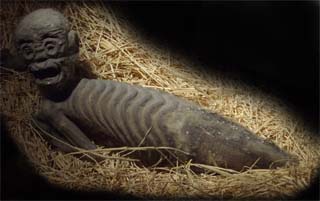

 Dragons,
or dragon-like creatures, have been found in folklore traditions
around the world, though they often differ in many details. For
example, dragons in the Chinese culture are depicted as good,
wise, magical creatures with long snake-like bodies and no wings.
This is very much different from the dragon pictured in European
traditions. Dragons in the western countries are often shown as
malevolent monsters happy to eat sheep, goats, children and the
occasional maiden. European dragons also are often shown jealously
guarding treasure.
Dragons,
or dragon-like creatures, have been found in folklore traditions
around the world, though they often differ in many details. For
example, dragons in the Chinese culture are depicted as good,
wise, magical creatures with long snake-like bodies and no wings.
This is very much different from the dragon pictured in European
traditions. Dragons in the western countries are often shown as
malevolent monsters happy to eat sheep, goats, children and the
occasional maiden. European dragons also are often shown jealously
guarding treasure. A
galaxy is a group of stars bound together by their gravity. A
galaxy often takes the shape of a flattened, rotating disc (left).
The stars are pulled into arms that give the galaxy the appearance
of a whirlpool when viewed from above. Not all galaxies have this
shape. Scientists speculate that galaxies with other shapes may
be the result of a collision between two galaxies. Galaxies typically
are composed of billions of stars. Scientists all speculate that
most galaxies may have a supermassive black hole at the very center.
A
galaxy is a group of stars bound together by their gravity. A
galaxy often takes the shape of a flattened, rotating disc (left).
The stars are pulled into arms that give the galaxy the appearance
of a whirlpool when viewed from above. Not all galaxies have this
shape. Scientists speculate that galaxies with other shapes may
be the result of a collision between two galaxies. Galaxies typically
are composed of billions of stars. Scientists all speculate that
most galaxies may have a supermassive black hole at the very center.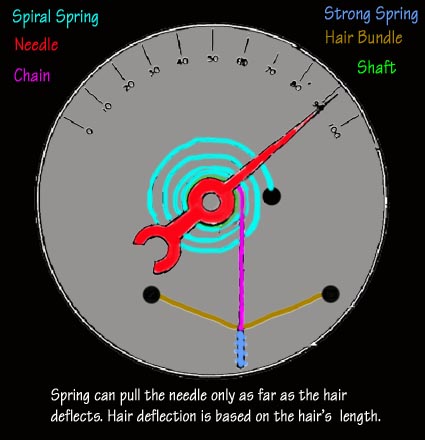 The
device you have there is probably a mechanical hygrometer. It's
not really the metal that is doing the work, but a small bundle
of human hair (chemically treated to remove any oil). Hair, being
organic in nature absorbs water in the air and stretches (That's
why bad hair days are usually those with high humidity).
The
device you have there is probably a mechanical hygrometer. It's
not really the metal that is doing the work, but a small bundle
of human hair (chemically treated to remove any oil). Hair, being
organic in nature absorbs water in the air and stretches (That's
why bad hair days are usually those with high humidity). 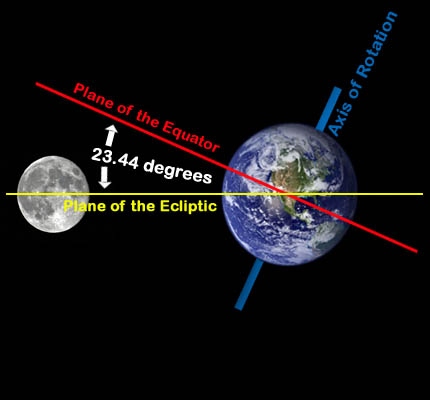 The
earth's equator is tilted off its ecliptic by a little more than
23 degrees. This angle is what gives us the seasons as the northern
hemisphere is more tilted toward the sun during the summer and
away from the sun in the winter (The opposite is true for the
southern hemisphere where the seasons there are reversed).
The
earth's equator is tilted off its ecliptic by a little more than
23 degrees. This angle is what gives us the seasons as the northern
hemisphere is more tilted toward the sun during the summer and
away from the sun in the winter (The opposite is true for the
southern hemisphere where the seasons there are reversed). 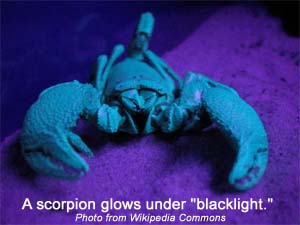 This
is a subject that scientists don't know a great deal about, but
let's start with some basic facts. Some materials when hit by
a light with a wave-length shorter than humans can see will absorb
that light energy and then radiate back light within the visible
spectrum so when a person looks at the object, it seems to glow.
This process is called fluorescence.
This
is a subject that scientists don't know a great deal about, but
let's start with some basic facts. Some materials when hit by
a light with a wave-length shorter than humans can see will absorb
that light energy and then radiate back light within the visible
spectrum so when a person looks at the object, it seems to glow.
This process is called fluorescence. 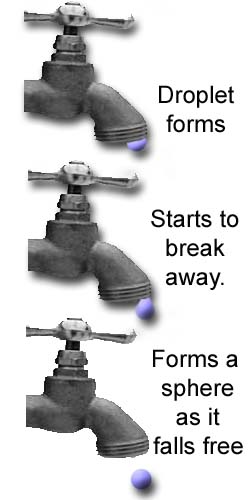 Intermolecular
forces tend to pull molecules of the same substance together more
strongly than molecules of substances of different types. This
is what causes water to form into beads on a waxed surface. The
wax does not attract the water molecules as much as other water
molecules do, so they pull themselves together into a sphere shape
which allows the most volume of water with the smallest surface
area letting the water molecules to get as close to each other
as they can. Because gravity is also acting on the water sphere,
however, it tends to flatten out a bit forming into a bead.
Intermolecular
forces tend to pull molecules of the same substance together more
strongly than molecules of substances of different types. This
is what causes water to form into beads on a waxed surface. The
wax does not attract the water molecules as much as other water
molecules do, so they pull themselves together into a sphere shape
which allows the most volume of water with the smallest surface
area letting the water molecules to get as close to each other
as they can. Because gravity is also acting on the water sphere,
however, it tends to flatten out a bit forming into a bead.  A
group of consecutive nucleotides on the ladder that composes the
instructions necessary to make one protein is called a gene. The
protein molecule that the gene makes may control characteristics
like a person's eye color, hair color, etc. On average a gene
includes 3000 nucleotides, but for some simple proteins only a
few dozen may be needed. Not all DNA nucleotides are part of a
gene. There are lengthy intergenic regions in between most genes
that either have no function or a regulatory function the scientists
are only yet beginning to understand.
A
group of consecutive nucleotides on the ladder that composes the
instructions necessary to make one protein is called a gene. The
protein molecule that the gene makes may control characteristics
like a person's eye color, hair color, etc. On average a gene
includes 3000 nucleotides, but for some simple proteins only a
few dozen may be needed. Not all DNA nucleotides are part of a
gene. There are lengthy intergenic regions in between most genes
that either have no function or a regulatory function the scientists
are only yet beginning to understand.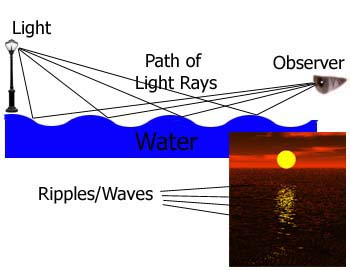 Because
a lake might have thousand of ripples between the viewer and a
distant object on the other side of the lake each ripple as it
moves is capable of picking a tiny bit of the light coming from
the object and reflecting it back to the viewer (see diagram)
making it look like the object is in thousands of different locations.
Because
a lake might have thousand of ripples between the viewer and a
distant object on the other side of the lake each ripple as it
moves is capable of picking a tiny bit of the light coming from
the object and reflecting it back to the viewer (see diagram)
making it look like the object is in thousands of different locations.
 One
illustration of the strangeness of quantum theory is the dual
nature of light. Is light a particle or a wave? The experiment
that scientists used to find this out is called the double-slit
experiment. A barrier with two narrow slits is placed between
a light source and a screen. If light is a stream of particles
we could expect to see each particle pass through one slit or
the other and create two separate lines of light on the screen
behind it. This isn't what occurs, however. We see a pattern of
light and dark lines all across the screen. This, known as an
interference pattern, is the result of waves of light passing
through the two slits, then interacting as they hit the screen
with the wave crests reinforcing each other to make the light
lines and the wave troughs making the dark lines.
One
illustration of the strangeness of quantum theory is the dual
nature of light. Is light a particle or a wave? The experiment
that scientists used to find this out is called the double-slit
experiment. A barrier with two narrow slits is placed between
a light source and a screen. If light is a stream of particles
we could expect to see each particle pass through one slit or
the other and create two separate lines of light on the screen
behind it. This isn't what occurs, however. We see a pattern of
light and dark lines all across the screen. This, known as an
interference pattern, is the result of waves of light passing
through the two slits, then interacting as they hit the screen
with the wave crests reinforcing each other to make the light
lines and the wave troughs making the dark lines. 
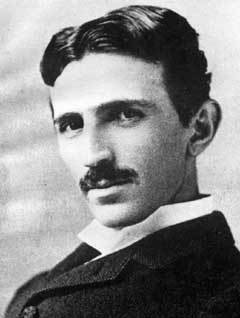

|
Related Links |
|
|