pop up description layer
HOME
Cryptozoology UFO Mysteries Aviation Space & Time Dinosaurs Geology Archaeology Exploration 7 Wonders Surprising Science Troubled History Library Laboratory Attic Theater Store Index/Site Map Cyclorama
Search the Site:
|



|
For more Q&A check the archive! See where to send your question at the bottom of the page. People
Too Heavy for the Earth? - This may be a very stupid
question, but I have been curious about this for a long
time. When the earth was first formed, there were no people
inhabiting the earth. Now there are over 6 1/2 billion people
on the earth (along with all the animals now roaming the
earth). I realize living things consume the resources of
earth but why has not the weight of 6 1/2 billion people
affected the orbit or tilt of the earth? It is an incredible
amount of weight on earth that was not there before. - Diane
There are a few reasons why this weight does not affect earth's orbit. If we take the average weight of a human being as 150lbs and multiply it by 6.5 billion, then converte it to kilograms by dividing by 2.2, we get an approximate mass for all the human life on our planet as 443.19 billion kilograms (this is probably an over-estimate as the much of the world's population are children which would lower the average weight). This seems like a large number until you compare it with the mass of the earth, however, which is 6,000,000,000,000,000 billion kilograms. We are only a tiny, tiny fraction of the planet's total mass. Accurate estimates of the planet's total biomass (all plants and animals) are hard to come by, but one often cited figure is 69,181 billion kilograms. Still only a tiny fraction of earth's total mass. Even if people did represent a large percentage of the earth's weight our growth in numbers on the planet would not represent a change in the planets total mass. Why? Because all that we are was once part of the earth. For example 80% percent of our bodies are water. The water was here before people were on the earth; it was just located in the lakes, rivers and oceans of our planet. As a human body grows it takes on this water that was already on the planet. The water is shifted from sitting on the surface of the earth to inside your body, but the mass does not change. This is the same for all the other materials in your body and for all life. The only way to significantly increase the weight of our planet would be for it to be hit by a large object (by large I mean planet-sized). If such a collision occurred, however, the impact would probably wipe out all life on the planet and any modifications to the orbit would be a moot point as far as human beings were concerned. DNA vs GENES - I would like to know the difference between DNA and genes. - Kamini DNA stands for deoxyribonucleic acid. It is a double-stranded, helical nucleic acid molecule that encodes information hereditary information for almost all living organisms. A gene is one section of the DNA that controls a specific function or characteristic. DNA is arranged like a twisted ladder with the up and down rails composed of sugar molecules and phosphate molecules connected to rungs made of either adenine and thymine or guanine and cytosine. One section of rail and a half rung is called a nucleotide and each nucleotide can be connected with others to make both sides of the ladder and to make the ladder longer. Because the half rungs (called bases) can be either adenine, thymine, guanine or cytosine, there are four different types of nucleotides. The order of the nucleotides on the ladder is important as this is how information is encoded into the DNA. It is not unlike the zeros and ones that encode information for computer program.
Humans are believed to have about 20,000 - 25,000 genes. More than ninety-nine percent of these genes are shared by all humans with only less than a percent involved in giving us all those traits that make use individuals. (In fact chimps, our closet biological relatives, have the 96% of the same DNA we do). Human DNA is also split up into unconnected sections called chromosomes. Humans have 23 pairs of chromosomes. A child gets one half of each pair from their mother and the other half from their father which is why a child might have their father's wide set eyes, but their mother's eye color. Chromosome number 23 is known as the sex chromosome because females carry two X types and males carry one Y and one X. The DNA in a gene is divided up into two components. A "non-coding" section that simply indicates whether the gene is "on" or "off" (sometimes referred to the gene being "expressed" or not) and a "coding" section which contains the instructions to build the protein. The DNA does not build the protein itself but transcribes the information to RNA (Ribonucleic acid) to do the work. RNA looks and acts a lot like DNA, but is made up of only one half of the twisted ladder and uses a few alternate materials. In a few cases gene may not make a protein at all, but just RNA which is then used in another part of the protein synthesis operation. Every cell in our body carries a copy of our DNA and parts of that DNA are very specific to each person, which is why it has become as important as fingerprinting to establish identity. Just a few cells left behind at a crime scene through a strand of hair can be enough to let police positively identify someone as the perpetrator. DNA can also predict if a person will get certain disease. For example, Tay-Sachs, which is a fatal disease often afflicting Eastern European Jews, has been shown to be the result a mutated and non-functioning HEXA gene. Other genes may not directly cause a disease, but increase the likelihood of a person getting ill. For example, researchers have shown that people with a nonfunctioning CREB gene are at an increased risk for anxiety and alcoholism. The DNA actually looks like a super-tiny thread and is impossible to see without the use of an electron microscope. Typically it is curled up on itself so it can fit inside a microscopic cell. If you were to uncurl the DNA in a single cell, however, it would stretch out to about three feet in length and contain three billion base pairs.
Vallée and Bostrom - Is the idea that we are all just living in a big computer simulation related to what Jacques Vallée and people like that are talking about when they try to explain UFO's as not extraterrestrial craft but "control devices" and so on? That is, do they mean that the ones behind the UFO's are the programmers of this big simulation we're living in, who are doing experiments on us by sending these weird, anomalous phenomena and seeing how we deal with them? I never really understood what Vallée was getting at till I read the article on the world as a computer simulation in the current edition of the Museum of Unnatural Mystery. Thanks. - Alan Meyers Dr. Jacques F. Vallée, a computer scientist, venture capitalist and former astronomer, has long been one of the "deep thinkers" in the arena of Ufology. Born in France in 1939 he became interested in the subject when he observed a UFO in 1955. At first Vallée was convinced that UFOs were extraterrestrial spacecraft and published his ideas in his book Anatomy of a phenomenon: unidentified objects in space--a scientific appraisal. By 1969, however, his thinking had changed and he began to see UFOs and alien abduction reports as part of a much larger phenomenon that included other paranormal events. He outlined his thinking for this in his book Passport to Magonia: From Folklore to Flying Saucers. Vallée suggested in his book that flying saucers and alien visitors might not be from other planets, but from other dimensions or even different time periods. These ideas did not sit well with many UFO enthusiasts and Vallée soon found himself an outcast among their ranks, or as he put it a "heretic among heretics". Vallée sees one possible explanation of the UFO phenomenon as that of a "control mechanism " with incidents as deceptions created to manipulate people and society. Sometimes this is done by other humans. For example, we know the US Air Force encouraged UFO reports to hide the flights of SR-71 Blackbird spy aircraft in the 80's. The Soviet Union also did the same thing to cover the launch of rockets that were not in compliance with the SALT treaty they had signed. Much of the social manipulation caused by UFOs reports, however, Vallée suggests are done by non-human entities who have an agenda of which we are totally unaware. Vallée's initial thinking was that these entities were from another dimension, and were not operators of a simulated world that we are living in (See last month article on Living in a Video Game). "There is a distinction to be made between a Matrix-like virtual world and what I first proposed in 'Messengers,' [Messengers of Deception: UFO Contacts and Cults his 1979 book] namely an information multiverse with fully physical manifestations" said Vallée, in an interview with SUB ROSA online magazine. The multiverse he is thinking about is related to some of the interpretations of quantum theory which suggest that reality consists of many nearly parallel universes. If beings from one universe successfully figured out how to cross to another universe we might interpret them as extra terrestrials. A visitor moving from one quantum parallel universe to another also might be jumping in time also leading to the suggestion that flying saucers are our ancestors' attempts to manipulate their past. Even though Vallée initial ideas with control mechanisms didn't involve our living in a simulated universe, in my opinion the idea that UFO incidents (and other paranormal experiences) are attempts by those outside the simulation to influence our society seem to make just as much sense as the multi-dimensional approach. Remember Vallée's initial thinking on this subject was published in 1979 long before Bostrom's 2002 paper on the simulation argument came out. Perhaps Vallée, after pondering Bostrom's thinking, will address this possibility directly in some future book. BC, AD, BCE, and CE- Why are the years are called by BC and AD and how exactly did the year change to BC to AD'? Did ancient people follow this? - Gajendra K. The B.C./A.D. numbering system is based on the presumed year of the birth of Jesus Christ. Years before his birth are given the abbreviation B.C. ("Before Christ") designation and are numbered backwards so the further back in time you go in time the higher the number. For example, the Great Pyramid is thought to have been built 2560 years before Christ was born which would be expressed as 2560 B.C.. The A.D. stands for "Anno Domini" which is Latin for "In the year of our Lord." All recent dates are expressed in the number of years after Jesus's birth. This year is A.D. 2008 which translates to "The year of our Lord 2008" or 2008 years after Christ was born. Technically the A.D. abbreviation should go before the number, but more recently it has become common to put it either at the beginning or the end, for example "2008 A.D.". Some people prefer to use the designation C.E. (for "Common Era") instead of A.D. so there is no religious connection (though C.E. can also thought of as "Christian Era."). The same thing can be done changing B.C. - Before Christ - to B.C.E which means "Before Common Era." This dating system wasn't invented until A.D. 525, and was not commonly used until the 8th century. Before then dates were typically numbered years based on the start of the reign of the current king. For example, Babylon was established as the center of the Babylonian Empire during the 30th year of King Hammurabi's reign. In some cases dates were not established by the beginning of the reign of the current king, but the beginning of the dynasty of kings to which he belonged. A few early calendars (like the Hebrew Calendar) tried to base their dates of the number of years since the world was created, but given that different religious scholars disagreed about when this occurred, the number system was never universal. While previous number systems were adequate in ancient times when there were few contacts between different peoples and little shared history, as interactions between cultures spread, it became difficult to constantly match the years of different king's reigns together to establish correct dates. The A.D. system first became popular in Western Europe and is now the defacto standard though out most of the world. Its popularity can also be attributed to the success of the Gregorian calendar (our system of months and days) to which it has been closely tied. Historical re-examination of the birth of Christ in the last century suggests Jesus was actually born several years before A.D. 1, but given that the system is now so well established there has been no attempt to fix it. Another quirk with the system is that there is no "year zero." This means that if you go one year backwards from A.D. 1 you will find yourself at 2 B.C.. Incidentally some people incorrectly attribute the A.D. to the abbreviation of "After [Christ's] Death" but this is incorrect as it would yield dates 33 years too low - The length of Jesus' life.
Cleopatra of Egypt - We studied Ancient Egypt and I was absent when we studied Queen Cleopatra. Who is she? - Samantha There are several Cleopatra's in Egyptian history, but the most famous one was Cleopatra VII. She was the last Pharaoh of Egypt, at a time just before the country was completely taken over by the Rome. Cleopatra herself was not of Egyptian heritage, but Greek. In 331BC Alexander the Great (who was from a section of Greece) liberated Egypt when he defeated the Persian Empire. After Alexander's death in 232BC, Egypt fell under control of one of Alexander's generals, Ptolemy. The Ptolemy family kept power there until Cleopatra was born to her father, Ptolemy XII, in 69BC. Cleopatra showed great interest in the traditions of Egypt and was the only member of her family in 300 years that bothered to learn the language. She followed the Egyptian beliefs and while she ruled she was considered the re-incarnation and embodiment of, Isis, the Egyptian goddess of wisdom. When her father died in 51 BC, a 17 year-old Cleopatra and her 12-year-old brother, Ptolemy XIII, took over. In addition to be siblings, Cleo and her brother were married (a common trick used to keep power in the family back then). Cleo attempted to push her husband/bother into the background and get sole control of the kingdom, but lost the battle and was forced to flee Egypt. Cleopatra's chance to get back into power came in 48BC when a political miscalculation by her brother got the Roman ruler Julius Caesar angry with him. Cleopatra took advantage of this situation: It is said that she had her servants bring an expensive Persian carpet to Caesar as a gift. When it was unrolled, Cleopatra tumbled out. Caesar, age 50, enchanted by her beauty and youth (she was only 21) and fell in love with her. He helped her returned her to the Egyptian throne which led to Ptolemy XIII's death. Caesar and Cleo had a son, Caesarion, together. It was Caesar's plan to have Caesarion rule Egypt after his death and leave Rome to grand-nephew, Octavian. Cleopatra, however, wished her son to be heir to all of Rome. When Caesar was killed by members of the Roman Senate in 44BC, Cleopatra made Caesarion her co-regent and successor. Later she allied herself with Mark Anthony, one of the three men ruling Rome after Caesar's death. They married and had children. It is likely that Cleopatra had plans to take on Rome and make herself and her son rulers of the known world, but the Romans, under Octavian, attacked first. Anthony and Cleopatra's forces were defeated at the naval battle off the coast of Actium. Soon the armies of Rome were marching through Egypt and Anthony was mortally wounded in battle. Cleopatra was held under house arrest and commited suicide (legend has it that she killed herself by letting a deadly Asp snake bite her) in 30BC at the age of 39. Cleopatra is remembered for her immense beauty and even more immense ambition. She ruled in a time when Greek women were expected to be submissive to their husbands. Instead of taking a back seat to men, however, she cleverly used her charms to gain political advantages over her enemies and was nearly successful in ruling the known world.
Tesla's
"Death Beam" - I'm wondering about Tesla's Death
Ray. Did anyone ever try to build one after his death? Was
it ever proven as a viable weapon? - Frank
Nikola Tesla, the almost forgotten genius of electricity, hated war and for years searched for a way to put an end to it. In 1934, at age 78, Tesla thought he had found it. He had an idea for a death beam based on sending a concentrated stream of charged particles though the air. The beam would carry tremendous energy and would disrupt or melt whatever it hit. The weapon, he thought, could be used to down any hostile airplane approaching a country's borders. The beam could only be sent in a straight line and would not follow the curve of the earth, so it only had a range of only a couple of hundred miles. Because of this, Tesla felt that his invention could be used only as a defensive weapon to prevent aggression. He failed to get much interest in it until he wrote a technical paper entitled "New Art of Projecting Concentrated Non-Dispersive Energy Through Natural Media" and mailed it to a number of Allied nations including the United States, Canada, England, France, the Soviet Union, and Yugoslavia. According to him the weapon would be "capable of destroying 10,000 enemy airplanes at a distance of 250 miles." The nation that showed the greatest interest in it was the Soviet Union, which tested one stage of the weapon in 1939 and sent Tesla a check for $25,000. Tesla's design was clever. One the problems with a charged particle weapon is that the particles need to be accelerated in a vacuum, but then must be able to emerge from the weapon into the atmosphere to make the beam. To keep the interior of the weapon a vacuum Tesla devised a gateway for the particles that consisted of a blast of high-speed air blowing across the weapon's barrel. The blowing air helped maintain the vacuum, but would not hinder the beam. Despite this, experts say his exact design appears unworkable. However, after his death some of his papers appeared to have gone missing and then, during the "cold war" both the United States and the Soviet Union tried to developed "charged particle" weapons similar in principal to Tesla's designs. Conspiracy theorists suggest this is more than a coincidence. Later a similar weapon was designed to be put aboard a rocket as part of the SDI ("Star Wars") program to down approaching missiles, but the idea was never implemented. Currently one company is experimenting with a charged particle beam weapon code named MEDUSA which they hope can be used to defend against planes and light tanks. So far, however, no charged particle weapon seems to have made it into the standard defense inventory of any nation.
The Zapotec's Little Tunnels - I've heard of tunnels found in buildings from the Zapotec empire, somewhere in Central or South America. These tunnels, as I have heard, were too small for adults or normal-sized children to enter, but still had little staircases carved into them, and ceremonial-type items were found in them. I can't find much information on them- are they real? Are people still trying to explore them? Any idea what they were used for? Many thanks - Tango. The Zapotec Empire of central American (now Mexico) existed from about 500 BC to 700 AD, and reached peak population of around 16,500 around 500 AD. At this point in time they abandoned their old capital and built a new one, Monte Albán, atop a high plateau in the valley of Oaxaca. Beneath the central plaza of this city runs a labyrinth of small tunnels. The tunnels, many only a foot high, are - as you note - too small for adults and most children. Some appear to have steps and are connected chambers containing artifacts like human skeletons and funerary objects. Despite Monte Albán being one of the most studied archeological sites in the Americans, the reason behind the tunnels is unknown, but ideas have been proposed ranging from water drainage to a transportation system for diminutive aliens. One explanation seems to be that the tubes were used for sighting the different positions of the sun, moon and stars as they moved across the sky, but the existence of the chambers snd artifacts seems to also suggest a ritual connection. This, by far, is not the only mystery about Monte Albán. On the north side of the site is an area called "The Gallery of Dancers" with many stone tablets carved with reliefs of human figures in contorted positions. Nobody is exactly sure what these figures mean, except that they are not really dancers. The leading theory is that they may be human sacrifices. Perhaps we could understand more about the city and its strange features if we could read the Zapotec hieroglyphics that cover city walls. While the language is still spoken in Mexico, the meanings of the glyphs have been lost and only a handful are now known. Without a key, like the Rosetta Stone which allowed Egyptian script to be deciphered, the translation of these texts may never be known.
The
BIG CRUNCH -What is the Big Crunch and when will it
occur? - Madison
The "Big Crunch" is one of several theories about how the universe will end. Probably everybody is now familiar with the leading theory about how the universe started, the so called "Big Bang." According to the Big Bang theory, at the beginning of the universe all matter and energy was compressed into an infinity small point with infinite density and temperature. Then followed a period of rapid inflation and expansion (the Bang). Matter in the universe cooled and coalesced into stars, planets and galaxies. The expansion continues today as each of the local groups of galaxies, including ours, grows further apart from each other. For many years scientists pondered what would happen at the end of the universe. While the expansion continues, gravity is trying to reverse the process and pull all matter back together. Scientists figured that either gravity would be too weak and the expansion would continue forever while just getting slower and slower, or gravity would be strong enough to bring all the matter and energy back together in a "Big Crunch." Scientists also speculated if the universe did come back into a "Big Crunch" it might precipitate another "Big Bang" which would create another universe. Ours, they suggested, might be just one in an unending series of universes. Initial measurements suggested the amount of gravity and the speed of the expansion were very nearly balanced. This meant that scientists had to impatiently wait for decades until better technology was available so that more accurate studies could be made and they could find out what the fate of the universe was. In one of those moments that proved that Sir Arthur Eddington was right when he said "not only is the universe stranger than we imagine, it is stranger than we can imagine," the results came back showing that the expansion wasn't slowing at all. It was - much to the shock of almost everybody - accelerating. Scientists have decided that the reason for the acceleration must be something they've dubbed "dark energy," but they have almost no idea what this energy might be and how it works. If the expansion continues at the current rate the universe may end in "The Big Rip." At some point about 50 billion years in the future the expansion will become so great that everything will be ripped apart. Galaxies will fly apart as individual solar systems go their own way. Later stars will lose their planets and eventually everything down to the subatomic level will be torn asunder. Although a "Big Crunch" seems unlikely due to this most recent finding, because scientists know almost nothing about what "dark energy" is, they can't rule out that it might suddenly reverse and cause a rapid collapse of the universe. When this might happen is also a mystery. If there is a Big Crunch, the universe would end as all matter was sucked into black holes, then the black holes were pulled together to create a single massive black hole. Scientists have no idea whether this singularity might lead to a new universe and a new expansion or not.
Funnel Shaped Universe? - Whenever they talk about the Big Bang, for illustration purposes they always show a funnel or trumpet shaped Universe from the point of the big bang to the present day, about 13.8 billion years. I often wonder that if there was a big bang, if the so-called explosion would have radiated in ALL directions, like a typical explosion - Victor N. When you see a diagram like that the illustrator is trying to express what is happening in four dimensional space (three directions and time), on a two dimensional piece of paper. It's a bit like trying to put a world map onto a flat piece of paper instead of a sphere: you do your best, but it's not a perfect representation. On most funnel diagrams the long dimension is time and the funnel shows how things changed over time. At the one end the universe it very small and highly compressed. Then as time moves forward it gets larger and larger, taking on, in the diagram, a funnel shape. While this a useful diagram to show the expansion, it isn't really meant to represent what the expansion actually would have looked like you had been standing there at the time. From that point of view that universe, as you have supposed, would have seemed to have expanded, or inflated, in all directions at the same time. Having said all that, there are a number of views of what shape that the universe expanded into. To think about this you need to understand that the stuff of the universe (matter and energy) is what creates the space. When the expansion of the universe happened it didn't expand into anything, but created the space as part of the expansion. For that reason the density of the universe (how much stuff there is compared to the amount of space) is critical to understanding its shape. A low density universe creates a saddle-shaped universe that will expand forever. A high density universe will probably create a sphere shaped universe which will collapse back on itself. A universe with density in between will be flat. The kicker here is that at least one scientist, Frank Steiner at the at the University of Ulm in Germany, does believe the universe expanded into a funnel shape! It's a minority opinion, but Steiner does back it up with data from Wilkinson's Microwave Anisotropy Probe (WMAP) which was used to map the distribution of the microwave background radiation in the visible universe . Is he right? We will just have to wait as other scientists figure out ways to confirm or show his theory to be in error.
Up
a Well - If a person is in a deep well in the daytime
and he looks straight up will he be able to see the stars? -
M. Matthews
The notion that you can see the stars during daylight hours from the bottom of a deep well or chimney has been around a long time. The ancient Greek philosopher Aristotle mentions it as does the 19th century author Charles Dickens. However, any theoretical or practical evidence for this seems lacking. The British astronomer Rev. W.F.A. Ellison tried it from the bottom of a bottom of a colliery 900 feet below the surface and found the he wasn't struck by the sight of stars, but the brilliant blue of the sky when compared the darkened tube he was looking up through. We cannot see the stars in the sky during the day because of the sunlight is scattering off gas molecules in the air, sending light in all directions - including into our eyes. (Blue is scattered more than the other colors so that is why the sky is blue). The light radiating this way during day is much brighter than most stars. A few extremely bright stars, like Sirius, are visible in the day if you know where to look, though they do not stand out against the day sky like they do at night. If you were at the bottom of a well shaft, and Sirius was directly overhead during the day, the well shaft might reduce the glare from the sun enough to make the star more visible. It would not, however, allow you to see the fainter stars and the real world chance of Sirius being exactly over your shaft would be extremely small. Similarly planets, like Venus, can be seen in the daylight and viewing them from a well or chimney might reduce the Sun's glare and make them more visible, but you could probably get the same effect by using the cardboard cylinder from a roll of paper towels that you hold up to your eye.
Expansion of Universe vs. Speed of Light - I read "K-Pax IV," a fictional book, and an alien character suggested that light only travels because the universe is expanding. She suggests that light cannot exceed the speed of light because that's the speed of the expanding universe and if the light exceeds that speed then it's going out of the universe's bounds. Is this somewhat true or completely fictional? - Melqui In reviewing the literature on this subject I see no credible theories that connect the expansion of the universe, as we know it, to the speed of light. Usually when we talk about the "expansion of the universe" we are referring to the way things in the universe get farther away from each other over the course of time. This started with the "Big Bang" and continues today. Recently this speed was measured to be about 71 (km/s)/megaparsec. That means that if two objects in the universe are a megaparsec apart (3261.5 light years) they will be moving away from each other at 71 kilometers a second. This speed is well below that of light so there doesn't seem to be a direct connection. In addition, the effect is additive so that at great distances - billions of megaparsecs apart - two objects can actually be moving away from each other at more that the speed of light. This would seem to defy Einstein's Theory, but remember that the movement of these objects is because they are just being carried along by the expansion of space, not because the objects themselves have been accelerated. There is also recent evidence that the rate that the universe is expanding is increasing for some unknown reason. This is also unlike that speed of light which almost all scientists believe is a constant. Even the few people that suggest light speed may not be a constant speculate that it is slowing down, not speeding up. Some future theory may find a connection between the speed of light and the expansion of the universe, but it is not obvious at point in time. Still, we do not know everything about the universe - in fact we do not even know what we don't know - so there is always the possibility of new discovery over the horizon that would change everything.
VASIMR Engine - I was reading about the VASIMR engine that Franklin Chang Diaz is building and I read it has an ISP of 4000-5000 while a falcon 9 rocket built by SpaceX has an ISP of only 300 and some. My question is what ISP would a plasma ion engine need to lift off from the surface of earth and make it to space. I don't have any ideas on what the weight would be of the ship. Sorry if this is a silly question. It's just in films like the chronicles of Riddick one of the Furyans say they've "located an ion trail that goes offworld." - C. Bell. The ISP (Specific Impulse) of a rocket engine is a measure of the weight of the propellant used to get a certain amount of thrust. It can give you an idea how efficiently the engine uses it's propellant, but it does not take into account the mass of the spacecraft itself which would be a critical concern for lifting off from a high gravity object, like the Earth. The VASIMR can create a very high ISP by sending ions and electrons out its exhaust at somewhere around 50,000 meters/second. To do this it takes a propellant material (perhaps hydrogen, since it the most abundant material in the universe) and uses radio waves to ionize it (heat it till the electrons separate from the nucleus of the hydrogen atoms) then uses a powerful magnetic field to accelerate the ionized propellant out the exhaust to create thrust. The problem is that the electric power needed to heat the propellant and create those magnetic fields can be significant. To send a manned ship to Mars you would probably need a small but powerful nuclear reactor on it. There are several problems with the idea of launching a rocket powered by a nuclear reactor from Earth. The first is that the reactor would likely be so heavy that any the advantage of the VASIMR's high thrust would be negated by the weight of the rocket. There are also serious concerns about the environmental impact of the reactor's nuclear fuel scattering over a wide area should there be an accident during the launch. That doesn't mean that VASIMR, and similar electromagnetic thruster based engine schemes, do not have a future in spaceflight. Carrying a heavy power reactor on your spaceship may not be such a big deal if your ship is leaving from a space station in orbit, rather than launching from Earth. It's not hard to envision a day where passengers and cargo ride up to an orbital platform on conventional rockets, or via a space elevator, then ride to Mars on a VASIMR powered interplanetary shuttle. By leaving from a space station in orbit, the size and weight of the vessel are a much smaller issue. For example, NASA's Deep Space 1 probe used an NSTAR ion engine (another type of electromagnetic thruster) to carry it out to survey the asteroid 9969 Braille back in 1999. This worked because the probe was launched from Earth with a conventional rocket. Once it had gotten away from Earth and shed the booster that go it into orbit, it was very light and was able to power its engine via solar panels on the craft. These type of drives look like they are excellent candidates for space probes moving between planets, but unless a very compact power plant is invented, they may be impractical for launching from the surface of a large celestial body into space.
Hindenburg Memory - Not a question, just a note since you mention the Hindenburg: I saw it as it flew over my school's playground in mid-Manhattan about an hour before it burned. We were at recess and thrilled to see it. - Ghislaine J. Thanks for sharing that memory with us. I sure it was an exciting sight. The Hindenburg was scheduled to land earlier that day on May 6th, 1937, but was delayed by thunderstorms over the Lakehurst, NJ, landing site, so the Captain, Max Pruss, took the ship up over Manhatten and down the Jersey shore to give the passengers something to look at while the weather cleared. The flight caused people to pour out into the streets to catch sight of the gigantic airship. The Hindenburg, as you probably know, was the largest object ever to fly. At 803 feet long it was a big as a skyscraper laid on its side and just short of the length of the ill-fated Titanic. In fact, with a diameter of over 135 feet, The Hindenburg is almost as wide as some modern adverting blimps are long. For example, the Direct TV blimp is 178 feet long. Now anybody who has seen one of these blimps up close knows that these are still pretty big objects. Standing next to one just imagine an airship who's width is almost as big as the distance from the tip of the blimp's nose to its tail. The mind boggles. I got a chance to get a feeling of the size of The Hindenburg while filming a documentary for the travel channel a few years ago. The crew and I got were allowed to film inside Hanger #1 at the "Joint Base McGuire-Dix-Lakehurst" which is now what the Navel Air Station at Lakehurst, New Jersey is now called. The hanger, just a short distance from the place where the airship crashed and burned, is just big enough that on previous trips The Hindenburg was able to snuggle inside. Walking around the hanger, with its massive doors and towering ceiling, you can really get a sense for the size of the massive airship. More than three times the length of the largest airliner in operation today, the Boeing 747-800. Thanks again for sharing that memory. For readers who want more information on the fate of The Hindenburg, check our page on the disaster or check my experince at Lakehurst while filiming the documentary. A WOW in SETI - What do you know about the WOW signal, and have scientists found any possible source (other than aliens)? Could it have even been faked? Or is it more likely to be a genuine signal from aliens? If that's the case, why haven't we heard any more? - Jonathan . This signal (called the "WOW" signal because that's what the scientist who first saw the data wrote on the printout) was observed by the "Big Ear" radio telescope at Ohio State University on August 15, 1977. The Big Ear was part of a SETI (Search for Extraterrestrial Intelligence) project run by the college for almost 30 years. The signal was the closest thing to an alien contact that the project - or anybody else involved in SETI - has ever found. There are several things that make the signal so interesting. The first is the strength. It is extremely high: The most powerful signal ever received from space from an unknown source. Second is its duration. Almost exactly 72 seconds. This is significant because the Big Ear was a fixed radio antenna which swept the sky as the earth turned and 72 seconds was exactly the length of time it would take for the antenna to sweep by a pinpoint source in space. Also the growth and decay pattern of the signal is exactly what one would expect for a fixed celestial source, making it unlikely it was an earthbound transmitter. Third is its frequency: It is very near the frequency of hydrogen and very concentrated. The hydrogen "line" is considered to be by most scientists the logical frequency to choose if you where trying to broadcast to another civilization. The fact that that signal did not extend much above or below that frequency is a strong indication that the broadcast was artificial, as natural sources a rarely so concentrated. Another intriguing aspect of this signal is that is that it was only observed from one of the Big Ear's two "horns" but not the other. They scanned the same section of sky about two minutes apart, so in that short period something, or somebody, stopped the transmission. As fascinating as the signal was, it has never been found again despite many researchers revisiting that location in the sky using, in many cases, much more sensitive equipment. This both deepens the mystery and makes it almost impossible to hope for a solution. The follow up surveys have almost eliminated the possibly of some weird natural source. However, the lack of any additional signals also makes it seem very unlikely that aliens are trying to contact us. Most scientists believe that they definitely would try more than once (although we ourselves have only sent a sent an outbound signal once). The only way we may have missed their additional signals, if they exist, is if they are being repeated at very long intervals (at least 14 hours apart). In science, unless something is repeatable, it doesn't count for much. Some have suggested that the signal may have been a man-made space probe that the SETI team wasn't aware of, but there is no way of proving that one way or another. So, the mystery continues. We can only hope that if E.T. was trying to contact us, he tries to phone again, soon.
Lyonesse: The Lost Land - What is the story behind the Arthurian "lost land" of Lyonesse, and what relationship does it have with other "lost lands" (e.g. Atlantis), if any? - Levi The Land of Lyonesse first appears in the medieval Arthurian legends. (An example of these is the History of the Kings of Britain that was published around the 12th century A.D.). However, in these early stories the Land of Lyonesse was not at all lost! It was actually are real place: Lothian. Lothian was part of Scotland that ran along the southern shore of the Firth of Forth. A number of legends exist about Lyonesse, perhaps the most well-known one being the story of Tristan and Iseult. In this tale, a tragic romance, Tritan falls in love with the King's wife, Iseult, ultimately leading to an adulteress relationship. The story most likely influenced the later romantic tale of Lancelot and Guinevere in the Arthurian legends. Later on Lyonesse became associated with the coast of Cornwall. Particularly an area between Land's End and the Isles of Scilly, which are about 15 miles to the west of the mainland in the Celtic Sea. How did this stretch of water get the reputation as a sunken land? Well Mount's Bay, just to the south of Land's End, shows signs of once being above the water. The stumps of a forest can still sometimes be seen at low tides following storms on the beach. In fact, the island of St Michael's Mount, sitting in the bay, is called in Cornish "Karrek Loos yn Koos" which means "hoar rock in woodland" which the suggests that the island was once a hill surround by a low, swampy forest. Radiocarbon dating of wood recovered from this forest suggest it was flooded in the 17th century B.C.. It is likely that later the actual disappearance of the bay was extended in legend to include the whole area between Land's End and the Isles of Schilly. How is this related to the story of Atlantis sinking below the sea? Well, the earliest references to Atlantis are in Plato's dialogues Timaeus and Critias, written in 360 BC. That's more than a thousand years after the area in the Mount's Bay disappeared underwater, so one could argue there might be a connection. In 1995 a Russian scientist, Viatcheslav Koudriavtsev, proposed that that an area to the west of the Isles of Schilly, called the Celtic Shelf, might be a possible location for Atlantis. Koudriavtsev's theory is that during the last Ice Age the sea levels were much lower and this area would have been exposed. He believes it was the center of a major civilization. He has also taken the location for Atlantis as described by Plato, and reinterpreted the directions so they point to this location. Armed with his theory he has been seeking the necessary permission and funds to support a scientific, underwater exploration of the shelf, but without much success. I intriguing as this idea is, over the years people have made cases for Atlantis being located in many places including, Crete, the Canary Islands, Spain, South America and even Antarctica. It not clear that Koudriavtsev has more evidence for the Celtic Shelf than any other location. In the end, however, perhaps Lyonesse, Atlantis and other mysterious missing lands of legend share more of a literary connection rather than a physical one. A place where the Gods punished evil men by sinking the ground beneath them into the sea.
Domesticated Dinosaurs - I have a Question which deals with something found in a LOT of Sci-fi and fantasy stories: The situation is this... That human beings and dinosaurs or dinosaur-like creatures live side by side... COULD humanity be able to domesticate dinosaurs or dino-like creatures in the same way we domesticated dogs, cattle, or cats? I already know nobody has tried to domesticate the Komodo Dragon, but still... Iguanas and small lizards are sold as pets, alligators are farmed for hides and meat, and so on... But could, if they had still been around, something like an armored ankylosaur or Triceratops, have been domesticated in the same way Humanity domesticated cattle or dogs? - David R. Could humanity have domesticated dinosaurs in the same way we domesticated dogs, cattle, or cats if humans had lived in the same era? Well, let's start by defining domestication. It not quite the same thing as training a wild animal. A true domesticated animal has been bred by humans to be sociable and easy to handle along with other desirable characteristics. Scientists can even estimate the date that certain animals were domesticated in history by looking for changes in the fossil record of animal's body that gave some advantage to the human's that did the domestication. Usually the domestication process takes decades, if not centuries. Now even if you didn't domesticate a wild animal, you still might be able to train it to assist you and live with you. Generally, the smarter, more social, and less aggressive a creature is, the more likely you would able to get it to cooperate. Wolves are good example. They are pack creatures, very social and very smart. If trained from a young age they can live with humans, though they still tend to have a wild streak in them. Another example is the elephant. These creatures are large and powerful, yet humans have been able to tame them to get them to do work. As you might be aware, reptiles (like snakes and crocodiles) are generally not very easy to train for some of the reasons I've already mentioned. They tend to be not as smart or sociable as many mammals. However, dinosaurs, while they are reptiles, are also thought to be the ancestors of birds, which are often highly trainable. Whether any particular species of dinosaur can be trained or even domesticate is an open question. When people think of dinosaurs they tend to picture the larger ones like the T-Rex or Apatosaurus. However, there were thousands of dinosaur species, some of which were no bigger than chickens. We believe some even hunted in a pack (velociraptor for instance) which would indicate they were of high intelligence and very social. It seems likely that at least some dinosaurs would have had the right characteristics to allow to be trained. Even if there weren't, however, humans could have still bred them till they were domesticated, if only for no other purpose then to serve as food (imagine chicken-like dinosaurs raised as a food source). Could a cave man have been riding around on a T-Rex if they had co-existed? My guess is probably not as they were likely to have been top predators and very aggressive as well as very large and powerful. However, humans have even had some success in training lions and tigers, though they usually don't ride on them, so perhaps a trained T-Rex is not an impossibility. Dogs are nothing but domesticated gray wolves, so it seems possible that something like a velociraptor, which might fill a similar niche in the environment, might both be trainable and perhaps eventually domesticated too.
Time Speeding Up? - Someone just said to me she thinks the last 3 years have aged everyone more than in the past because the actual minute itself (the unit of time) is speeding up. Can this be possible? - Jennifer E. I suspect your friend is referring to the insertion of "leap seconds" into the calendar in the last few years. If this is the case, it isn't so much that time itself is speeding up, but that the earth's rotation is slowing down. Of course, how you look at it depends on how you define time. We casually define our days as one rotation of our planet, hours as one 24th the length of that day, minutes as one 60th of the length of that hour and seconds as one 60th the length of that minute. If the Earth rotation slows (which it does due to the pull of the moon and sun's gravity on our oceans which create friction between the water and land) the days get longer by a few fractions of a second each year. While this tiny difference is unimportant to most people, it is of great concern to scientists who need to measure things carefully down to the thousandths of a second for many scientific experiments. If the length of a second is changing as the earth slows down it can't be used to compare the results of one experiment with a similar one done years earlier. To solve this problem scientists invented the "physics second." A physics second is length that the second was according to the rotation of our planet in 1900. Scientists then use atomic clocks (that measure time as a function of the change of states in the element cesium) to track time without having to refer to the earth rotation. When the atomic clocks slip out of sync with the rotation of the earth by about a second a "leap second" is inserted into the clocks tracking to keep it aligned with the astronomical day. If you thought of the real value of time as the length of the day, then indeed you might come to the conclusion that time is going faster - after all we are inserting extra fractions of a second into those days so time must have sped up, right? Well, not really. It is probably more accurate to think that time has stayed the same, but our days are getting longer.
Unknown Museum - I was watching a special on The Discovery Channel a year ago about an actual museum that I would desperately like to go to, but I can't seem to find any info on it! I don't know the name of it, but I know it has strange, morbid exhibits of human oddities, and things of that nature. For some reason I thought it was in Philadelphia, but their tourism board had no listing for it. -Amy You are thinking of the Mutter Museum which is part of The College of Physicians of Philadelphia. The Mutter houses over 20,000 objects including 900 anatomical and pathological specimens and 10,000 medical instruments. The exhibits are sometimes grotesque, but always fascinating. Currently the Mutter is featuring a special exhibition on conjoined twins. You can visit the Mutter on the web at http://www.collegeofphysicians.org/mutter-museum . If you can't get there in person you may want to order one of their extremely popular calendars which feature the work of photographic artists that have recorded some of the museum's collection of oddities and their gruesome beauty.
Bones of the Minotaur - Was there actually a minotaur under the Knossos' temple, and if so could we find bones? - Sean The story of the Minotaur comes from Greek mythology. In the story the King of Crete, Minos, by tradition sacrifices his best bull to the sea god, Poseidon, each year. Then one year the god sent him a perfectly white bull to use in the sacrifice. Minos is so taken by the bull he decides to keep it and sacrifice a lessor animal. This displeases Poseidon and he causes the king's wife, Pasiphaë, to fall in love with the bull. She develops complex plot (involving a hollow, fake cow) to mate with the bull. Nine months later she gives birth to a horrible man/bull hybrid monster which is named the Minotaur. The word, Minotaur, is actually a proper name, by the way, meaning "bull of Minos." It has been more recently been used, however, as the designation of class of bull/man creatures found in fantasy stories and games. The Minotaur turns out to be a powerful and angry creature with a taste for human flesh. He is traditionally depicted as a creature with the head of a bull and the body of a man. Minos builds a maze (called the Labyrinth) for him under his palace where he is confined. At the time of the story the city of Athens is under the control of Crete and is forced to send as tribute every year (or every seven years depending on the version of the story) seven young men and seven maidens to be sent into the maze to be consumed by the monster. The King of Athens son, Theseus, volunteers to be in the group. He enters the Labyrinth and slays the beast with the help of Minos' daughter, who has fallen in love with him. So is there some basis for this myth? Was there really a Minotaur? For that matter, was there even a Labyrinth? If you discount the supernatural, it seems unlikely that the union of a bull and a woman would result in the birth of a living creature. Certainly animal hybrids exist (For example, the half lion, half tiger, liger). However, most scientists agree that humans and cattle would be too far apart on the genetic scale to make this combination work. (For some insight on this check our page on the likelihood of a human/chimp hybrid). Could the Minotaur been a man that was born deformed with bull-like features? Or perhaps a man who was simply physically powerful with a raging temper? These seem like more realistic possibilities. If we accept that, can we find his remains in the Labyrinth? Well, that's another problem. Nobody can say for sure where the Labyrinth was. The explorer Arthur Evans excavated the ruins at Knossos. He didn't find an underground maze underneath and came to the conclusion that the Knossos palace itself, with is many complex rooms and passageways, was the inspiration for the Labyrinth. If this is that case, however, it would seem to make the story of the Minotaur simply a legend. Other people argue, however, that a site some 20 miles from the palace, called the Gortyn caves on the coast of Crete is the site of the ancient Labyrinth. The caves are about three miles of interlocking tunnels with different chambers and dead ends. The caves have been explored and used for many years now (the Nazi's utilized it as an ammo dump during World War II) but no remains of the Minotaur have ever been found. However, if you wanted to look for creature like that, the caves might be the logical place.
Tank vs. Tank - I've heard a lot of stories about the German Tiger II vs. U.S. M4 Sherman tank during WWII. Which was really the better tank? - Joe The answer to this question is hinges on what you mean by "better?" The Tiger II tank (sometimes referred to as the "King Tiger" by U.S. soldiers) was perhaps the most technically advanced tank of the war. I was a heavy tank featuring thick armor particularly on the front of the machine. Its 88-millimeter gun could penetrate five inches of enemy armor at a range of two kilometers. On the other hand most M4 Sherman tanks mounted a 75-millimeter gun that was incapable of punching through the Tiger's frontal armor at any distance. Its own 2-inch frontal armor gave the crew little protection from the Tiger's heavy gun. Also early M4's tended to easily catch fire when hit (a problem solved in later models by increasing the protection of the stored ammunition). So it's an open and shut case, right? Well, not quite. From the point of view of the generals charged with winning the war, things looked a little different. The Tiger II, because it was so advanced, heavy and complex was hard and expensive to build and difficult to maintain in the field. In fact, only 492 King Tigers were built by the Germans. (And only 1347 of the slightly less formable Tiger I). Compare this with the nearly 50,000 M4 manufactured by the Americans. The Shermans were simpler to build, very reliable and easier to maintain in the field. They were also faster and more maneuverable than the King Tiger and used a lot less fuel. From a General's point of view a tank wasn't very useful if it broke down or ran out of gas. It's also important to remember that the Sherman's main mission in WW II was not to engage other tanks (The U.S. had tank destroyers like the M10 Wolverine for that). The Sherman was supposed to protect infantry by taking out German positions defended by machine guns and pill boxes. In this role the M4 rocked. Unfortunately, tank destroyers were more effective as a defensive plan. While advancing toward Germany quite a few Shermans did meet of with Tigers and in that situation the M4 would be in trouble, especially if it was on its own and not part of a group. It's clear that in that particular situation the crew of the King Tiger would have a much better chance at survival. However, these encounters would be relatively rare and when they did occur it was often several Shermans up against a single Tiger. The Allied strategy was to work together until one of the M4's flanked the Tiger and could take it out with a shot to the rear or side. Or course this often came at a cost of one or more of the Shermans being hit and their crews being injured or killed (For a dramatization of this scenario check the 2014 movie "Fury.") So was the Tiger II better than the Sherman? From the point of the crew in inside the tank during a one-on-one battle, yes, it was. From the perspective of the Allied command trying to win the war, the Sherman was much superior not because they were technically better, but because they were more reliable and there were many, many more of them. Weird Findings - What do you do if you find pieces of a creature unlike that of anything of this earth? - Charlie Probably your best bet, when trying to identify an unknown animal (extraterrestrial or not) is to contact a biologist professor at a local college or university. They will be familiar with animals in your area and can eliminate some possibilities of an unusual, but earthly species. Most scientists would jump at the chance to identify a new species (even an earthly one) if given the chance. If they find one, they get to write a paper on it and they become famous (at least within the biology world). This goes for fossils too. If you find a fossil, which you think might be something significant you can contact a geologist or paleontologist at a local college or university. It could be an important find. It has happened before: In 1974 a contractor working on a housing development in South Dakota came across some strange bones. His son, who was a college student, recognized them as fossils and contacted a university. Scientists came out and examined the location and immediately discovered the remains of at least four Columbian Mammoths. Later excavations revealed that the location was an ancient sinkhole which had trapped mammoths for centuries and was a treasure trove of important fossils. The housing project was abandoned and a museum built on the location: The South Dakota Mammoth Site near Hot Springs. It's great place to learn about mammoths while visiting South Dakota.
The Berkeley Horror - I have a book by Daniel Cohen called Worlds Most Famous Ghosts. In it is a chapter on something called the "Berkeley Square Horror" in London. It is something about a room at 50 Berkeley Square that if anyone stays one night in there they will either be dead or have gone insane. Supposedly this has happened several times. I have searched several sights including wikipedia.com and I have found nearly no info. It would be much appreciated if you could help me out. - Frank There are multiple stories about 50 Berkeley Square, many of them contradictory. The house was constructed in 1740 and for a number of years was the home to British Prime Minister George Canning. The source of the haunting stories starts around 1830 with either young woman who committed suicide by jumping from the top floor, or a Mr. Myers was preparing the house for the just new bride and went insane after he was jilted. Or maybe the haunting really comes from a Mr. Dupre, who confined his insane brother in an upper story room. Or maybe the story about the little girl who was tortured to death by a sadistic servant is what started it. Well, take your pick. According to the story after Mr. Myers/Dupre/young woman/little girl was gone and a new family had moved in, a maid was found in a third floor bedroom screaming and muttering she has seen something "horrible" there. The story continues next with a Captain Kenfeild, fiancée, to the family's daughter (In other versions this is a young aristocrat named Robert Warboys) who decides to challenge the apparition by staying in the room overnight. He sees something that either kills him with fright (in some versions) or leaves him crazed. Another tale connected with the house brings the story into the 20th century with two sailors in 1943 who break into the long empty house to stay overnight and encounter a monstrous, shapeless, oozing mass in the third floor room. One sailor escapes to tell the tale while the other jumps out the window to his death (speared on the points of an iron railing) to avoid the horror. The house became famous for these stories and by the beginning of the 20th century and was listed by some authors as "the most haunted place in Britain." The current owners still get visitors from time to time curious about the house. The stories were also an inspiration for a 1947 movie "The Ghosts of Berkeley Square." As far as I am aware nobody has carefully researched the history of the house to determine if any of the 18th century stories are real. This could probably be done by checking records to see who owned the house, who died there, and going though police reports associated with the house, etc. Clearly there are problems with the 1943 story as it indicates the house was empty, but history shows that in 1938 Maggs Brothers Rare Books moved into the location. The company reports no ghostly incidents since they have been there even though there were many all-night fire watches held during the Second World War.
Elongated Night Reflections - If you look at the reflection of a street light from across a body of water, it appears long in one direction but not the other? Why? - Tariq Water, under the right conditions, reflects light just like mirror. Of course, a mirror is a usually composed of solid material (most commonly glass with a silver backing) and water is liquid. As long as the water is perfectly still and flat the image reflected is almost mirror-like, but should a breeze start to ripple the water, strange things start to happen. The ripples cause the shape of the surface of the water to change into a series of up and down curves. This means that the light normal reflected by the surface doesn't come straight to the viewer, but is distorted much like in a fun house mirror. While fun house mirrors are usually static - either making you look tall and thin or short and fat - the many ripples in the water are always moving and changing giving the reflected image a vibrating quality.
During the day when everything is evenly lighted these bits of light are overwhelmed by all the other reflections involved and only contribute to the overall reflected image by making it look fuzzy. At night, however, when the most of the background is dark, all these tiny reflection become visible. They tend to appear to elongate the lighted object in the direction where the ripples appear spaced closely together from the viewer's perspective. That is vertically as you have observed. It is possible to see some spreading horizontally, however, depending on what direction the wind is blowing the ripples. Before Big Bang - I'm a 60 year old scientist and I have a rock-solid understanding of the concept of entropy, including the idea of life as a temporary bump in the overall decline of order and organization in a system. All I want before I die is to know if there is any credible scientific theory about how the spring originally got wound 14-or-so billion years ago - Bob W. Let me re-phrase you question as, "What was there before the Big-Bang and where did all the energy it requires come from?" At this point I don't believe there are any "credible" theories to explain this as none of the ideas scientists have about this area can be tested by experimentation. In fact, there is not likely to be anything testable until scientists can first create a Grand Unified theory of everything combining Einstein's General Relativity with Quantum Physics. That quest, which has been pursued by physicists like the Holy Grail for almost a century, so far does not seem near a conclusion. So the best I can do is to throw out one of the more intriguing ideas floating around cosmology circles these days. This particular model comes out of string theory (One possible candidate for the Grand Unified Theory that says all energy and matter is composed of super-small vibrating loops of strings.) This idea was worked out by Paul Steinhardt (Princeton University) and Neil Turok (Cambridge University). They suggest our universe is part of a much larger universe. The model says that our universe exists on a three dimensional membrane ( or "Brane" in string theory lingo) and there are other branes close to ours, only millimeters away, but invisible. Every trillion years or so these branes are drawn together and when they collide a huge amount of energy is released making a "Big Bang" that creates a universe on the brane (other universes can be created at other locations of the brane that may collide at other times) This process of collision Steinhardt and Turok named ekpyrosis which is the Greek word for conflagration. In addition to creating a smaller universe, ekpyrosis also pushes the branes apart. Over the life of the universe some of the big bang energy turns into matter which becomes stars, galaxies and, of course, us. Eventually the energy involved in our universe spreads out as stars burn out and the universe grows cold. According to this idea, however, the branes which still contain the energy, and they are drawn back together again to collide and create another universe in an eternal cycle. They only problem with this, and alternate theories like it, is that there is no way to test these theories experimentally to know if there is any evidence that they are true. Even if this idea is true, however, we may have just moved the question back a little bit further: What created that greater universe and where did all its energy come from?
Fate of the Mars Born - My question is about something that is always popping up in Sci Fi stories, and NOW it could actually happen at some point in the future: Assuming we eventually colonize mars, would a human being who is born and raised on mars be taller and thinner than a human being that is born and raised on earth? And, biologically speaking, what could be some of the other differences be between a Mars-born and an Earth-born? This is an interesting and complex questions that nobody has any definite answers for at this point. We haven't been able to do a lot of experiments with animals in low gravity situations, so there isn't a lot of data to work with, just speculation. Science fiction writers have often speculated that humans born and raised on Mars would be taller and thinner than their cousins on Earth. The idea is that since Mars has roughly 1/3 the gravity of Earth (because of its smaller size) their bones would grow longer and they would need less strength (and therefore less muscle) to move around and do things making them thinner. There is some evidence that this might be true. We know that astronauts, living for an extended time aboard the ISS get taller. The mechanism that causes this is similar to the change in height many of us experience every day. When we lay down to sleep the pressure is taken off our spinal columns and the discs (sort of shock absorbers for our body) between each of the vertebrae swell a bit. After we get up in the morning and stand up pressure on the discs over the course of the day causes the discs to lose water and compress a small amount. A typical person can lose a ½ inch of height over the course of a day. An astronaut during an extended stay in the ISS never experiences anything but micro-gravity so his discs continue to swell and he may find himself 2 inches taller in orbit, than he was on Earth. NASA needs to design their spacesuits with this expansion in mind. A child born on Mars would not be growing up in micro-gravity, but he would be permanently living on a world with a much lower gravity and it seems likely he or she would might find their discs more permanently swollen than they would be on Earth. Also while our genes often play a part in how tall we grow, our bodies also respond to environmental cues like gravity too. Bones in a low gravity situation might grow longer and thinner. We know that astronauts on the ISS living in micro-gravity for any length of time lose bone mass making them more prone to fractures when they return to Earth. It isn't quite clear how this would play out for someone growing up under low gravity on Mars but lighter, thinner bones might be the result. There are other factors that might play into their height beyond gravity too. For example, people here on Earth living in developed nations have been growing taller though the last few centuries. This is mostly because they have been getting more and higher quality food during childhood leading allowing them to reach their full growth potential. Would a Martian colony, however, be able to produce sufficient high quality food to allow its space born members to reach their full potential? A struggling Mars colony might find its children shorter than their Earth counterparts, not taller. One thing we are certain off, however, is that children born and raised on Mars would have an extremely difficult time relocating to Earth. Since their bodies would be adapted to the lower gravity they would not have the muscles necessary to move around easily on Earth at three times the gravity. It would be like an Earth resident taking a visit to a planet with three times the mass of Earth. If he weighed 180 pounds on our planet during his visit he would suddenly be forced to carry around a 540 pound body. An extremely difficult burden! It's likely if you were born on Mars you would never be able to visit your ancestral home world.
Behind Wonder Door Number Two - Which is the Second Wonder? - Purity By wonders, I assume you are talking about the Seven Wonders of the Ancient World. This is the first and probably most famous list of wonders, though people have come up with others like The Seven Wonders of the Modern World, The Seven Wonders of the Natural World, The Seven Wonders of the Solar System and The Seven Wonders of the Medieval World. Most of the rest of the lists of wonders are collections people came up within the last century or so. Usually some organization will create the list (The Seven Wonders of the Natural World came from CNN) and decide what should be on it. The list of the Seven Wonders of the Ancient World, however, stretches back for a least two millennia into antiquity. It was a Greek invention. The Greeks loved lists of things and like many ancients thought seven was a magical number. Exactly why they thought seven was so special isn't clear, but it could be because it was the number you got when you counted the sun, moon and five known planets (Mercury, Venus, Mars, Jupiter and Saturn. (Uranus wasn't discovered until 1781 after the telescope had been invented). Because the list was made by the Greeks, the items on the list limited to things they knew about. None are particularly far from the region of Mediterranean Sea. We tend to think of the list of the seven wonders as a single item, but the truth is that many Greek writers made different versions of the list. Antipater of Sidon, and Philon of Byzantium, drew up two of the most well-known lists. As time went on many of the lists started to agree on six of the seven items. However, the finally item differed. Sometimes it was Walls of the City of Babylon. On others, the Palace of Cyrus, king of Persia. It wasn't until around the 6th century A.D. that people began to agree on the Lighthouse at Alexandria as the last item. Because there where many different writers, each with their own list, there is no particular order to the items, other than the Lighthouse at Alexandria being the last added. So, there is no item there is considered "the second wonder." However, if you wanted to order the list chronologically the oldest would be the Great Pyramid at Giza. The second oldest would be the Hanging Gardens of Babylon, which were thought to have been built around 600 B.C. This was followed by the Statue of Zeus (432 B.C.), the Mausoleum at Halicarnassus (350 B.C.), The Temple at Ephesus (323 B.C.) and at about the same time, the Colossus of Rhodes and the Lighthouse at Alexandria around 280 or 270 B.C.). Arranging things that way would make the Hanging Gardens of Babylon the second wonder on the list. If you had lived in ancient times and had been rich enough to travel the world so see the wonders, you would have had a hard time getting a glimpse of them all. The Colossus of Rhodes only stood for a little over 50 years. While most of the other of the ancient wonders still existed during this period the Hanging Gardens of Babylon were thought to be destroy by an Earthquake sometimes during that same period, so you might have been stuck seeing the ruins, not the actual place.
Unknown Flying Disc - In November of 1984 I was traveling to Naval Air Weapons Station China Lake when I saw a disk shaped aircraft come over the horizon and fly over me at low altitude. It was powered by two conventional jet engines and had Air Force markings as shown. Do you have any information about this aircraft? When I got to China Lake I was greeted with a blank stare when I mentioned it. - W. A. There has certainly been a lot of speculation about secret disc shaped aircraft over the years and very little hard evidence. We know that disc-shaped aircraft are possible and the United States built one, the Vought "Flying Flapjack" during WW II. The Flapjack had a conventional tail and fuselage with an oval-shaped wing. Powered by two counter rotating propellers it could lift off of a short runway, like an aircraft carrier with ease. By the time it was done testing, however, the war was over and the military was more interested in jets than flying saucers. In the 1950's the Avro Canada company developed a saucer-shaped aircraft. The Avrocar had a turbo jet engine that was mounted vertically in the center of the saucer so that the exhaust would flow outward from it and, because of the Coand? effect, over the top of the craft to the edge were a flap would direct it downward giving it lift. This, in theory, would have permitted the plane to do a vertical takeoff and maneuver in any direction like a classic "flying saucer." Unfortunately it never had the high performance expected, which was originally supposed to allow it to go supersonic, and the Air Force lost interest in the project. The Army funded it for a while, hoping it might turn out to be sort of a super-helicopter, but when a prototype was built it turned out to be unstable and difficult to control. The project carried several names over the years, so if you've have heard of project "Y2" or "VZ-9" or the Silver Bug, they are all talking about a variation of the Avrocar idea. There have also been other rumors, here and there of other disc-shaped aircraft. For example, on a website called "USAF Flying Saucers" Michael H. Schratt claims that U.S. Navy aviator and aviation writer Jack D. Pickett and his business partner Harold Baker visited MacDill Air Force Base in Tampa Florida in the late 60's and saw several disc-shape, jet-powered aircraft, waiting to be scrapped. They ranged in size from 20 feet in diameter, to 116 feet in diameter. With his article Schratt include a number of startling photographs of these disc-shaped aircraft. However, he admitted they were only computer generated images combined with real USAF photographs. Schratt's story, which was never confirmed independently is highly suspect, but that hasn't stopped his fake photos from appearing on many websites since (often without the disclaimer that they are just an artist's conception). Still, there has always been a persistent interest in disc-shaped aircraft through the years. They have several useful characteristics, like already mentioned ability to take off or land over a very small distance. Another feature is that they are naturally very stealthy. Radar tends to bounce well off of flat surfaces. Since a flying saucer as few of those it can more easily be made radar invisible that more conversional designs. In fact, in the 1980's before pictures of the Lockheed F-117 Nighthawk stealth fighter were released, a lot of people expected that it would look exactly like the object you described seeing: A disc-shape with jet intakes on top (hidden from surface radar as they tend to stand out) and twin, small, raked tails at the back. One difference from what you saw is that an operational stealth aircraft would almost always be dark in color. Of, course, the F-117 Nighthawk turned out not to look like a disc at all. Instead it used flat, angular surfaces to bounce any radar signals off in a direction away from the radar receiver. Is it a possibility that what you saw was an alternate stealth fighter design under assessment? A design that was tested in flight, but never chosen for production? It certainly would have been the right era as the F-117 was under development right about that time. As far as I'm aware, however, the U.S. military has never released any information about such an alternate project, if it existed.
Big Packaderm vs. Little Sport Device - Could an elephant have the same momentum as a golf ball? - Anonymous. The easiest way of thinking about momentum is the force necessary to stop a moving object. It involves both the mass of the object and speed of the object. Technically, in classical physics, this can be expressed as the mass of the object mulitpled by its velocity. The formula is: P = mv Where P is the momentum, m is the mass and v is the veolocity. If we had and elephant that weighed 7200 Kg (about 15840 pounds) running at 1 meter per second, the elephant would have: 7200 kg m/s = 7200kg 1m/s That means that 7200kg is the mass, 1 meter/second (m/s) is the velocity and 7200 kg m/s ("kilogram meters per second") is the momentum. It is easy to see a trivial situation where any two objects, no matter the size of their mass, would have the same momentum. Any object that has no veolocity has no momentum. So both an elephant and a golf ball would have the same momentum if neither were moving. There are also cases where the elephant and the golf ball could have the momentum even if they were both moving. Imagine our 7200 kilograms elephant from above and a golf ball weighing .046 kilograms. If we set up the equation with the elephant on the left and the golf ball on the right: Mv = p = mv Or 7200kg 1m/s = 7200kg m/s = .046kg V m/s we just need to solve for the V, the velocity of the golf ball: 7200kg 1m/s = 7200kg m/s = .046kg 156521 m/s We can see that an elephant running along at 1 meter per second has the same momentum as a golf ball moving at 156,521 meters per second (around 351,000 miles per hour). So an heavy elephant moving along at a trot would have the same momentum as small golf ball going very, very fast. Now, a couple of additional considerations. This is the formula for momentum under classical (Newtonian physics). The formala under relativistic physics is slightly different and allows for objects like photons, which have no mass, to still have momentum. Also a complete description of momentum for an object includes the direction (or vector) of the motion.
Gravitational Waves - I hear that scientists have discovered gravitational waves. What is the significance of finding gravitational waves and how might they advance future technology? - Levi The idea that like there are gravitational waves goes back to Albert Einstein a century ago. In 1915 he published this General Theory of Relativity and out of that work it became apparent that gravitational waves should exist. Einstein said that any object with mass makes a dent in the fabric of space and other objects with mass, because space is curved, tend to move toward that object. The best way to visualize this is to imagine the fabric of space as a rubber sheet stretched out on a frame. Large, heavy objects (like the sun and its planets) make a big dents in that sheet. Smaller objects tend to roll downhill into those big dents. If an object (like a ball representing the moon) has enough velocity, however, it can find itself looping around (orbiting) the larger object (the Earth) only slowly falling into its dent as it loses it speed. Of course, the fabric of space is three dimensional, not two dimensional like our rubber sheet, but it still works the same way. Now imagine you took a heavy object and bounced it on that rubber sheet. Ripples would move outward though the rubber. These are the equivalent of gravitational waves in our model. Though scientists have known that gravitational waves must exist, it hasn't been possible to build a machine sensitive enough to detect them till just recently (Because of the difficulty Einstein predicted that they would probably never be found!) so finding them is significant both as a proof of Einstein's work and a demonstration of the sophistication of modern technology. The machine that detected them, the Laser Interferometer Gravitational-Wave Observatory (LIGO) consists of a machine built in an "L" shape with arms 4 kilometers in length. It sends a laser signal down both arms to measure the distance, which should be the same. If a large enough gravitation wave comes through it will stretch the fabric of space time by just a tiny amount making one arm slightly longer than the other. If the computer monitoring the machine detects that change (and all other sources of error are ruled out) then LIGO has detected a gravitation wave. The problem is that the change in distance is very, very small: about a thousandths the width of a proton, so it is very hard to detect (Imagine trying to detect the change in distance between the sun and its nearest neighbor star by only a hair's breath, and you get the idea about how challenging this is to do). One of the immediately benefits of being able to detect gravitational waves is being able to create new and infinitely more powerful telescopes that can see back in time very close to the beginnings of the universe. All telescopes are in effect time machines. The light from the nearest star takes about 4.2 years to reach us, so we see Proxima Centauri as it was a little over four years ago. The light from the Andromeda Galaxy takes 2.5 million years to reach us, so we see that galaxy as it was over two million years ago. Optical and radio telescopes are limited in how far back in time they can see, however, by the cosmic microwave background in the early universe. This cosmic microwave background is opaque to photons, but gravity waves should have passed right though it allowing gravitational telescopes to see back to the first few minutes of the universe. Gravitational telescopes should also be able to detect events like supernovas and black holes collisions way before the light from such an event would arrive allowing scientists with optical telescopes to have them pointing in the right direction to see the whole event. The gravitational scopes should also tell us something about what is happening inside the event, which we can't see from just looking at the outside by using the more traditional scopes. In fact, scientists believe that the gravitational waves LIGO detected were the result of two black holes, both located inside a huge star, colliding with one another. There are a number of groups with gravitational telescopes and others who have plans to build them. Some of them here on Earth will be deep underground to minimize vibrations that might spoil delicate measurements, but others may be located in space. Where ever they are, however, they will open up a whole new area of astronomy and cosmology.
I'm trying to figure out where to buy Quartz Rock, can you help me? I would definitely appreciate it. - Sincerely, Brandon Finding someone to sell you quartz will be a lot easier than picking from the many variations of quartz there are including Amethyst, Rose Quartz and Smoky Quartz. If you want to shop on-line you may want to try a site like www.johnbetts-fineminerals.com which has a nice gallery of all kinds of rocks that you can view and buy. Quartz specimens are available there starting at about $15. If you want to go cheaper and see the goods in person before you buy you should try a local rock shop. They should be listed in your yellow pages. Finally, you might want to consider joining a local geology club. The site www.gemandmineral.com/states.html keeps a list of geology clubs and rock related organizations throughout the U.S.
In Genesis it says," And the sons of God saw the daughters of man, that they were fair and they took wives from among those they chose." Isn't this some sort of alien abduction? Who were the sons of God and who were the daughters of man? Aliens and us? Aliens and apes? Us and apes? Confusing isn't it? -Reuban You would not be alone in suggesting that Genesis 6:2 might be interpreted as some kind of interbreeding of humans with visitors from outer space. It often cited as evidence of the "Ancient Astronaut" theory that Earth was visited by aliens in early history. However, a more traditional view of this would be the "sons of God" are angels (or fallen angels) that produced a hybrid race of giants (call Nephilim in the Bible) which were killed in Noah's flood. One objection to this idea is that Jesus says in a later portion of the bible that angels do not marry (and therefore do not reproduce). However, other people argue that this only applies to angels in heaven, not fallen angels (what we might call demons) on Earth. The most interesting interpretation I've heard of this scripture comes from Gerald Schroeder author of The Science of God. In this excellent book he tries to reconcile a literal interpretation of the Bible with modern science and suggests this may be a case of non-human humanoids living on the earth (for example, Neanderthal Man) interbreeding with modern man.
Black Hole Collisions - Black holes devour everything in their path, even light, but what would happen if 2 black holes suddenly met each other? - Damien This is a question that scientists have been pondering for a while now. It is inevitable that somewhere in the universe two black holes will eventually meet and merge. However, it is unlikely to be "sudden" as the distances between them are vast and because of the tremendous gravity of these objects have they would start to have gravitational effects on each other millions of years before they actually came in contact. In fact, scientists are waiting with bated breath for two very large black holes in a quasar named PG 1302-102 to collide so they can see what happens. Well, bated breath might be an exaggeration as these holes, though they are the closest that we know about - only about a light week apart - are still about 100,000 years away from coming in physical contact with each other. The prediction is when they do, there will be a tremendous, violent release of energy. Fortunately, PG 1302-102 is 3.5 billion light-years away from us (technically they have already collided, but we won't see the results for a 100,000 years or so) and we won't feel much of the effects of the explosion. What scientists are hoping to be able to detect from such a collision, however, are gravitational waves. Gravitational waves - ripples in space and time - are predicted by Einstein's theory of relativity, but have not yet been found, though scientists are working on building devices that might detect them. The hope is that somewhere in the universe two black holes with collide and we will be able to detect these waves as they radiate out from the event. Though it will be a long wait before the pair of holes at PG 1302-102 send us any waves, scientists may have noticed something while watching them that may help identify other pairs of holes a lot closer to collision. The holes are located in a quasar. A quasar is a galaxy which is radiating a lot of energy. This energy comes from matter being accelerated to high speeds as it is sucked into the holes. Normally the energy from a quasar varies randomly over time getting brighter and dimmer. At PG 1302-102, however, it follows a pattern of getting brighter and dimmer every five years. This is due to the interaction of the two holes as the smaller one orbits the larger one. Scientists think the speed of the variation will be a good indication of how close the holes are to colliding. The closer they get, the shorter the interval of brightening and dimming should be. If they find a quasar where that interval is very short, it may mean that two holes are on the verge of collision and may help scientists get ready to detect those gravitational waves they have been looking for. Man in the Iron Mask - A man named Eustache Dauger was arrested in 1669-1670 and was under Bénigne Dauvergne de Saint-Mars care. The iron mask he wore was actually a black velvet hood. Has his body been found? Could you get a mitochondrial DNA signature from the hood or body? - Conrad. As far as I have been able to determine the body of the man called Eustache Dauger has not been found. If it was, however, it seems likely that DNA could be obtained from it and, if you had a clue to who he was, you might be able to match it up with other living relatives to find his true identity (or at least eliminate some possibilities). For people not aware of this incident, however, I should explain the mystery. As Conrad notes, records show that around 1669 or 1670 a man was arrested in France during the reign of Louse XIV. He spent the next 34 or so years in jail until his death in November of 1703. While he was only one of a number of long-term prisoners held in France at the time, he was the only one that was required to wear a mask at any time he in the presence of other people. Why a mask? Writers have speculated that Dauger was not his real name, but he was a person so well known that someone seeing his face would know who he was. French writer Voltaire (1694-1778) claimed that the true identity of the man was the king's illegitimate older brother (The king would have an interest in keeping such a person under wraps as he would be a contender for the throne), but there isn't any evidence for this. In the 17th century writer Alexandre Dumas used the story as a part of the last section of his Three Musketeers saga. In Dumas's fictional world the man wearing the iron mask (not a black velvet one, which what Dauger actually wore) is Louis XIV's identical twin, Philippe, and within the plotline of the story he seeks to replace his brother as king. Of course, Dumas's book was just piece of entertainment. What was the true identity of Dauger, if he wasn't really Dauger? Theories abound on this and historians have debated the subject for centuries. Historian Hugh Ross Williamson makes the case that the prisoner was actually the biological father of Louis XIV (Louis XIII had been estranged from his wife for 14 years at the time of t Louis XIV's birth. If Louis the XIII was not actually the King's father, the king would certainly have an interest in keeping his biological dad under wraps.) Some people make the case that General Vivien de Bulonde, who angered the Louis the XIV by withdrawing a battle and leaving men and munitions behind, is the mysterious prisoner. However, other documents indicate the General was released after just a few months confinement and his death is recorded as occurring six years after Dauger's demise. Another possibility was an Italian diplomat named Count Ercole Antonio Mattioli. The Count had angered the King by leaking the details of the sale of Casale, a strategic fortified town near the border of France and Italy. Records indeed show Mattioli was arrested, but also show he was never jailed in the same location as the mysterious Dauger. What we do know for sure about the prisoner, however, is found in the letters between the French prison governor, Bénigne d'Auvergne de Saint-Mars, and his various bosses during the years Dauger was under his administration. In July 1669 Saint-Mars was sent instructions to prepare a cell with multiple doors (an inner and an outer one to help isolate the prisoner for the outside world). The prisoner was to be killed if he spoke to anyone about anything other than his immediate needs. The letter also states that Dauger is "only a valet" and his needs should be minimal. Later Dauger actually temporary served as a valet to one other prisoners, Nicolas Fouquet, Marquis of Belle-Île, and a former superintendent of finances who was imprisoned for embezzlement. The fact that Dauger could be treated as a servant this way is a clue to his identity. The class protocol at the time made it unthinkable that somebody of noble class could serve someone else even if he was a prisoner. This makes it very unlikely that Dauger was any relative of the king or of noble blood. Still, that leaves the nagging question, if Dauger was a nobody, then why did he have to wear the mask? Very, Very Cold - Is it possible to attain 0° Kelvin? -Feloxi Zero on the Kelvin temperature scale is often referred to as absolute zero. To get an idea of what absolute zero is, we first need to know a little bit about heat and temperature. All atoms and molecules "vibrate" with thermal energy. The more vibration, the more heat the atom or molecule has. As the atoms and molecules of a material are cooled, the vibration slows down and the energy decreases. The point at which all heat energy has been removed from a material is called absolute zero. This is approximately -459.67 °F on the Fahrenheit scale or 0° on the Kelvin scale. According to the third law of Thermodynamics you can never completely achieve absolute zero but only approach it, but scientists have come darn close. In September of 2003 scientists at MIT managed to get a small group of sodium atoms down to 240 millionths of a degree above absolute zero. Larger objects are harder to cool, but another group at MIT managed to get a mirror about the size of a dime down to just 0.8 °K above absolute zero. They did this by shooting laser pulses at it to "trap" and "damp" the molecular motion. These laboratory temperatures are just a bit colder than any reported in nature. The coldest known place is about 5,000 light years away from Earth in the Boomerang Nebula located in the constellation Centaurus. Astronomers think the temperatures there run around 1°K. If you ever visit it, better bring a jacket. Scientists are very interested in the behavior of objects very close to absolute zero. It may give them the chance to observe quantum physics effects that normally are too small to see because the are lost in the heat motion of the material. Just a final note: There is also something called a negative temperature (less then absolute zero on the Kelvin scale) but negative temperatures are actually hotter then absolute zero.
Quantum Physics Weirdness - I noticed on your site that quantum physics is mentioned often. I was wondering if you could explain its origins and why it's considered more reliable than the physics used prior to its emergence? (If that is so) - Robert D. Quantum Mechanics is one of the two great physics theories of the 20th century that replaced classical (Newtonian) physics. The other was General Relativity. Interestingly both were fathered by the same man: Albert Einstein. While he loved the one child the other was disliked. Einstein never felt comfortable with Quantum Physics. General Relativity is mostly used to describe how the world of big things work: The movement of planets, stars, rockets, etc. Everything down to about the size of an atom. Below that size scientists almost always use quantum physics to do their calculations. Both were needed as classical physics created by Issac Newton in 17th century couldn't predict how the things worked when dealing with extremely large objects (like planets and stars) or extremely small objects (like photons and electrons). While the rules of general relativity seem to make some kind of sense to us, the rules involved with quantum physics are bizarre and challenge our understanding of reality. Little in this realm is for certain. Everything is based on the probability of something happening. This is one of the reasons Einstein disliked it. He has often been quoted as saying, "He [God] does not play dice" with the universe.
So I guess light is a wave them, huh? If you close one of slits, though, suddenly light starts behaving like a particle again. We see it piling up behind the open slit. Well, maybe light only behaves like a wave when a lot of light particles are moving together. Unfortunately this is not the case. When the double slit experiment is performed sending only one photon (light particle) though the barrier at a time the photon doesn't show up behind the slits. It can show up anywhere on the screen. In fact, as you send more and more photons though the experiment one at a time the interference pattern slowly builds up, just as before. Does that mean that each individual photon is a wave that interferes with itself? Yep. Does this mean that the photon passed through both slits at the same time? Indeed, this seems to be the case. When scientists have placed photon detectors at each slit to see which side the photon goes though a strange thing happens. Suddenly the interference pattern disappears and there are just two lines of light one behind each slit. The detector has somehow forced the photon to stop behaving as a wave and act like a particle again. Even if the detector is placed on the opposite side of the barrier, after the photon passes though the slits, the photon still acts like a particle. How did it know that there was going to be a photon detector on the opposite side of the barrier so it would behave like a particle and not a wave when it passed though the barrier? In the end, light is both a wave and a particle at the same time. If you think that doesn't make sense, you are right. However, that doesn't change the fact that it is true. If you can explain why all this happens and support your ideas with experimental proof, you're probably on your way to a Nobel prize. This is just the tip of the iceberg when it comes to Quantum Physics weirdness. As you get deeper and deeper into it what you find seems to make less and less common sense. You might try to argue that scientists simply have gotten the thing wrong except that quantum theory is one of the most successful theories of all time and is used in the design of such everyday things as TVs and cell phones. Experiments show that not just light is both a particle and a wave, so are electrons, protons and atoms. These maybe small things too, but remember we are just made of atoms. At some level are we just waves too? Scientists have grappled to figure out what this means in the real world. Some interpretations include the ideas like "nothing is real until it is observed" or that there are countless "multiple universes" each differing just slightly from the one next to it. There isn't room here to discuss all the ramifications of quantum theory, so I'm going to give you a couple links that may help. Prepare to see the world in a different light after reading these, or at least have an awful headache: http://www.thekeyboard.org.uk/Quantum%20mechanics.htm and http://en.wikipedia.org/wiki/Quantum_mechanics
Sword from the Stars - I am asking this question because I have seen several movies/cartoons/stories which feature this: The tale is set far back in the past and somebody sees a meteor fall to earth or discovers a meteorite buried in the ground and recovers it and makes a weapon out of the meteorite metal. Which in the tale is superior to all of the other weapons made locally. My questions are these: Could a blacksmiths furnace of those times be able to get hot enough to melt down the iron-nickel meteorite, AND has any weapons like swords or axes ever been found to contain meteoric iron? - David Actually the history of using iron from meteorites for tools, decorative objects and weapons goes way back. Before the beginning of the Iron Age (around 1200 BC) when the process of smelling was invented that allowed iron to be extracted from iron ore, almost all the iron available for use was from meteorites. King Tutankhamen had a metal dagger found with him that was composed of meteoric iron. Meteorites generally come in two varieties. Most of them (94%) are "stony" and contain no iron. However, the remainder are either "iron" (5%) or some mixture of stone and iron (1%). Iron meteorites also contain some nickel in them. Objects made from meteoric iron could be cold hammered into shape or worked at low temperatures way before we had the technology to create temperatures necessary to smelt ore (around 2282 Fahrenheit). However, because of the high nickel content found in meteoric iron, weapons made from it tend to be brittle. However, it was still tougher than some of the alternatives available at the time like copper and bronze.Meteoric iron was so valuable in some places during this period it was often traded like gold. The Thule people of Greenland used the Cape York meteorite as the source of iron for knives and harpoon tips for many centuries. Again these were cold hammered into shape. Even after many, many knives and harpoon tips and been made from it, the remains of the meteorite still weighed 33 tons when it was shipped to the American Museum of Natural History in New York in 1897 where it remains today. When iron smelting became possible the value of meteorite iron dropped, but was still used for its symbolic value mixed in with regular iron or steel. There is no indication that a weapon with some meteoric iron is somehow actually better than a steel weapon, however. It's just the idea that the material "came from the stars" that gets people's attention. One example of such a weapon was created for Emperor Jahangir, of the Mughal Empire in India. He obtained a meteorite that fell from the sky in April of 1621 and had his smiths mix the meteorite iron with regular iron and forge it into two swords and a dagger. Modern sword smith's still make weapons with some meteoric iron mixed into them just because they have a large wow factor. Probably one of the most well-known examples of this was a sword made for science fiction/fantasy writer Sir Terence David John "Terry" Pratchett. Pratchett was knighted for his work in 2010 and decided provide his own ingots for the blacksmith to use to create the sword for the ceremony. Pratchett dug his own ore and smelted it himself. He also said he decided to add, as he put it, "several pieces of meteorites -- thunderbolt iron, you see -- highly magical, you've got to chuck that stuff in whether you believe in it or not."
End of Magnetism? - If the earth's magnetic field collapsed would there still be magnets? - Anonymous Magnetism is one of those funny things we see everyday - use everyday - but never know how it works. As it turns out, it is the result of moving electric charges. Almost everybody has done the experiment of wrapping a wire around an iron nail in a spiral pattern, then connecting the wires to a battery to product a crude electromagnet. The current flowing though the wire (in the form of electrons) creates the magnetic field. This field then influences the iron nail to become a magnet also, adding to the strength of the effect, though it would work even without the nail. If you need a moving electric charge to make a magnetic field, how do permanent magnets work? After all there is no battery involved and no apparent electric charge. Well there actually is, however, a moving electric charge at the atomic level. The electrons orbit around the nucleus of each atom in the material. The electrons also have a quantum-mechanical property called "spin" which looks like a moving electrical charge. These two effects produce a tiny magnetic field for each atom. In most materials the magnetic fields of each atom are aligned in no particular order so they cancel each other out. In some special materials, however, the fields line up (or can be made to line up) in a particular pattern so that their strength adds up. That's why the nail in the electromagnet experiment above becomes a magnet when exposed to a magnetic field. The field created by the moving electric charges in the wire lines up the nail's fields properly and then those fields can add their own strength to the overall effect. If you want to see this at home take a paper clip and hang it from a permanent magnet. The paper clip isn't a magnet in itself, but will become a temporary magnet in the presence of a magnetic field. You can then hang a second paper clip from the first one and it will also become a magnet because of the field of the one before it. It is easy to construct a whole chain of paper clips this way. Detach the first one from the permanent magnet, however, and the whole chain falls apart as each of the magnetic fields fall apart one after another. For centuries scientists have puzzled about why Earth has a strong magnetic field. (The magnetic field of Venus is barely detectable.) They still don't understand the details, but they do know that the outer core of the Earth is mostly molten iron that moves in a convection pattern due to heat at the core. This movement, along with the Earth's spin seems to make the Earth into a big electromagnet. The magnetic field of our planet isn't as stable as we might think, however. There is evidence that the poles of this gigantic magnet have moved, changed intensity, and even reversed many times in past. If the magnetic field of the Earth went away would we still have magnets? Yes, because each magnet generates its own magnetic field independently. The Earth is just a big version of our experiment with the wire and the nail. A collapse in the Earth's magnetic field, however, would mean that compasses (which are just little magnets in the form of pointers that align with the Earth's magnetic field) would not point the right direction. This would cause problem not only for humans who depend on compasses for navigation, but also for animals that have developed internal compasses in their bodies for use in migration. Fortunately, though the Earth's magnetic field has weakened in the past 150 years, it looks like it will many centuries before a full collapse and reversal. In fact it may be just as likely that nothing will happen at all in the near future and the original orientation will regain its strength.
Poisonous
Dinos - I've seen and read in the Jurassic Park movies
and books that some dinosaurs like Dilophosaurus and Procompsognathus
were poisonous. My teacher says that they weren't, but were some
dinosaurs really venomous?
There is no real hard evidence that any dinosaur killed or injured its victims with poison. On the other hand there is no real evidence that all the dinosaurs were non-poisonous, either. The problem is that most of structures of the dinosaurs that would tell this story, like a gland that would make and store the poison, are soft tissue. Soft tissue is not preserved well in the fossil record, however. Only hard tissue like bones usually survive. So we just don't know one way or another. Because we don't know for sure Michael Crichton, who wrote the original Jurassic Park books decided to make his story a little more exciting by giving Dilophosaurus the ability to project poison like a spitting cobra snake can today. (In the movie version they also added the frill around the creature's neck which does not appear in the fossil record for Dilophosaurus either, but as the frill is also soft tissue we can't positively say it didn't have a this characteristic either). In 2000, Mexican paleontologist Rubin A. Rodriguez de la Rosa of the Museum of the Desert in Saltillo showed his fellow scientists at the annual meeting of the Society of Vertebrate Paleontology a tooth he had found. It was from an unknown species of carnivorous dinosaur and it had a groove running down it like those found on modern poisonous snakes. (The groove provides a channel for the poison to enter the body of the victim). Rodriguez de la Rosa thinks that his maybe evidence that some dinosaurs were verminous. Not all scientists are convinced of his interpretation of this fossil, however. So we just don't know for sure. Hopefully, some paleontologist will find more of this odd creature and maybe then we will be certain. Despite the lack of evidence it isn't unreasonable that there might have been poisonous dinosaurs. The Komodo Dragon, the world's largest lizard alive today has a poisonous and septic bite. Why not some dinosaurs?
One night I was watching a documentary on TNT. The documentary said that Hitler was practicing the mystical arts in order to gain an advantage during WWII. In fact they showed a temple that he built just for the purposes of the study of mystical arts. Ever since then I have tried to find out more about this "temple". No one seems to know what I'm talking about, and I can't seem to dig up any information about it. Is there really such a place or was I watching a hoax documentary? Thank you for your time. -Michael The show may have been referring to Wewelsburg Castle. Heinrich Himmler, head of the SS, established the Ahnenerbe, which operated out of Wewelsburg, an SS headquarters. The Ahnenerbe was the Ancestral Heritage Research and Teaching Society. Its functions included research into Germanic prehistory, archaeology and occult mysticism. Below the castle's great dining hall was a special circular room with a shallow depression which could be reached by climbing three stone steps. These steps symbolised the three Reiches. Inside the castle Himmler and his inner circle would perform various occult rituals, which included trying to contact dead Teuton heros. Hitler apparently never visited Wewelsburg, and may even have expressed distain for Himmler's interest in the occult, according to Alan Baker, author of Invisable Eagle, The History of Nazi Occultism.
Disappearing Ship - I'm a fan of the movie, "Close Encounters of the Third Kind" and have wondered about the ship, the "Cotopaxi," they discover in the desert. Was it supposedly lost in the "Bermuda Triangle?" Thanks. -Anonymous If you only saw Stephen Spielberg's classic film in the theaters in 1977, you never saw this scene as it was deleted from the final cut in. However, when the "Directors Cut" was released in 1980 it was included. It the scene shows several bewildered investigators as they come across a tramp steamer perched on a sand dune in the Gobi Desert. The real SS Cotopaxi was a steamer that disappeared in December o f 1925 on a trip from Charleston, South Carolina, to Havana, Cuba, while hauling coal. It is generally listed as one of the ships that disappeared mysteriously in the Bermuda Triangle, but when it did go missing it seems likely that a large storm was going on in the area. It gave a distress call on December 1st that the ship was in trouble, listing and taking on water. It went down with a crew of 32 on board. The model used in the film did not look like the actual ship.
Power
from Radio - I read that radio waves can be received and
turned back into useable energy. Can it be done ? - John
The idea of wireless power goes back as far as the beginning of the 20the century. The electrical genius, Nikola Tesla, experimented with transmitting power using radio frequency resonant transformers (which we now call Tesla coils). At the 1893 Columbian Exposition in Chicago he was able to demonstrate he could light bulbs from across the width of a stage. Later in 1900, at his laboratory in Colorado Springs he used a gigantic Tesla coil(producing an enormous 20 megavolts of power) to light three incandescent lamps at a distance of about one hundred feet or so. Tesla, in fact, thought it would be possible to transmit power around the world and dreamed of sending electricity wirelessly into home and factories. In 1901 he started building a prototype wireless power station at Shoreham, New York. The Wardenclyffe Tower, however, was never completed when his financial backers pulled out of the project. The tower was scrapped to pay off Tesla's debts. Most modern electrical scientists and engineers do not think his plan of transmitting power through air for great distances would have worked. That doesn't mean that wireless power does not have a place in modern electronics. For short distances magnetic fields can be used to charge cell phones with no actual wires involved. The phone simply sits on top of a pad. Another application where this is used is to recharge artificial cardiac pacemakers implanted in the chest of a patient. This avoids the patient having to have wires piercing his skin. For longer transmission of power without wires, radio waves (usually in the form of microwaves, or lasers can be used). However, these techniques require that the transmission be directed at a particular receiver. One possible use of this type of transmission would be to put satellites in space with vast solar arrays. The satellite would then beam the power back to an earth receiving station using a laser or microwave beam. It would be possible to get it to go in the other direction too. For example, by powering a plane or drone from the ground by pointing a laser beam or microwave at it. Recently some engineers at Duke University have designed a device that 'harvests' background microwave radiation and converts it into electricity. The gadget consists of fiberglass and has copper conductors wired together on a circuit board. According to their tests it can gather energy and converts it to electricity with 37 percent efficiently, which is comparable to solar cells. The engineers think it could be used to recharge cell phones or used to gather microwave energy beamed to a remote location. Skeptics point out that while the 7.3 volts the unit outputs is enough voltage to recharge a cell phone, the amperage needed is far short of what a charger plugged into a wall socket can do. However, there may be a future for such power harvesting system to drive very lower power/ low amperage devices such as wireless sensors.
Genetic Memory - I'm a big fan of the Assassin's Creed series, which says that inside our DNA we carry genetic memories; the memories of our ancestors. Is this based in a true thing? Is genetic memory real? - Jonathan In the game the Assassin's Creed a machine called the Animus is supposed to be able to tap into hidden memories in a person's DNA and let them play out their ancestors past as waking "dreams." But do we really carry anything like these genetic memories in our DNA? The famous, early 20th century Swiss psychiatrist, Carl Jung, suggested that such a thing did exist. He called it racial memory. Jung thought that feelings, patterns of thought, and fragments of experience could be transmitted from generation to generation in humans creating a "collective unconscious" we all share. In Jung's thinking these "memories" deeply influence people's minds and behavior. An often cited example is fear of snakes. Most people have a fear of snakes, even though they haven't personally had a bad experience with them. One way to explain this fear is that earlier generations of humans have had bad incidents with snakes and this memory is passed down to their children. If Jung's racial memory is true, how might it work? It seems the most likely suggestion is that somehow these memories are incorporated into our genome over long period of time so that these memories are carried in our DNA. While Jung's idea of "collective unconscious" has been a popular idea with writers and those with a new age bend, most scientists are skeptical that such a mechanism exists in DNA. Do we fear snakes because of an instinct encoded in our genes, or because we were taught to fear them by instruction or example? Even if it did work Jung's racial memories do exist they seem much too vague (like a general fear of snakes) to create the "waking dreams" seen in the Assassin's Creed game. Recently scientist have done intriguing work with something known as epigenetics. It was believed until recently that genes controlled only what was passed down from parent to child and the behavior of the parent would not affect those genes. New studies, however, suggest that what a parent does can change how that gene is expressed in the following generations. In one experiment scientists used a strain of mice known for having a gene that gave them fat bodies and yellowish color. However, by giving a mother mouse a healthier diet they could cause the gene not to be expressed in the next generation giving them sleeker bodies and a normal brown color. As interesting as it is that some of these "genetic memories" can indeed be passed down from parent to child, they still fall far short of the type of memories found the game and the Animus machine in the story, I'm afraid, will ever be a myth.
Galaxy Arms - I have often wondered about the shape of a galaxy. Especially the arms. Are they being flung outwards like in a Catherine Wheel, or are they being sucked inwards like in a vortex? Since they say there is a black hole in the centre of every galaxy, could it be possible that the shape is due to the vortex effect? Given that the black hole attracts everything towards the centre?- Victor As your question suggests there are several forces acting on a galaxy to give it its shape. Since it is spinning the centrifugal force pushes the stars away from the center (in the same way when you ride a Merry-Go-Round you feel pulled to the outside). However, the gravity of the galaxy works in the opposite direction to pull all the stars back together as a group. It's the balance of these two forces that gives the galaxy it size and stability. As you point out many galaxies have a massive black hole in the center. While the gravity provided by the black hole may be large (the one at the center of the Milky Way is at least the mass of 40,000 suns) it is actually the total mass of the galaxy that keeps it together. Strangely enough if you add up all the mass of the black holes in a galaxy, all the stars, planets and free gas (which is pretty much everything we can detect with our instruments), it still isn't enough mass to keep a galaxy together at the rate that it spins. It should actually fly apart. Scientists were extremely puzzled by this when they first made the calculations back in the 1970's. Several theories to explain this have been put forward but the most accepted is Dark Matter. Dark matter is thought to make up more than 50% of the mass of a galaxy. Scientists don't know what it is, but they do know that they can't see it with their telescopes and it only seems to interact with other forms of matter through gravity. One suggestion is that Dark Matter is composed of an unknown massive sub-atomic particles. Experiments are underway to see if these mysterious particles can be found. One part of your question that I haven't tackled is "why do the spiral galaxies have arms?" Researchers have been working on this puzzle for years and only recently have computers been powerful enough to do the massive calculations necessary to simulate the life of a galaxy. One study suggests that the arms form in response to clumps in the early galaxy (usually in the form of molecular clouds of hydrogen). The gravity of these "perturbers" can cause matter in the galaxy to form into density waves and these waves appear as arms. Scientists debated for many years whether these arms came and went on a regular basis, but the simulation seems to indicate that once arms form they become self perpetuating even if the original "perturbers" go away. As stars rotate around the core of the galaxy they will actually move in and out of the arms. It's a bit like a traffic jam caused by someone gapping at an accident. As the cars slow down they cause other cars behind them to slow down too. This creates an area of high car density around the accident, but the cars involved are always different as they move into and out of the jam. It's the same case with the stars. They slow down as they pass throught the arms making the region denser with stars.
The
End of the Universe - Our small Earth and other planets
are in space. It's a big area; can you tell me the total size
of space? Will it have a beginning and an end? - J.R.
One of the fundamental questions scientists have struggled with over the years is the size, shape and destiny of the universe. The prevailing theory is that the universe came into being about 13.7 billion years ago in what has been whimsically called "The Big Bang." It has been expanding (some people use the term "inflating") ever since. Gravity - the force that pulls all forms of matter toward each other - is working against the expansion. For a long time scientists debated over whether there was enough matter in the universe given its size (what we call the density) to bring the expansion to a halt and eventually reverse it. If there isn't, gravity will just slow down the expansion but never stop it. If the universe came back together it would end in a "Big Crunch." If it continued with a slow expansion it would just sort of slowly die out as all energy was expended and evenly distributed through out all of space. The scientists were blown away when recent observations showed that the universe is unlikely to either be pulled back together or just slowed down. The universe's expansion actually appears to be accelerating, for some unknown reason. Scientists have speculated that is due to an unknown force we can't detect which they have dubbed "dark energy." If this is the case, if the universe is accelerated enough it may end when it is actually ripped apart at the atomic level in some distance future. The shape of the universe is related to its density because higher density means more gravity. If the density is beyond a certain critical value, space, as seen in four dimensions, will be rolled up into the shape of a ball. If the density is just at the critical value, it will be as if the surface of the ball had been flattened out into a sheet. If the density falls below that critical point, it will be as if the sheet had been bent down on two sides and up on the other two forming a "saddle" shape. The shape of the universe, in turn, has an impact on theories about how large it is. For example, the observable universe (that is the part we can see) is about 92-94 billion light-years across. If the universe were a closed sphere, however, it could actually be quite a bit smaller than this because light traveling in a "straight line" would eventually follow the curve of the sphere and come back to its starting point. This means that if you used a telescope to look at a distance galaxy, you might be actually be looking at your own galaxy from the other side. It might seem that it would be easy to look at a distant part of space and see if the galaxies there matched up with any galaxies in opposite direction, but an experiment like this is extremely difficult to do. In reality the great distances involved mean that we are seeing the galaxies at different times in their history, so they may not look the same or be in the same position. Recent data from the Wilkinson Microwave Anisotropy Probe (WMAP) NASA launched in 2001 suggests that the shape of the universe - at least the observable universe - is nearly "flat" with a minimum size of around 78 billion light years. However it is more likely that it is quite larger and may indeed be infinite. For comparison the diameter of the orbit of Neptune, our outer most planet, is a little more than one thousandth of a light year wide.
Flying Stones - Recently, on a trip to Cape Breton Island we saw a few signs along the road saying "Warning -- Flying Stones." What are these "flying stones?" It sounds like a Fortean phenomenon, but I have a feeling there is another explanation. - Alan. As much as the phrase "flying stones" brings to my mind a vision of boulders levitating in the sky like alien flying saucers, I suspected that there was a more pedestrian explanation for this warning sign, so I did some research by checking the website for the department of roads in the Cape Breton area. Here is what I think the signs are about: There is an inexpensive way of coating a road called "Chip Seal." Basically you lay down a surface of sticky tar-like material, then on top of that a layer of stone chips, then finally another layer on top that to seal the chips down. This method produces a road surface that is much smoother than a gravel road, but rougher than a normal asphalt surface. For this reason it's unpopular in urban high-traffic areas or on high-speed roads. However, because of its low cost, it is often found in rural areas with light traffic and low road speeds. Chip Seal is sometimes also used as a cheap way to patch normal asphalt road until more permanent repairs can be made. However, there are some additional disadvantages to Chip Seal beyond the rough road surface. For the first 24/48 hours after the surface has been laid down there is a very high chance that stone chips will be picked up, caught in tire treads and thrown by vehicles, especially trucks. In the Cape Breton Island area they call this phenomenon "flying stones." I suspect the signs you saw were warning of a section of road that was just recently been redone with chip seal. Cars hit by flying stone chips thrown up by other vehicles can, of course, wind up with expensive cracked windshields or unsightly chipped paint, so the department of road there warns driver with the "Flying Stones" sign.
Best Pirates of the 18th Century - Who were the most successful/famous pirates of the 18th century? - Matthew If you had included the 17th century in your question the answer would have been easy: Sir Henry Morgan. Morgan was born in Wales in 1635. In his teens he joined a pirate crew from Tortuga and swore an oath as a member of the "Brethren of the Coast." After a successful trip, Morgan and some friends decided to outfit their own ship. Morgan was elected captain and his first raid was a great success. Many more followed. Morgan became a vice admiral in the buccaneer fleet and quickly became very famous and rich. Morgan was smart enough to ally himself with the English as a privateer (A pirate that only attacks ships of nations that his sponsor is at war with and splits the booty with the crown) which meant that when he was ready to give up his pirate career he could retire and live safely in English controlled territory. In may book, the fact that he survived to leisurely retirement makes Morgan perhaps the most successfully pirate of all time. Few of his colleagues had that pleasure. If we are dealing with the 18th century pirates, however, we need to perhaps assign the titles of "most famous" and "most successful" to two different rogues. It is an easy argument to make that the most famous pirate of the era was Edward Teach, more commonly known as Blackbeard. Blackbeard, early in his career, recognized that to be a successful pirate, you had to be a terrifying pirate. One that was so feared that ships would surrender at the very sound of your name. If you could manage this, you could avoid many battles. Blackbeard was a big man, with a naturally scowling face, long, thick black hair and beard, and wild, deep-set eyes. To further heighten his terrifying presence, Blackbeard would go into battle with lighted tapers in his hair. These belched black smoke, making Blackbeard appear to his enemies as some kind of demon. Since Blackbeard has shown up in numerous books, TV shows and movies (ranging from 1952's very serious Blackbeard the Pirate, to Disney's 1968 comic effort Blackbeard's Ghost) it's really hard to argue the he shouldn't get the title of most famous pirate. While Blackbeard, even today, is probably the best known pirate name from that era, he wasn't the most successful one of that century. That accolade belong to Bartholomew "Black Bart" Roberts. Roberts and his crew attacked ships off the Americas and West Africa between 1719 and 1722. While was only in the business for less than four years, he captured more ships than any other pirate during the famed "Golden Age of Piracy." He was born Bartholomew Roberts in Wales in 1682 and grew up to be an honest seaman, but in 1719, his ship was captured by pirate Howell Davis and Roberts was forced to join the crew. While he was first reluctant, he soon came to see the advantages of piracy and went at it with a vengeance. He came to the conclusion: In an honest service there is thin commons, low wages, and hard labour. In this, plenty and satiety, pleasure and ease, liberty and power; and who would not balance creditor on this side, when all the hazard that is run for it, at worst is only a sour look or two at choking? No, a merry life and a short one shall be my motto. He turned out to be such a good pirate that when Davis was killed a few months after Robert's joined the crew, his fellow pirates elected him the new captain. In his short career he captured 470 ships. Unfortunately, for him, he was killed in a clash with the Royal navy off the coast of Africa in 1722 when his crew was too drunk to put up a good fight.
El Dorado and Lost Gold - I would like to know if there WERE any "Lost Cities of Gold", like the fabled El Dorado, ever discovered or if they were just tales the natives told to the better-equipped Spaniards to get rid of them. - David R. Ironically the term "El Dorado" originally referred to not to a city, but to a man. Translated it means "the gilded one" and is the result of an ancient ritual done by a people that lived in the Andes mountains in what is now part of Colombia. The new king of this people as part of his coronation rites would dust himself in gold and head out into the middle of the local lake where he would throw gold and valuable jewels into the water to appease the god who lived there. This ritual ended before the Spanish arrived, but they were still fascinated by the story and somehow came to believe that if there was so much gold involved, it must mean there was a rich, golden city somewhere in the area. Somehow this city came to be called as El Dorado. El Dorado spawned a lot of expeditions that cost a lot of lives. In 1617 Sir Walter Raleigh, the Englishman, though he knew where it was and mounted an expedition. Raleigh stayed at the base camp while he sent his son, Watt, into the jungle to look it. Unfortunately Watt's party found the Spanish instead of the city and in the resulting clash the younger Raleigh was killed. The father himself, heartbroken, returned to England where the King had him beheaded for making trouble with the Spanish. So there is no truth to the El Dorado story. The Spanish did find the lake involved in the original tale, Lake Guatavita, and managed to drain part of it in 1545 and found gold pieces along the edge. Some people still think there maybe gold in its depths, but the government banned treasure hunters from hunting in lake in 1965. El Dorado, however, was just one of the stories of enormous hoards of gold hidden in the new world. In North America the Spanish found themselves searching for the Seven Cities of Cibola. According to legend these towns were filled with gold and gems. The search had come to naught till 1539 when a Franciscan priest, Friar Marcos de Niza, reported to the authorities that he had seen one of the golden cities while wandering in what we now call New Mexico. He reported he had seen from a distance, but was afraid to approach as the Zuni Indian inhabitants might kill him. In 1541 Francisco Vazquez de Coronado led and expedition into the area to find this city. Unfortunately he only located an unimpressive adobe pueblo that didn't seem to match the description given by the priest. The expedition was a financial disaster leaving its backers in heavy debt. Experts are divided on what exactly the priest saw, and whether he saw anything at all, but was just spinning a tall tale. Finally there is the legend of the lost gold of the Incas. In this case it's not a city, but a cache fabulous treasures hidden deep in the mountains of central Ecuador that the native Americans manage to keep hidden from Spanish conquistadors. The story started in the 16th century with the Inca king Atahualpa. Atahualpa was captured by Spanish commander Francisco Pizarro, who held him for ransom. The agreed upon payment was a room full of gold. Pizarro, for some reason, however, had Atahualpa put to death before the final and largest payment was made. The story had it that the King's people instead buried the treasure in a secret mountain cave. A half century after the king's death a Spaniard named Valverde supposedly became very wealthy after finding the hoard. In 1886 Barth Blake, a treasure hunter, also claimed he found the cave. "There are thousands of gold and silver pieces of Inca and pre-Inca handicraft, the most beautiful goldsmith works you are not able to imagine," he wrote. According to the story Blake took as much as he could carry and headed back to civilization to raise money for a full expedition. Unfortunately he disappeared on a ship head to New York, perhaps thrown overboard, by those that stole the gold he had on him. Of all these gold tales, probably the last one, the story of Atahualpa's ransom, has the most chance of being real. We know that the cashe actually existed, because Spanish records show that a large shipment was on its way from Ecuador when the king was executed. What happened to the gold, however, is an open question. Most scholars think that it was probably looted centuries ago, but there is no way of knowing for sure and some believe that a cave full of gold is still somewhere out there waiting to be found.
A Killer History - Who were the Assassins? - Octavio The Assassins were an order of Nizari Ismailis (which itself is a branch of Islam) that became famous in the period of the 12th century for committing murders to forward their military or political goals. It is from their name that we get the English word for a professional killer: assassin. The order was founded around 1080 A.D. by Hassan-i Sabbah who became its first Grandmaster. We don't know exactly why Sabbah started the order, but legend has it he wished to exact vengeance on his enemies. This probably included other Muslims as well as Christians who came to the region as part of the First Crusade. As his headquarters Sabbah used the fortress at Alamut in what is now northwestern Iran. The order he created had a hierarchical structure with himself at the top. At the lowest level were the "Fida'i" (which means self-sacrificing agent). The Fida'i went through an extensive training program that included combat, convert operations, disguise, religion and the use of horses. A Fida'i also had to be cold, calculating, patient and willing to sacrifice his own life for the success of the mission. These traits made them perhaps the most feared assassins in the world at that time. It is unclear exactly how Sabbah commanded such fervent loyalty among his foot soldiers. One story is that Sabbah, after drugging new recruits with hashish, would take them into a "secret garden of paradise" which contained attractive young maidens and beautiful plants. They were told that if they wanted to return to this wonderful place in the afterlife they would need to serve the order's cause. Most scholars consider this story, which came from Marco Polo's writings, a myth, as the Alamut fortress shows no sign of ever having contained a "secret garden." The Assassins had a strict code of ethics and never targeted common people, but only important political or military figures. They believed a single assassination could be used to achieve their goals instead of open warfare which would lead to widespread bloodshed. Their weapon of choice for such attacks was a dagger, sometimes tipped with poison. Sometimes murder was unnecessary, however. It is said that Sultan Sanjar, who was at odds with the Nizari, woke up one morning to find an assassin's dagger driven into the ground beside his bed. Alarmed he secretly arranged a truce with the group which lasted for decades. The end of the Assassins Order in Iran came in 1275. The Mongols invaded the region and it is thought that the order sent its agents to kill their leader, Möngke Khan. They failed and the Mongol army besieged Alamut. Eventually the fortress was taken and the order wiped out. Another portion of the order, however, survived in Syria into the 14th century. Toward the end they may have worked as assassins for hire. There are a lot of stories about the Assassins and they often appear as characters in both role-playing and video games like Assassins Creed. Much of the material in these, however, has been based on unconfirmed stories about the order, which may have been originally propaganda authored by the group's enemies so it is unreliable. Most of the truth about the Assassins, unfortunately, has been lost to history as many of their records were destroyed when Alamut fell.
Radiation to Destroy World's Oceans? - I heard someone say that there is a large radiation leak from a reactor in Japan that is contaminating the northern Pacific area and also the west coast of North America. It is a leak into the atmosphere that eventually effect the entire earth. Are there any facts to support this or is it complete fiction? - Bernie You are probably talking about the Fukushima nuclear plant disaster that occurred as a result of an earthquake on March 11, 2011. The earthquake shutdown the reactors and may have caused damage to some of the containment buildings. The real problems, however, started 50 minutes later when as a result of the earthquake a massive tsunami hit the Japanese coastline killing thousands. The waves also topped the seawall at Fukushima and swamped the power plant. Nuclear reactors like those at Fukushima produce heat for many hours or even days after they have been shut down. So it is necessary to use auxiliary power to keep water circulating though the reactors to keep them cool even after they have been turned off. A reactor that gets too hot can have its fuel rods melt with serious consequences. The Fukushima plant had emergency diesel generators to supply power to keep the reactors cool, but these failed when they were flooded by the tsunami. There were batteries to back up the generators, but those only lasted 12 hours. As some of the reactors overheated hydrogen gas formed inside the containment structure and this lead to several small explosions throughout the buildings and some leakage of radioactive gas into the air. The biggest problem at Fukushima, however, has turned out to be radioactive water. As water has been pumped into the damaged reactors to keep them cool, it also has been leaking out, probably through cracks caused by the earthquake. Water has also leaked from some pools where spent radioactive fuel was being stored. This water has mixed in with the natural ground water below the plant and has been slowly it is working its way out into the sea. Steps have been taken to try and keep the water from getting into the ocean, such as freezing the water in the ground, but so far it hasn't stopped the flow. By some estimates 100 tons (about the size of an Olympic swimming pool) of contaminated water gets into the ocean each day. What does this mean to the environment? Local fish can no longer be caught and sold as food. They carry too much cesium-134 and strontium-90. (Iodine-131 is also a concern, but it has very short half-life and disappears rapidly) The cesium is also less of a problem as it moves quickly out of living tissue and may not contaminate seafood for very long. However, the strontium gets into bones and concentrates making it a very long term problem. All of this radiation, however, bodes poorly for Japanese fishing anywhere near Fukushima. How about contamination on the U.S. West Coast? Fortunately the Pacific Ocean is huge and the more diluted the contaminated water gets, the less of a problem it becomes. Scientists think they have detected increased radiation levels in fish they've collected off the California coast, however, it is extremely hard to separate these from the normal background radiation in the fish. In any case the amounts are so small that they do not seem to be a threat to humans that might consume them. Nor do scientists fear that humans swimming in west coast waters might be harmed. As for any leak into the air, any problems with air contamination would be limited to the local area around the Fukushima plant, and isn't a world-wide problem. It may be possible to detect minute increases in radioactive in the air at a considerable distance from Fukushima, but this tiny increase would not be dangerous to humans. The Chernobyl incident released much, much more radiation into the air than Fukushima did, but was still only a health concern to those in the region surrounding the original accident.
Many
Worlds - On your quantum physics exhibit, you briefly touched
on the multiple realities theory. I was wondering if you could
go into a bit more detail.- Quinn
Readers unfamiliar with quantum physics may want to visit our page to get some background before reading this answer. The idea that we may live in a multiverse (multiple-universes) has gotten increasing attention in the last few years. There are several different reasons scientists think that we may live in a multiverse. One multi-verse theory arises out of the idea that the universe is infinite, and therefore everything eventually repeats itself. Another theory is that since laws of physics that make life in our universe possible are improbable, there must be infinite other universes with different laws where life could not arise. However, today we will talk only about multiple universes that arise out of quantum theory, as that was the subject of the original article. Quantum mechanics is the physics we use to deal with the smallest things in the universe such as electrons, protons and other sub-atomic particles. One characteristic of these particles is that we know that they can exist in "superposition." That is they can be in two or more possible locations or states at the same time. Scientists have been puzzled by this. We never see this kind of thing in the world of macro objects. (The paper weight on your desk is always in only one location at a time) We also know that whenever one of these particles in superposition is observed (or measured) they seem to suddenly decide to jump into one definite state/location or another. But how do the particles know they are being observed? On another level, do we even care if they are in superposition or not? After all they are just tiny, little things. Well, the problem is that we are made up of just tiny things like atoms and molecules. So it seems that is possible that we might be able to exist in two different states/locations at the same time too. Yet, again, we never see this in our full-sized world. The idea that observation somehow causes the particles to jump into a definite states/locations has bothered a lot of scientists. Why should this happen with an observer? Why is he special? And if the observer is also made of things that can be in superposition too, what does that mean? American physicist Hugh Everett III suggested that rather than these particles collapsing into definite states, maybe instead the universe actually splits. One new universe for each possible state or location that the particle could be in. This gets rid of the whole concern about the particle jumping into a state and the need for it to be observed (or measured) to do that. This idea of multiple universes, which has gotten the moniker the "Many Worlds Interpretation" (MWI), clears up a lot of problems with quantum mechanics, so many of physicists think it might be right. However, as one person pointed out, the accuracy of a theory is not determined by polling scientists. However, many people are highly skeptical about MWI. Since there are countless particle collapses going on every second of everyday this easily means that there an infinite universes. Many of them only slightly different than the one we live in. What's more, it implies that if anything could happen, then it does indeed happen in at least one universe. A lot of people think that this is just too crazy to be true. The peoople that find MWI crazy argue that Occam's Razor (a rule of thumb that suggests the least complicated explanation is the right one explaintation) indicates that MWI must be wrong. Proponents of MWI, however, argue that describing the rules for one particular universe is a lot more complicated than describing the rules for all possible universes and that Occam's Razor actually favors MWI. Another crazy possibility that comes out of this kind of MWI is that idea of Quantum immortality. The idea that at every point where a person might die, the universe will split into a least two: one with the person alive, the other one with the person dead. Since (barring an afterlife, which if it exists would probably be outside a universe anyway) a person can only consciously experience life, he will only ever find himself in a universe where he survived. This means he will be immortal from this own perspective (though he would be dead in many other versions of the universe). Because there would be at least one universe where that person lived an immensely long life, and that person would, from their own point of view, would experience only that. However, let's note, this effect, if true, would not protect one from growing old and increasingly infirm, so it is not necessarily a good, healthy immortal life. The controversy surrounding MWI will probably never be resolved until somebody can figure out how to do a scientific experiment that will prove if other quantum universes exist or not. In fact, some people argue that since MWI cannot be tested, it is wild speculation, not science. A few people have suggested an experiment that might prove MWI, but we do not currently have the technology to carry it out. One rather bizarre way of proving MWI is through a process that has been nicknamed "Quantum Suicide." In this odd approach a brave (or perhaps foolish) physicist creates a gun that has a 50% chance of firing based on some quantum event. When he pulls the trigger it either goes off, or he hears an audible "click." He then uses it to attempt to kill himself multiple times. If the MWI is correct he will (from his own perspective) never succeed and will always only hear the "click." As in quantum immortality his conscious will not continue in any of the worlds where he dies, only in the worlds where he lives, so he will be able to prove, to at least himself, that the MWI is correct. (It should be noted, however, that he leaves a string of dead copies of himself in other universes, each with a bereaved relatives and friends). The controversy around the MWI has not kept it from showing up in popular culture. Typical of these is the classic Star Trek episode "Mirror, Mirror" in which Captain Kirk finds himself accidentally transferred to a different universe where the typically good Federation of Planets is replaced by a brutal empire. So are we living in the MWI of quantum physics? Hopefully some bright physicist will come up with an experiment that we can accurately do that will tell us for sure.
All Photons Look Alike? - If photons are all identical how do they carry any properties of what they are reflecting off of? - Gary Well, let's start by defining what a photo is for readers that don't know. A photon is a single packet of electromagnetic (or light) energy. The actual term photon was coined by Gilbert Lewis in 1926, but the idea of light in the form of discrete particles had been around much longer. Photons are constantly in motion and in a vacuum travel at the colossal speed of 186,000 miles a second (The speed of light). Another interesting characteristic of a photon is that they are both a particle and a wave at the same time. Photons are created when radiation is emitted from an object. For example, heating a piece of metal till it glows is causing the atoms in the metal to radiate photons (This is how an incandescent lamp works). Photons can also be absorbed by an object. Now to your question: How can all photons be identical to one another? Well, they are in the sense that they are all made of the same stuff, but that doesn't mean that a photon doesn't also have properties that allow us to tell them apart. One property that they have is the amount of energy they carry. This is expressed in the frequency of their wave. To us the wave frequency of a photon appears as its color. Low frequencies are seen as the red end of the color spectrum and high frequencies are seen as the blue end of the spectrum. When photons hit a green painted surface the photons that aren't at the green frequency are absorbed while those with the green frequency are reflected (which is why we see the surface as green). Another property a photon can have how it is polarized. Photons that are polarized vertically will not pass through a sheet of glass or plastic that has a horizontal polarization. (This is used in 3-D movies where the images going to your right eye are polarized one way and images meant for your left eye are polarized the other. You wear glasses with each lens polarized a different way to filter out the unwanted image). Perhaps a word picture will help. Imagine two identical cars driving down a road at the same speed. One is has just come out of the desert, however, and is really hot. The other just came out of a freezer, so it really cold. Identical cars traveling same speed, but they have different kinetic energy levels. This might give them different behaviors too. Imagine them hitting a wall made of ice very slowly, the hot one might melts its way through while the cold one might just bounce off.
Electric UFO - How does an ionocraft work? I've only ever seen unmanned models of them--is it possible to build a manned one? - Specboy In the August 1964 issue of Popular Mechanics there was an article entitled "Major De Seversky's Ion-Propelled Aircraft." It tells the story of a wonderful new method of flight being developed at Electron-Atom Inc., a research firm in Long Island City, New York, under the direction of aviation designer Alexander P. de Seversky. The author, Hans Fantel, describes watching a model aircraft with no props, no jets and no wings lift straight up and fly silently around the company's test facility. The engineers predicted that as soon as some of the bugs got worked out they could build a full sized aircraft that would climb straight up like a helicopter, but capable of extremely high altitudes (300,000 feet) and super-high speeds. As a bonus since it didn't generate heat it would be invulnerable to heat-seeking guided missiles. They called this test model an ionocaft.
Needless to say those predictions from half a century ago have not panned out. Still, the ionocraft is a fascinating device and many engineers are still intrigued by it. It is simple, quiet and had has no moving parts. How does it work? Typically there are two major parts to an ionocraft: At the top is a "Corona Wire." This wire is charged with positive high voltage electricity. This will strip the electrons from the surrounding air "ionizing" it and giving it a positive electrical charge. The second part of craft is a collector which is negatively charged and placed just below the corona wire. The positively charged air is attracted to the collector and moves downward through the gap between the two parts. As the charged air makes this move it bumps into neutrally charged air pushing it downward also. This creates a downdraft and this downdraft provides lift for the vehicle. The ionocraft they were experimenting in the 60's had a metal grid for the collector and rising above it spikes which created the corona. The ions moved from around the spikes to the grid creating the downdraft. The engineers pictured the full-size version as a cockpit would hang below the grid, a bit like the way a basket hangs below a balloon. Most ionocrafts you see today, however, are just science fair demonstrations. They are usually built in a triangular shape with three corona wires just above three collectors made of foil. By increasing the voltage to any of the three corona/collector pairs the lift of that section is increased. This allows for it to be steered by just adjusting the voltage to each of the sides. The problem that the engineers ran into with the ionocraft back the 60's was that the technology did not scale up well. They could never build a vehicle that had enough lift to carry the equipment needed to produce the electricity to drive it. Any version of an ionocraft you see today has wires running to it that carry the electricity from a power plant located on the ground. Still, engineers have not given up on using electrohydrodynamic lift to create engines. NASA's developed their NSTAR electrostatic ion thruster in the 1990's, which has been used to power a number of deep space probes and satellites, using similar principles as with the ionocraft. There has been somewhat of a revival in interest in electrohydrodynamic lift in the last few years and recently researchers at MIT did a study on the ionocraft and discovered it is actually a much more efficient way to produce thrust than a jet engine. Also Professor Subrata Roy of the University of Florida is working with NASA to design a prototype airship called the Wingless Electromagnetic Air Vehicle (WEAV) using a design similar to an ionocraft. Roy's design calls for a vehicle that ionizes the air around it, then pushes it away by using electromagnets. He has the same power problems, however, as other engineers encountered with their ionocrafts, but hopes to find a solution using either a battery, ultracapacitor, solar panel or some combination of those items. The shape of Roy's vehicle would be disc-like: In other words, a flying saucer. And perhaps this is why so many people have been fascinated by the idea of the ionocraft for so long. These strange flyers sound so much like the descriptions people have reported over the years about UFO sightings: They make almost no sound (just a humming or crackling) are disc shaped and can move in any direction. Perhaps if Roy is successful we may actually see a flying saucer in our skies someday, though instead of being from Mars it would be from Florida.
Elmo on Fire II - Last month Janie L. asked Is St. Elmo's Fire a symbol related to "The Masonic Order? Though I searched my resources I could not find a strong connection and invited readers to help us out. Reader Ruth Austin came to my rescue. According to Ms Austin: "Yes, a connection does exist between St. Elmo's fire and Masonic symbolism. The rare phenomenon is represented as light from Heaven, coming down to earth and being manifested as holy fire on the altar found in the Masonic temple." She goes on to say: "According to the 'Codex Veritas,' this flaming light has a dual meaning, as most of the symbols in the Masonic beliefs have. It is associated with the Urim and Thumim, the two sacred objects that were used for divination purposes by the Hebrew high priest. When not in use, they were safely kept in the breastplate of the priest." I did a little research on these objects and found that nobody at this point knows precisely what they were, but some scholars think they may have been small, flat objects made of wood or bone kept in a pouch on the high priest's vestments. When a divine judgment was needed the priest would reach into the pouch and pull one out randomly (this presumes that they were both identical to the touch so he couldn't know which one he was holding). The Urim essentially meant guilty and Thummim meant innocent. This might have also been interpreted as "Yes" or "No" depending on the question at hand. It seems likely that these devices might have been used to choose Saul as King in the Bible at 1 Samuel 10:22. Ms Austin continues: "The original Urim and Thumim would shine with heavenly light when the high priest needed a decision to be made, such as the guilt or innocence of an accused person. The original Umim and Thumim vanished when the Babylonians sacked Jerusalem and destroyed the Temple." "The 'Codex Veritas' is an ancient text of Templar lore that I'm preparing for publication. It was originally a Latin manuscript acquired by Sir John Lindsay in 1246 AD, as he was returning from the Holy Land. He was a Knight Templar and a Mason." Hopefully this sheds some more light on the original question. Thank you, Ms. Austin, and good luck with your coming publication.
Elmo on Fire - Is St. Elmo's Fire a symbol related to "The Masonic Order"? - Janie L. St. Elmo's fire itself is an electrical effect that occurs during bad weather. It is often appears as bright blue or violet glow on high objects like a ship's mast or church steeple d during storms. The effect can be caused by high voltage differentials are present between clouds and the ground during thunderstorms. As the voltages approach 1000 volts per centimeter along an object, the air molecules ionize (gain an electrical charge) and turn into a plasma which glows. Where St. Elmo's fire appears on the surface of an object depends a lot on its geometry. Sharp points lower the required voltage making likely that objects, like lightning rods, will glow at their tips. St. Elmo's Fire has been known to appear on flag poles, spires, chimneys, aircraft wings and even the horns of cattle. One theory holds that the airship Hindenburg was the victim of St. Elmo's Fire coupled with a gas leak. What does that have to do with the Masons? Not all that much that I can find. Although a fair number of Masons lodges use the name of St. Elmo, St. Elmo's fire does not appear as a symbol in any of the Masonic sources I have access to. However, since the Masons are a secret society, the reference may be buried out of public sight. This, however, does led us to a vague, possible connection. There is a secret club known as the St. Elmo's Society. It does not appear to be related to the masons, but is a Yale club very similar to the more famous Skull and Bones. It was founded in 1889 as an independent club for seniors within the nationally chartered fraternity, Delta Phi, Omicron Chapter. St. Elmo's split with the national fraternity in 1925. The Society still operates to day and some of its former members include John Ashcroft, the former United States Attorney General, and actress Allison Williams of the HBO series Girls. If have any other readers who know of any other connection between St. Elmo's Fire and the Masons, drop us a line.
Drifting Away Over the Earth - When I was little, I thought of a situation whereby one can, with the help of a machine, float in the air, letting the Earth run past below him, as the Earth revolves with great speed. But if that was so, then merely jumping up in the street could cause a building (or a mast, billboard, tree, etc.) to hit him, as it's fixed on the speeding Earth. Then I came to realize that the Earth moves with everything on it and in its -spheres. - I'm sure you get the picture now- Now, my question is: since the higher a man goes above sea level, the lesser the gravity and the pull, can one vertically float miles above (say, in Poland,) and then vertically descend, dropping in Germany? About how many miles would he go before the Earth starts moving away from the spot whereon he rose? - Cheta So, basically you are asking, "How far do you have to go up in the air before the rotation of the Earth starts moving it under you and carrying you away from where you started?" Well, the simple answer is, it never does, or it does immediately, depending on how you approach the problem. Let me explain.
Now another thing that Newton tells us is that when we are moving we will continue in a straight line unless another force is applied. So you might ask how come we follow the curve of the earth as we move, instead of flying into space? The answer, of course, is gravity. It pulls us down and keeps us stuck to the earth forcing us to follow a curving path. But suppose you had a personal anti-gravity device you could switch on that would negate this force? (And let's also suppose that there was no atmosphere with wind to blow you about). Well, the moment you switched it on you would find yourself floating away because you would be headed off on a straight line while the surface of the earth followed a curve. But as Newton's first law tells us our movements does not change unless an outside force is applied. So even as you rose above the earth you would still be traveling at the same speed (let says a 1000 miles per hour) that you were standing on the surface. In fact, you would continue moving on that straight line for the rest of eternity unless you were acted on by some other force. So the answer seems to be that you would never "slow down" so that Earth would drift beneath you. However, things are just a bit more complicated than that. Once you switched on your ant-gravity device it would appear that you were drifting away into the sky, but what would actually be happening is that the ground, following the curve of the earth, would be falling away from you. You would be the one traveling on a straight line. As you started to move away immediately the angle that you would consider to be "straight down" would start changing. This effect would grow slowly so you would need to be a great height before you would start to notice it. It would appear that you were slowly drifting backwards (westward) although you actual speed would not have changed. So you see you can make a case that in never does, or does immediately depending on how you think about it. In reality if you were to try this with a balloon the direction and speed of the wind would be a far greater factor in how you moved that any effect from the rotation of earth.
Interstellar Travel in an Expanding Universe - We often say that one day it may be possible to visit or even occupy (colonize) another star system. Can this be possible when the universe keeps on expanding, meaning that at any given time, the nearest star is getting even further away? Won't there be this continually expanding distance to consider, which means we should be traveling faster than the rate of expansion to reach the nearest star? - Nanshir That's a good question and to answer it we have to talk about the structure of the universe on various levels. Let's start with the galactic level. Galaxies are collections of stars that are held together by their respective gravities. Our galaxy, known as the Milky Way, has somewhere between 100 and 400 billion stars in it. It is a typical spiral galaxy in the form of a disc about 110,000 light years wide and 10,000 light years thick at the center where it tends to bulge outward. Within the confines of a galaxy the force of gravity dominates over the universal expansion. This means that within the Milky Way the stars do not move apart and the galaxy stays basically the same size. The stars within our galaxy (like our nearest neighbor Proxima Centauri) do not tend to move away from each other. In fact, they sort of just wander around pushed and pulled by the forces of gravity. For example while Proxima Centauri is our closest neighbor at 4.3 light years today, another star designated Ross 248 (which is currently at a distance of 10.3 light-years) is coming toward us and will pass by us in about 31,000 years at a distance of only 3 light years.
Okay, so let's look at the next level up from our galaxy: the local group of galaxies. Does the space between them always get larger because of the expansion of the universe? Well, not really. Gravity also works between galaxies and they often wander around in their groups. For example, in our local group we are on a collision course with our neighbor the Andromeda Galaxy. Don't sweat it though. It won't happen for another 4 billion years (And even when it does the stars of the galaxies don't actually hit each other. The collision mainly changes the shape of the affected galaxies). It is only after we get beyond the local group of galaxies, and even beyond the local cluster of groups, that we finally see the distance between these collections of galaxies growing because of the universal expansion. So colonizing other stars in our galaxy will not be a problem at least as far as the expansion of the universe is concerned. We would still have the vast distances between stars to be worried about, however. One way of solving this problem might be to use a "sleeper" ship (where all the passengers would be put in to suspended animation for the flight that might last decades of even centuries).Another solution would be a "generational" ship (where one generation would start the voyage, live out their lives on their spaceship, and the journey would be completed by their children, or grandchildren). And, of course, if we could find a way to build engines that would "warp" space - like on Star Trek - and defy the speed-of-light, then we might be able to colonize planets by zipping between them on a starship like the Enterprise. Power From a Thunderbolt - Could a power company use lightning rods to collect electricity?- John The idea that you might be able to harvest electrical energy from lightning is one that scientists have found intriguing for many years. Anybody who has seen the 1985 hit movie Back to the Future knows that Doc Brown was able to use a bolt from a thunderstorm to power his DeLorean/time machine and send Marty McFly back to his own era. Doc Brown had one advantage in using lightning that most scientists don't, however. Because of his time machine he knew exactly when and where the lightning was going to strike. That's one of the major problems with trying to harness this source of power. We don't know exactly where lightning is going to hit, or how powerful the bolt will be. This hadn't stopped scientist from trying to make it work. After all a lighting strike can carry a lot of power. As much as five billion Joules of energy which would be enough, by some estimates, to power a single household for a month. One idea is to build a series of tall towers in an area that has frequent thunderstorms in the hopes that they will get struck on a regular basis. A sort of a "lightning farm." The best place for something like this would be Florida or the Pacific Coast as those locations get the most lightning strikes per square mile. Even with towers in those locations, however, strikes probably would not be regular enough to make the system economical. However, it might be possible to get lightning to strike on cue using a laser. Scientists have been successful in using a high-powered laser with a short pulse to create what's known as a laser-Induced plasma channel. The idea is that the laser heats the air so much that ionizes the gases to form plasma. The plasma conducts electricity much more easily than the surrounding air so an electrical charge will travel down the laser's path. Most of the development of this had been by the military. Imagine being able to direct an artificial lightning bolt via laser to an enemy target. It might be able to disable enemy weapons or detonate munitions at a distance. Using smaller electrical charges (like those in a Taser) you might be able to build a stun gun like those seen on Star Trek. A commercial application of the technology, however, might be to use the laser to create a path from the lightning farm up into thunderclouds to initiate a lightning strike directly onto your power collection equipment. Of course this brings a new concern. Can you really build a tough enough system to withstand the surge of five billion Joules of energy? An Illinois inventor named Steve LeRoy came up with an idea of how to make it work and demonstrated it using an artificial lightning bolt that lit up a 60-watt light bulb for 20 minutes. In 2007, an alternative energy company called Alternate Energy Holdings, Inc. (AEHI) tested his design. The idea was that a lightning tower would capture the bolt and some of the energy would be sent to a capacitor with the rest just being shunted off into the ground. After working with the idea for a while the company's CEO, Donald Gillispie, concluded that they "couldn't make it work," although "given enough time and money, you could probably scale this thing up... it's not black magic; it's truly math and science, and it could happen." So maybe getting power from lightning still might be possible. Some experts, however, question whether such a system will ever be practical. Martin A. Uman, co-director of the Lightning Research Laboratory at the University of Florida noted that while a single lightning strike is fast and bright, only a small portion of the energy it actually has reaches the ground. "The energy is in the thunderstorm," he explained. "A typical little thunderstorm is like an atomic bomb's worth of energy. But trying to get the energy from the bottom of the lightning is hopeless." A Million Mile-Per-Hour Wind - How do the Voyager spacecraft survive the (according to NASA) "250,000 to one million per hour" solar winds while traversing the heliopause? Shouldn't they be obliterated? - Maureen Well, the first thing we should do is define what the solar wind is. It isn't quite like the wind we experience here on the surface of the Earth. The solar wind consists of charged particles of the sun that have some gotten so much kinetic energy (from heat of the sun's corona) that they can escape from the sun's strong gravity. These particles are mostly subatomic elements (pieces of atoms) like electrons or protons. Depending on the activity around the sun the particles, as you noted, can pick up considerable speed. On earth our wind consists of air, which is molecules of gas (about 80% percent of air is nitrogen and most of the rest is oxygen). The air we have here on the surface is very dense because it is under pressure. The pressure comes from the thickness of the atmosphere above us which extends upward for around a hundred miles. This causes the air to press against you if you are standing at sea level at around 14.7 pounds per square inch. You don't really notice this, however, because it comes at you equally from every direction. How much the wind pushes against you (its force) isn't just a function of the speed of the wind, it is also involves the density of the air. The lower the density of the air, the less the wind pushes against you. Now if you were standing on Earth and you were hit by a million mile per hour wind, there wouldn't be much left of you. That kind of pressure applied to your body would tear it apart. Even a shock wave of pressure (let's say from an explosion) traveling at a few hundreds of miles an hour can be very damaging and knock down a building. However, there is a big difference between the density of the air at sea level and the density of the solar wind in space. In fact it's round a trillion to one difference. To get an idea of what this means imagine a box one inch square filled with air at the pressure it is at sea level. To get that air down to the density of the solar wind you would have to extend that box so it was still was one inch in height and depth, but almost 16 million miles long, while still containing the same amount of air. So while the solar wind can go whipping by at a million miles per hour, the density is so, so low that it effectively creates no pressure on something like the Voyager spacecraft. Yes, the probe carries sensitive instruments that can detect the wind, but if you were out there with the spacecraft you would be unable to feel any pressure against your hand if you were able to hold it out in the solar wind. In fact, the further the solar wind gets from the sun, the slower it goes. This means that the Voyagers at the edge of the solar system experience much less solar wind than say the Apollo spacecraft that carried the astronauts to the moon. The heliopause, which one of the Voyager spacecraft just crossed, is actually the boundary where the solar wind is so far from the sun that slows to a complete stop, blocked by the interstellar medium (which is really the result of solar winds from surrounding stars). This might lead you to ask the question, "What happened to Voyager when it hit the interstellar medium?" Well, the answer is "not much," because it, like the solar wind, has an extremely low density. Just because the solar wind is has little density, however, doesn't mean that it can't have a big effect on the solar system. Most of the effect it has, however, is due to the electrical charge of the particles. A good solar flare can send a shock wave of highly charged particles close to the earth that can damage the electronics inside satellites and upset radio transmissions.
The Shape of the Universe - Sir Stephen Hawking once said that if one stands long enough at one spot, he can see the back of his head, due to the curvature of space/time. Of course, this will take billions of years. By the same token, now that Voyager has left our solar system, will it ever come back to Earth having circumnavigated the universe, assuming all things remain equal? - Nanshir I looked for this quote from Hawking and I haven't found it. However, this type of example has been used by many cosmologists when they are trying to describe the shape of the universe, so it's perfectly believable that Hawking might have used it too. In this scenario, called a closed universe, the universe curves back on itself like a big sphere. It is said that if you stand somewhere long enough (and with a powerful enough telescope) you could peer deep into space and see you backside (provide you waited long enough). By the same token the voyager spacecraft would eventual comeback to Earth again in some very, very distant future by circumnavigating the universe. (Imagine and ant walking across a basketball. The ant is voyager and the universe is the basketball). While this example is great tool for college professors to explain the shape of a closed universe to astronomy 101 students, it would never actually work. The most obvious problem is that even if we are in a closed universe, it is expanding and has been ever since the big bang. The furthest parts of the universe are actually moving away from us faster than the speed of light. So if you were standing there looking for the back of your head through a telescope you would never see yourself because the light that bounced off of you carrying your image can never catch up the with the expanding universe (Imaging an ant trying to walk around a huge, rapidly expanding balloon. He can't do it because the balloon expands much faster than he can walk). Since voyager is going way slower than the speed of light, it hasn't got a chance of actually returning to us through by this method either. The closed universe, however, is just one of the possible shapes the universe can have. Much of the current evidence actually favors a flat universe, like the top of a table. Some recent data from NASA's Wilkinson Microwave Anisotropy Probe, or WMAP, however, suggests the universe might actually be saddle-shaped. (This might seem like a really odd shape for a universe, but it permits the points along the outer edges to be as distant from each other as possible). The WMAP was designed to investigate the Cosmic Background Radiation (CBR) left over from the big bang. The CBR can be detected at every direction in space and it was thought to be very uniform. However, WMAP measurements have shown the CBR to be just slightly colder in one direction than another. This might suggest that the universe is indeed saddle-shaped (Another theory is, however, that the difference might have been caused by another universe bumping into ours). So the question of the shape of the universe isn't really settled yet. One thing we can be sure, however, is that we won't see voyager coming back to us anytime in the near future (unless it is carried by a humongous alien probe like in the 1979 film Star Trek the Motion Picture).
Life by Any Other Name... - In science fiction there are sentient, intelligent alien species: Many are air-breathers, but many more are methane-breathing or silicon-based creatures. Scientifically speaking, can there actually be methane-breathing and/or silicon creatures? - David The first part of your question - "can there be methane-breathing creatures?" - is easy to answer: Yes. And we don't even need to leave the Earth to find them. They are called "methanophiles." One example of them is Methylococcus capsulatus, a bacteria that is often found in soils, landfills, sediments and peat bogs. This little critter was in the news a few years ago because it was the first methane breathing creature to get its genome sequenced. Scientists interested in biotechnology are quite intrigued with Methylococcus capsulatus as a possible mechanism to make useful products or services. So it isn't inconceivable at all that somewhere out in space you might find creatures - maybe even intelligent ones - that breath methane. In fact, scientists analyzing data from the Cassini spacecraft that has been watching the Saturn moon Titan have suggested there may be methane involved life on its surface. Hydrogen and acetylene have been disappearing from the moon's atmosphere for no good reason. It may be that there is a microbe on the planet breathing in these compounds and breathing out methane. The question of silicon based life, however, is a little more complicated. Currently all the life we know on Earth (including Methylococcus capsulatus) depends on organic molecules based on carbon. Carbon in many ways is a unique element. Its bonding versatility allows it to form itself into many molecules with differing structures - rings, long chains and multi-ring chains. It can also double-bond itself with some atoms. This allows it to make complex molecules which, in turn, make life possible. Now, as you mentioned, science fiction stories often picture life that might be based on another element, usually silicon. (Probably the most famous of these is the original Star Trek episode "Devil in the Dark" in which a silicon based life form, called a Horta, finds itself at odds with Captain Kirk). Silicon in many ways seems like a viable substitute for carbon. It's just below carbon on the periodic table. It can also form many interesting and complex molecules too. However, when we actually look for these we see few of these molecules formed in nature. If we point our telescope towards the skies and use the observations of the spectra of light to see what elements are prevalent, we find a lot of carbon and not much silicon. Even more important, we can find a lot of complex organic (carbon-based) molecules that form naturally, but very few similar complex molecules based on silicon. This is because the processes that forms heavier elements in the heart of stars favors carbon over silicon. Also many of the structures that carbon so easily forms would be unstable if you had the silicon equivalent. While the largest silicon molecule observed in nature has only had six silicon atoms, there are molecules found in nature that can have thousands of carbon atoms. Now this does not mean that some kind of silicon life might not be possible, just unlikely. If you could find the right environment, perhaps deep inside a planet with high pressures and temperatures, the possibility of silicon life forming might be much larger. This raises and interesting idea. Could we make synthetic silicon life under the right conditions in a laboratory? So far this is science fiction, but who knows. One final thought: Our computers use chips that are silicon based. While computers don't have biological cells, one could argue that if we ever make intelligent computers that can reproduce themselves, perhaps we have indeed created a form of silicon-based life! Nuke vs. Asteroid - I read somewhere that the reason a nuclear bomb causes so much damage is that it superheats the surrounding air which expands very rapidly to create the blast. I also read that a way to stop large asteroids hitting the earth would be to use a nuclear missile to either blow it up or use the blast to move its orbit. How would this work in the vacuum of space? - Mike The idea of using nuclear weapons to blow up an incoming asteroid to save the Earth has long been a theme of science fiction movies, short stories and books. However, when the scientists at NASA that were charged with coming up with a scheme to deal with an incoming space rock were initially very concerned about the ramifications of such a strategy. The problem is that many asteroids are not so much a single large rock as a loose collection of boulders clinging together based on their slight gravitational attraction to each other. Scientists were concerned that if an asteroid large enough to end all life on our planet (say 6.2 miles or 10 kilometers across or bigger) was hit with a nuclear tipped missile it might simply fracture into several different pieces, all bound for Earth. The effect of these separate smaller impacts on Earth might be even worse than a single large impact. For this reason they thought the idea of using something other than nuclear weapons to nudge the asteroid off course might be the way to go. For example, using a robot spaceship to push the asteroid onto a new course. Or having a spaceship fly alongside the asteroid and use a laser to vaporize bits of the asteroid. The parts that were vaporized would be turned into gas which would expand and push the asteroid in the opposite direction. Even painting the asteroid with a reflective color on one side, so the sunlight reflected off it (imparting a slight nudge to it) instead of being absorbed might be enough to change its direction over time. The problem with all of the above solutions, however, is that they take time. You would have to know that the asteroid was going to hit Earth several years in advance for these low power pushes to change the asteroid's course. If you suddenly learned only a few weeks in advance that a collision was going to take place, you'd need to take a more direct approach. NASA found that the most effective way to handle a last minute encounter with an incoming space rock was employing one or more nuclear weapons. They considered using surface explosions, delayed surface explosions, subsurface explosions and standoff explosions. The best solution was standoff explosions where a nuclear device is actually not detonated on the asteroid, but at some distance. The method was deemed the least likely to split the asteroid into smaller, and perhaps more dangerous, pieces. Since, as you point out, that shock wave from a nuclear blast can't effectively cross that vacuum of space, how would such a method work? Well, the destructive force of a nuke doesn't just come from the shock wave. It also destroys with heat. If you look at some of the old atomic test bomb movies where they filmed a house in the path of a nuclear blast you will see the first thing that arrives at the building when the device goes off is an intense wave of electromagnetic radiation, including light (especially infrared light which is heat). The outside wall of the building starts smoking and catches on fire. Then a few seconds later the blast wave hits and actually knocks the building down. In space you wouldn't get the blast wave because there isn't any air to transmit it. However you do get the infrared light and other electromagnetic radiation. This will vaporize the top layer of the asteroid in the direction facing the blast. The expanding gas from the vaporization will push the asteroid off course. Since the vaporization is widely distributed across the face of the asteroid the push is unlikely to cause a split. The best part of this scheme is if it turns out that one standoff blast isn't enough, you can immediately try another and another until you pushed the asteroid far enough in one direction to miss the Earth.
For more Q&A check the archive! Got a question? Click here and fill in the form. Best questions will be displayed here on the site. Let us know if you want your name withheld. We reserve the right to edit the questions for content and length. We may not be able to answer every question we get.
Copyright Lee Krystek 2000. All Rights Reserved. |
 Send us your questions on weird and alternate science!
 A
group of consecutive nucleotides on the ladder that composes
the instructions necessary to make one protein is called
a gene. The protein molecule that the gene makes may control
characteristics like a person's eye color, hair color, etc.
On average a gene includes 3000 nucleotides, but for some
simple proteins only a few dozen may be needed. Not all
DNA nucleotides are part of a gene. There are lengthy intergenic
regions in between most genes that either have no function
or a regulatory function the scientists are only yet beginning
to understand.
A
group of consecutive nucleotides on the ladder that composes
the instructions necessary to make one protein is called
a gene. The protein molecule that the gene makes may control
characteristics like a person's eye color, hair color, etc.
On average a gene includes 3000 nucleotides, but for some
simple proteins only a few dozen may be needed. Not all
DNA nucleotides are part of a gene. There are lengthy intergenic
regions in between most genes that either have no function
or a regulatory function the scientists are only yet beginning
to understand.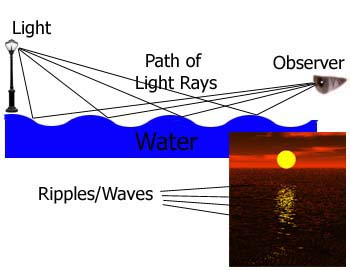 Because
a lake might have thousand of ripples between the viewer and
a distant object on the other side of the lake each ripple as
it moves is capable of picking a tiny bit of the light coming
from the object and reflecting it back to the viewer (see diagram)
making it look like the object is in thousands of different
locations.
Because
a lake might have thousand of ripples between the viewer and
a distant object on the other side of the lake each ripple as
it moves is capable of picking a tiny bit of the light coming
from the object and reflecting it back to the viewer (see diagram)
making it look like the object is in thousands of different
locations.  One
illustration of the strangeness of quantum theory is the dual
nature of light. Is light a particle or a wave? The experiment
that scientists used to find this out is called the double-slit
experiment. A barrier with two narrow slits is placed between
a light source and a screen. If light is a stream of particles
we could expect to see each particle pass through one slit or
the other and create two separate lines of light on the screen
behind it. This isn't what occurs, however. We see a pattern of
light and dark lines all across the screen. This, known as an
interference pattern, is the result of waves of light passing
through the two slits, then interacting as they hit the screen
with the wave crests reinforcing each other to make the light
lines and the wave troughs making the dark lines.
One
illustration of the strangeness of quantum theory is the dual
nature of light. Is light a particle or a wave? The experiment
that scientists used to find this out is called the double-slit
experiment. A barrier with two narrow slits is placed between
a light source and a screen. If light is a stream of particles
we could expect to see each particle pass through one slit or
the other and create two separate lines of light on the screen
behind it. This isn't what occurs, however. We see a pattern of
light and dark lines all across the screen. This, known as an
interference pattern, is the result of waves of light passing
through the two slits, then interacting as they hit the screen
with the wave crests reinforcing each other to make the light
lines and the wave troughs making the dark lines. 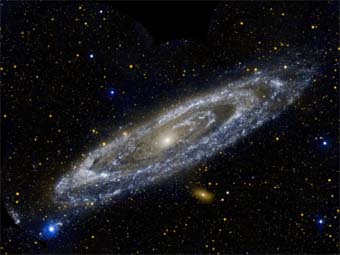 Well,
let's start with an explanation of what a galaxy is for readers
unfamiliar with the concept. A galaxy is a collection of stars
that rotate together and are held together by gravity. A galaxy
may contain trillions of stars (along with their planets) . While
galaxies come in many shapes about 70% in our region seem to form
into what appears to be a flattened disc with whirlpool type arms.
Our sun is a member of the Milky Way galaxy (which is a spiral)
and it located about 1/3 of the way out from the center on one
of the arms.
Well,
let's start with an explanation of what a galaxy is for readers
unfamiliar with the concept. A galaxy is a collection of stars
that rotate together and are held together by gravity. A galaxy
may contain trillions of stars (along with their planets) . While
galaxies come in many shapes about 70% in our region seem to form
into what appears to be a flattened disc with whirlpool type arms.
Our sun is a member of the Milky Way galaxy (which is a spiral)
and it located about 1/3 of the way out from the center on one
of the arms. 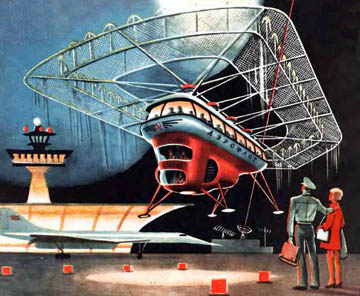
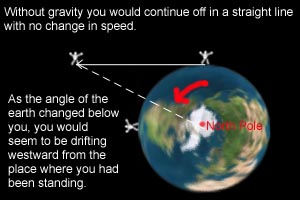 Newton's
first law of motion is "Every object in motion tends to remain
in that state of motion unless an external force is applied to
it." So when you are standing on the Earth you being carried in
a easternly direction at about 1000 miles per hour (if you're
standing near the equator). You don't notice this because everything
around you - the ground, the buildings and the air - are moving
with you. (In much the same way as when you are on an airliner
moving at 400 mph everything around you seems still because it's
all moving at the same speed in the same direction.)
Newton's
first law of motion is "Every object in motion tends to remain
in that state of motion unless an external force is applied to
it." So when you are standing on the Earth you being carried in
a easternly direction at about 1000 miles per hour (if you're
standing near the equator). You don't notice this because everything
around you - the ground, the buildings and the air - are moving
with you. (In much the same way as when you are on an airliner
moving at 400 mph everything around you seems still because it's
all moving at the same speed in the same direction.) 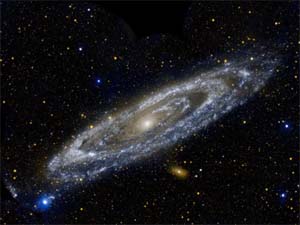

|
Related Links |
|
|