pop up description layer
HOME
Cryptozoology UFO Mysteries Aviation Space & Time Dinosaurs Geology Archaeology Exploration 7 Wonders Surprising Science Troubled History Library Laboratory Attic Theater Store Index/Site Map Cyclorama
Search the Site:
|



|
The Secret of Leonardo Da Vinci
A recent spate of books and articles have suggested that Leonardo Da Vinci was the leader of a clandestine society and that he hid secret codes and messages in his art work. Is this true? In addition to his role in history as a famous painter, scientist and inventor, was he also the keeper of some vast secret to be passed down through the ages? Ciphers and Encryption Leonardo was certainly no stranger to the use codes and encryption. His notes are all written backwards with "mirror" writing. It is unclear exactly why Leonardo did this. It has been suggested that he may have felt that some of his military inventions would be too destructive and powerful if they fell into the wrong hands, therefore he protected his notes by using this reversed writing method. Other scholars point out that this type of encryption was is fairly simple to break. One needs only to hold to hold the paper up to a mirror to read it. If Leonardo was using it for security, he probably was only concerned about hiding the contents from a casual observer. Other researchers have suggested that he used this reversed writing because he found it easier. Leonardo was left-handed and this would have made writing backwards less difficult for him than for a right-handed person. Recently Leonardo has been credited by many people with inventing a device dubbed a cryptex. A cryptex is a tube constructed with a series of rings with letters of the alphabet engraved on them. When the rings are turned so that certain letters line up to the cryptex's password, one of the end caps can be removed and the contents (usually a piece of papyrus wrapped around a glass bottle containing vinegar) can be removed. Should someone try and get at the message by smashing the device, the glass bottle will break and the vinegar will dissolve the papyrus before the message on it can be read. As ingenious as this device is, and as much as it sounds like something Leonardo might have invented, the cryptex is a fictional device created by Dan Brown and credited to Leonardo in his popular book, The Da Vinci Code. There is no evidence that Leonardo actually conceived or built such a device. Mystery of the Mona Lisa
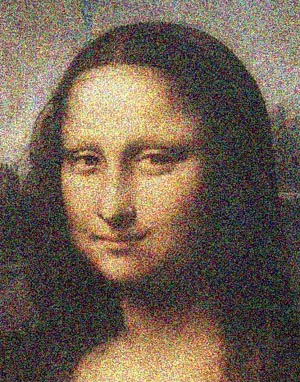
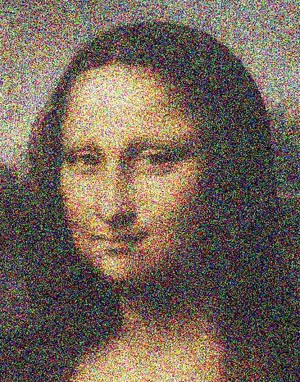
One popular idea is that Leonardo painted secret symbols or messages into his artworks. People have analysed his most famous painting, The Mona Lisa, and have found all kinds of hidden meanings and techniques in it. It is certain that Leonardo used some of his best artist's tricks to create the painting. Many people find the portrait's smile particularly haunting. They say it seems to change, even though the paint on the surface of the painting obviously does not. Professor Margaret Livingstone of Harvard University makes the argument that Leonardo painted the edges of the portrait's smile so they would appear slightly out of focus. Because of this the edges of the smile are more easily seen by a person's peripheral vision rather than by looking directly at them. This may explain why some people report that the portrait seems to be smiling more when they are not directly looking at her. Another theory proposed by Christopher Tyler and Leonid Kontsevich of the Smith-Kettlewell Eye Research Institute in San Francisco says that the smile seems to change because of variable levels of random noise in human visual system. If you close your eyes in a dark room you will notice that everything is not perfectly black. The cells in your eyes generate a low level of "background noise" (which you see as tiny light and dark dots). Your brain usually filters these out, but Tyler and Kontsevich suggest that when viewing the Mona Lisa, these little dots can change the shape of the smile. As evidence for their theory they imposed several random sets of dots over a picture of the Mona Lisa and showed them to people. Some of the sets made the portrait look very happy, others seemed to sadden it. Tyler and Kontsevich argue that the noise which is inherent in the human visual system has the same effect. As someone views the painting, the noise of their own visual system adds to the image and changes it, making the smile seem to change. So what is the Mona Lisa smiling about in the first place? Through the years people have speculated that perhaps she was pregnant. Others have found the smile to be sad and have suggested she was unhappy in her marriage.
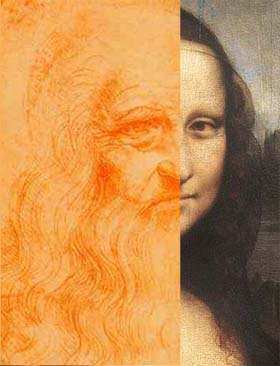
Dr. Lillian Schwartz of Bell Laboratories has come up with what seems an unlikely, but intriguing idea. She thinks that the subject is smiling because the artist has put a joke over on the viewers. She contends the painting is not of a pretty young woman, but is actually a self-portrait of the artist himself. Schwartz noticed that when she used a computer to line up the features of the Mona Lisa with a portrait that Leonardo had done of himself, they matched up perfectly. Other experts note, however, that this may simply be the result of the two pictures being painted by the same artist using the same techniques. The Last Supper Dan Brown in his popular thriller The Da Vinci Code suggests that Leonardo's The Last Supper has a number of hidden meanings and symbols. In the fictional story there is conspiracy by the early church to suppress the importance of Mary Magdalene, one of Jesus' followers (the story suggests - to the distress of many believers - that she was his wife). Supposedly Leonardo was the head of a secret order of men who knew the truth about Magdalene and attempted to preserve it. One of the ways Leonardo did this was to leave clues in his famous work in The Last Supper. The painting depicts the last Passover dinner Jesus shared with his disciples before his death. Leonardo attempts to capture the moment when Jesus announces he will be betrayed and that one of the men at the table will be his betrayer. The most significant clue left by Leonardo, according to Brown, is that the disciple usually identified as John in the picture is actually Mary Magdalene. Indeed, a quick look at the painting seems to confirm this. The person to Jesus' right has long hair and smooth skin with what might be regarded as feminine features compared to the older, rougher-looking apostles around them. Brown also points out, through the characters in his story, that Jesus and the figure to his right together form the outline of the letter "M." Does it stand for Mary or perhaps Matrimony? Are these clues left by Leonardo about his secret knowledge? Despite our first impression that the figure in the picture is feminine, the question is whether the figure would have looked feminine to a viewer of the era in which Leonardo painted it. Probably it would have not. John was considered to be the youngest of the disciples and as such he was often portrayed as being a beardless youth with soft features and long hair. We translate this today as being female, but back in Florence in the fifteen century, which was a different culture with different expectations of what it is to be feminine and masculine, that wouldn't necessarily have been the case. Leonardo was only one of a number of artists, including Ghirlandio and Andrea del Castagno, who pictured St. John in this manner. In his Treatise on Painting, Leonardo explains that characters in a painting should be depicted based on their types. These types might include a "wise man" or an "old woman" each with their own characteristics: beard, wrinkles, short or long hair. John as pictured in The Last Supper is a "student" type: A protégé who has not yet matured. Artists of this day, including Leonardo, would have portrayed this "student type" as a very young man with soft features just as we see in the painting.
As for the outline of the "M" in the picture, this is a result of the way the artist composed the picture. Jesus, at the time he announces his betrayal, sits alone in the center of the painting, his body in the shape of a pyramid and the disciples in groups on either side. Leonardo favored this pyramid design and often used it in his works. The Priory Supposedly Leonardo was the leader of a secret group called the Priory of Sion. According to The Da Vinci Code, it was the Priory's mission to keep the secret of Mary Magdalene and her marriage to Jesus alive. While The Da Vinci Code is fiction, it is based on theories from a controversial "non-fiction" book entitled Holy Blood, Holy Grail written by Michael Baigent, Richard Leigh and Henry Lincoln in the early 1980's. Holy Blood, Holy Grail cites the evidence for Leonardo's membership in the secret Priory of Sion as a number of documents deposited in the Bibliotheque Nationale in Paris. While there is some evidence that an order of monks with this name existed as far back as 1116 A.D., there is little to suggest that the medieval group had anything to do with the Priory of Sion of the 20th century. The documents in the Bibliotheque Nationale supporting the existence of the Priory actually are there, but they appear to be part of a hoax conceived by a man named Pierre Plantard in the 1950's. Plantard and a group of like-minded friends with right wing and anti-Semitic leanings formed the Priory. By fabricating and planting the documents, including fake genealogical tables, Plantard apparently hoped to show that he was a descendant of the Merovingians and an heir to the French throne. The document purporting to show Leonardo, along with such luminaries as Botticellie and Isaac Newton as grand masters of the group, was fake as well. It is unclear whether Plantard also tried to perpetuate the Mary Magdalene story as well. It is known that he claimed the Priory did possess a treasure. Not a set of invaluable documents as suggested in The Da Vinci Code, but a collection of sacred objects inscribed on a copper scroll found with the Dead Sea scrolls in the 1950's. Plantard told interviewers that the Priory would return this treasure to Israel when "the time was right." Experts are divided on wheather the treasure mentioned in the copper scroll ever really existed Even if it did, there is no evidence that any group has control of it today. The fact that Leonardo wasn't the grand master of a clandestine society as pictured in The Da Vinci Code shouldn't lesson our admiration for him, however. While the inclusion of this historical personage in a work of modern fiction is intriguing, we should not allow it to cloud our vision of what Leonardo really did accomplish. His art works have been an inspiration to millions down through the centuries and contain intricacies that experts are still trying to unravel. In addition, his experiments and inventions have shown him to be an advanced thinker whose explorations went far beyond that of his contemporaries. The secret of Leonardo Da Vinci is that he was a genius that few people in his own century appreciated. A Partial Bibliography De-Coding Da Vinci by Amy Welborn, Our Sunday Visitor Inc, 2004. Da Vinci Code Decoded by Martin Lunn, The Disinformation Company Ltd,, 2004. Leonardo's Secret Code Revealed by Lynn Picknett and Clive Prince, USN & WR Special Edition, 2005. The Da Vinci Code by Dan Brown, Doubleday, 2003.
Copyright Lee Krystek 2005. All Rights Reserved. |



|
Related Links |
|
|