pop up description layer
HOME
Cryptozoology UFO Mysteries Aviation Space & Time Dinosaurs Geology Archaeology Exploration 7 Wonders Surprising Science Troubled History Library Laboratory Attic Theater Store Index/Site Map Cyclorama
Search the Site:
|



|
The Mysterious Moons of Mars
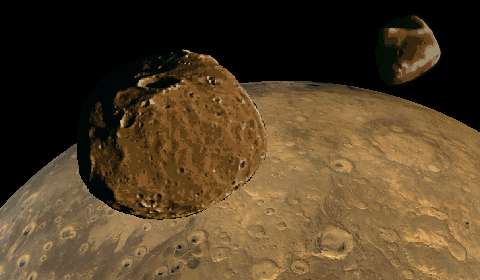
Deimos (left), and Phobos (right), above Mars in this composite picture. (NASA/Lee Krystek) They [the Laputians] have likewise discovered two lesser stars, or satellites, which revolve about Mars, whereof the innermost is distant from the center of the primary planet exactly three of its diameters, and the outermost five; the former revolves in the space of ten hours, and the latter in twenty-one and a half; so that the squares of their periodical times are very near the same proportion with the cubes of their distance from the center of Mars, which evidently shows them to be governed by the same law of gravitation that influences the other heavenly bodies. - Gulliver's Travels - Jonathan Swift - 1726 The fourth planet out from the Sun, Mars, has two moons. The are named Phobos (meaning "fear") and Deimos (meaning "panic"); appropriate companions for Mars, the God of War.
Over a hundred years before the moons' discovery, in 1877, British writer and satirist Jonathan Swift "predicted" their existence in the book we now know as "Gulliver's Travels." There is no way Swift could have known the moons were real yet he described Phobos' orbital period as 10 hours (very close to the real figure of 7.6) and Deimos' as 21.5 (close to the real 30.2). Both seem to be very lucky guesses. How was Swift able to predict the existence of the moons and their attributes so well? Some have seriously suggested he had psychic powers. More likely, though, Swift may have employed the same logic as the French writer Voltaire did a quarter century later when he also predicted two Martian moons. Voltaire knew that the inner planets, Mercury and Venus had no moons and the outer planets, Jupiter and Saturn each had many. Earth had one. It seemed likely to Voltaire that Mars, that next out from Earth, probably had at least two. Even if Swift had employed the same logic to figure the number of moons his estimate on the duration of their orbits was still startlingly accurate. Swift's prediction isn't the only mystery about the Martian moons. In 1862 scientists were looking for them carefully because conditions for finding Martian satellites were extremely favorable. The scientists found nothing. Fifteen years later Asaph Hall, an American astronomer working at the US Naval Observatory in Washington D.C., discovered them at time when conditions for observation weren't nearly as good.
Why did Hall find Phobos and Deimos when better equipped scientists failed to find them earlier? One American scientist, Frank Salisbury, suggested, in the journal Science, the moons were actually artificial satellites and the failure to detect them was due to them only being launched, by the Martians, sometime after 1862. We now know from space probe observations that both Phobos and Deimos are natural objects. Phobos is a chunk of blackish carbonaceous chondrite rock some 17 miles long by 12 miles wide. Its most striking feature is a giant depression, Stickney Crater, which is about a half a mile across. Demios, 10 miles long and 7.5 miles wide, is like Phobos in composition, but with a smoother surface. Both are very similar to the many asteroids found between the orbit of Mars and Jupiter. This leads some scientists to speculate that they actually originated in the asteroid belt and only later were captured by Mars' gravity.
Copyright Lee Krystek 1997-2012. All Rights Reserved. |


|
Related Links |
|
|