pop up description layer
HOME
Cryptozoology UFO Mysteries Aviation Space & Time Dinosaurs Geology Archaeology Exploration 7 Wonders Surprising Science Troubled History Library Laboratory Attic Theater Store Index/Site Map Cyclorama
Search the Site:
|



|
The Speed
of
|

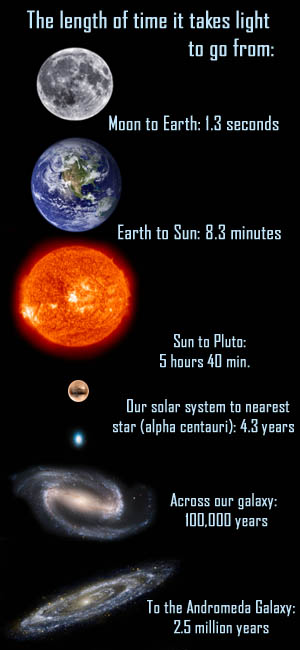 Light travels at a speed of 186,000 miles a second or 700 million
miles an hour. For scale, the distance from the Earth to the Moon
is about 239,000 miles. This seems pretty fast and indeed theory
says that nothing can travel faster than the speed of light.
Light travels at a speed of 186,000 miles a second or 700 million
miles an hour. For scale, the distance from the Earth to the Moon
is about 239,000 miles. This seems pretty fast and indeed theory
says that nothing can travel faster than the speed of light.
|
The delay caused by the speed of light can sometimes be noticed here on Earth during telephone calls. Long distance calls that have been routed over one or more space satellites may cause a half second or so delay between the speaker and the listener.
The speed of light has several properties which may seem counter-intuitive to us, but are true:
-Nothing travels faster than the speed of light.
-No matter how fast you are moving the speed of light seems to be the same speed as if you were not moving at all.
-As an object or person is accelerated toward the speed of light time slows down for it/him.
This last property leads to the "twins" effect: Twin brothers live on Earth. One brother takes a trip to a distant star traveling at a high percentage of the speed of light. When the twin returns he will be younger than his brother because for him time slowed down during the trip.
This effect, called "time dilation," helps explain why the speed of light is the same no matter how fast you are going. As a traveler accelerates time slows down for him. This, in turn, affects his measurements.

Copyright Lee Krystek 1996-2013. All Rights Reserved.
|
Related Links |
|
|